
Catalogue Search | MBRL


Are you sure you want to remove the book from the shelf?

{{itemTitle}}
618
result(s) for
"Jewish coins"
Sort by:

The Coinage of Herod Antipas
The Coinage of Herod Antipas provides a comprehensive, multifaceted and up-to-date re-examination of the coins of Herod Antipas, the tetrarch of Galilee and Peraea between 4/3 BCE and 39/40 CE.
eBook
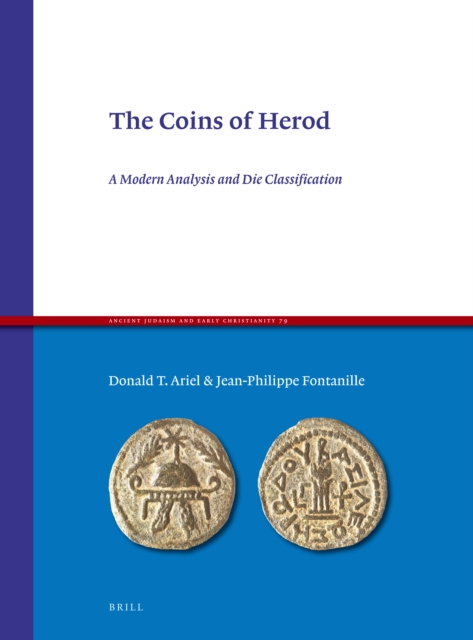
The coins of Herod : a modern analysis and die classification
A comprehensive reappraisal of Herod the Great's coinage is undertaken. Hoard and archaeological evidence, together with iconographic, epigraphic and numismatic observations, contribute to innovative interpretations of the coins, a new relative chronology, and some historical 'pegs' towards an absolute chronology.
eBook

Silver Denarii of Bar Kokhba from Kherbit et-Tayba West of Hebron
This paper deals with nine silver coins recovered from antiquity looters. They are dated to the Bar Kokhba's revolt (ad 132–135) against the Roman rule in Palestine and were struck over Roman silver denarii. The texts that occurred on the coins were written in old Hebrew letters, short and relatively homogenous in content. Obverses indicate the name of the authority of minting, while reverses repeatedly mention the phrase “for the freedom of Jerusalem / of [Isra]el”. Various ornamental elements including household vessels, musical instruments and domesticated plants were also applied on the obverses and reverses of the coins.
Journal Article

LEḤERUT YERUSHALAYIM: THE TEMPLE ON THE COINS OF THE BAR KOKHBA WAR 1
In the third year of his fight against Rome (134/135 CE), Bar Kokhba minted coins with the slogan \"leherut Yerushalayim: For the freedom of Jerusalem\". In this paper, I argue that what was meant by this expression was not the geographic place but a powerful idea: the worship center of the Jewish identity. Jerusalem as a slogan seems to be a metonymy for the temple, and the temple was the link between God and the Jews. By proclaiming the necessity to liberate Jerusalem, Bar Kokhba actually tried to regroup all the Jews under his banner, exploiting the theocratic ideals and the eschatological hopes of the time. However, the documents found in the desert reveal that this propagandist expectancy was not universally shared by his own troops. For the political needs of the leader, \"Jerusalem\" was probably the best slogan possible, but it appears to have meant little in real life, even perhaps in the eyes of Bar Kokhba himself.
Journal Article

A Representation of the Inauguration Ceremony of the Restored Temple? A (Tentative) Reinterpretation of the Bar Kokhba Tetradrachm
The coinage of Bar Kosiba (Bar Kokhba), the leader of the Second Jewish Revolt (132–135/6 CE), has long been acknowledged as a source of data for understanding the ideology and goals of the rebel regime he headed. In particular, the imagery and legends on Bar Kosiba’s tetradrachms have been the subject of many interpretations and controversies. This article proposes that the facade of the temple on the obverse of Bar Kosiba’s tetradrachms and the four species on its reverse side are complementary symbols, joined together to represent the future inauguration ceremony of the restored temple. Furthermore, this imagery on the tetradrachms may have been intended to respond to the coins issued to commemorate the founding of the colony of Aelia Capitolina on the site of Jerusalem.
Journal Article

Palm Trees and Palm Branches in Graeco-Roman Iconography
When Vespasian captured Jerusalem in 70 AD, he put a palm tree on some of his victory coins. Is this palm tree a symbol for victory or rather for the subdued Jews? This controversial question can be clearly answered by making an iconographical distinction between palm trees and palm branches. This article discusses especially numismatic, but also philological, literary, pictorial, and botanical evidence, to defend that only the branches and wreaths of palms were used as symbols for victory, whereas the entire palm tree stood for Phoenicia or Judaea.
Journal Article

The Coinage of the First Jewish Revolt: Context and Meaning
From AD 66-70 the rebel authorities of the First Jewish Revolt minted a series of silver and bronze coins dated to an internal era. These have been intensively studied since the mid-20th century, and have been used to support a range of opinions about the Revolt and its causes. Those who attribute the uprising to messianism and millenarian expectations have identified radical religious symbolism in their iconography and legends. Those who prefer a 'nationalistic' explanation for the war have characterized them as demonstrating an anti-Roman, reactionary ideology. Others, by contrast, have claimed that they were 'relatively restrained' in design and therefore represented elite opposition to the war, or an attempt to project stability. Here, Economou focuses on the design and purpose of the coinage of the First Jewish Revolt.
Journal Article

The Colmar Treasure: A Medieval Jewish Legacy
Ackley reviews The Colmar Treasure: A Medieval Jewish Legacy, an exhibition of Jewish artefacts held at the Met Cloisters in New York City. Discovered in 1863, in the wall of a shop located at the corner of Colmar’s historic rue des Juifs, the Colmar Treasure is a hoard of fine jewellery, precious-metal adornments and more than three hundred coins. These are the valuables of a prosperous Jewish family, most likely hidden for safekeeping sometime before the 1349 pogrom in Colmar.
Journal Article