
Catalogue Search | MBRL


Are you sure you want to remove the book from the shelf?

{{itemTitle}}
402
result(s) for
"Jewish dating"
Sort by:

Jewish Mad Men
It is easy to dismiss advertising as simply the background chatter of modern life, often annoying, sometimes hilarious, and ultimately meaningless. But Kerri P. Steinberg argues that a careful study of the history of advertising can reveal a wealth of insight into a culture. InJewish Mad Men, Steinberg looks specifically at how advertising helped shape the evolution of American Jewish life and culture over the past one hundred years.
Drawing on case studies of famous advertising campaigns-from Levy's Rye Bread (\"You don't have to be Jewish to love Levy's\") to Hebrew National hot dogs (\"We answer to a higher authority\")-Steinberg examines advertisements from the late nineteenth-century in New York, the center of advertising in the United States, to trace changes in Jewish life there and across the entire country. She looks at ads aimed at the immigrant population, at suburbanites in midcentury, and at hipster and post-denominational Jews today.
In addition to discussing campaigns for everything from Manischewitz wine to matzoh,Jewish Mad Menalso portrays the legendary Jewish figures in advertising-like Albert Lasker and Bill Bernbach-and lesser known \"Mad Men\" like Joseph Jacobs, whose pioneering agency created the brilliantly successful Maxwell House Coffee Haggadah. Throughout, Steinberg uses the lens of advertising to illuminate the Jewish trajectory from outsider to insider, and the related arc of immigration, acculturation, upward mobility, and suburbanization.
Anchored in the illustrations, photographs, jingles, and taglines of advertising,Jewish Mad Menfeatures a dozen color advertisements and many black-and-white images. Lively and insightful, this book offers a unique look at both advertising and Jewish life in the United States.
eBook
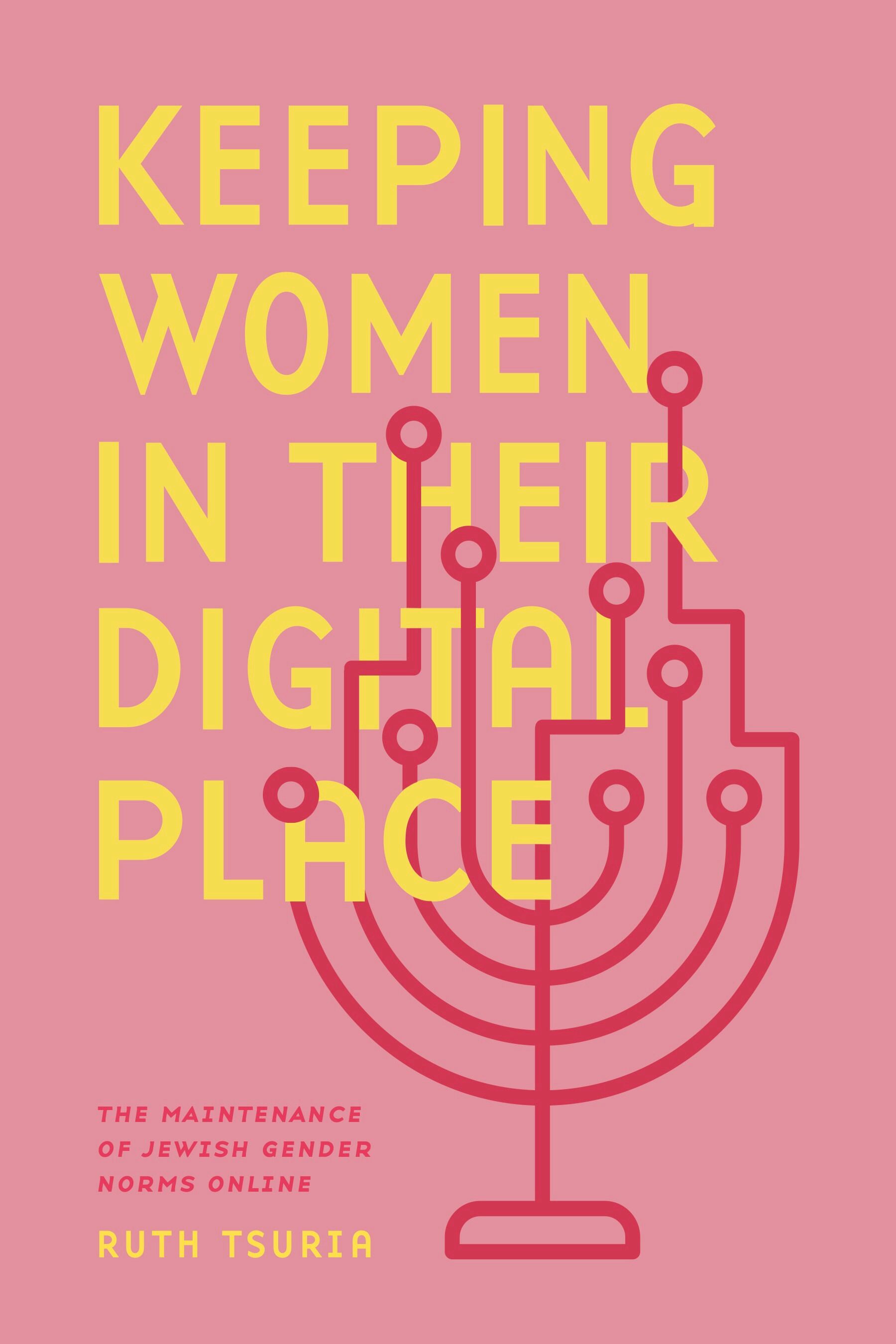
Keeping Women in Their Digital Place
Since its inception, the internet has been theorized as a democratic force, a public sphere in which hierarchies are flattened. But the internet is not a neutral tool; it has the power to amplify and mirror certain opinions and, as a result, can concretize social norms. So what happens when matters of religious practice and gender identity collide in these—often unregulated—online spaces?In Keeping Women in Their Digital Place, Ruth Tsuria explores how Orthodox Jewish communities in the United States and Israel have used “digital enclaves”—online safe havens created specifically for their denominations—to renegotiate traditional values in the face of taboo discourse encountered online. Combining a personal narrative with years of qualitative analysis, Tsuria examines how discussions in blogs and forums and on social media navigate issues of modesty, dating, marriage, intimacy, motherhood, and feminism. Unpacking the complexity of religious uses of the internet, Tsuria shows how the participatory qualities of digital spaces have been used both to challenge accepted norms and—more pervasively—to reinforce traditional and even extreme attitudes toward gender and sexuality.Original and engaging, this book will appeal to media, feminist, and religious studies scholars and students, particularly those interested in religion in the digital age and Orthodox Jewish communities.
eBook

The time and place of European admixture in Ashkenazi Jewish history
The Ashkenazi Jewish (AJ) population is important in genetics due to its high rate of Mendelian disorders. AJ appeared in Europe in the 10th century, and their ancestry is thought to comprise European (EU) and Middle-Eastern (ME) components. However, both the time and place of admixture are subject to debate. Here, we attempt to characterize the AJ admixture history using a careful application of new and existing methods on a large AJ sample. Our main approach was based on local ancestry inference, in which we first classified each AJ genomic segment as EU or ME, and then compared allele frequencies along the EU segments to those of different EU populations. The contribution of each EU source was also estimated using GLOBETROTTER and haplotype sharing. The time of admixture was inferred based on multiple statistics, including ME segment lengths, the total EU ancestry per chromosome, and the correlation of ancestries along the chromosome. The major source of EU ancestry in AJ was found to be Southern Europe (≈60-80% of EU ancestry), with the rest being likely Eastern European. The inferred admixture time was ≈30 generations ago, but multiple lines of evidence suggest that it represents an average over two or more events, pre- and post-dating the founder event experienced by AJ in late medieval times. The time of the pre-bottleneck admixture event, which was likely Southern European, was estimated to ≈25-50 generations ago.
Journal Article

“Looking for a Nice Jewish Girl…”: Personal Ads and the Creation of Jewish Families in Germany before and after the Holocaust
German political policies and social pressures before, during, and immediately after the National Socialist period had considerable impact on the process of Jewish family formation. Personal ads placed in several leading newspapers based in Berlin reveal changing attitudes and parameters for the creation of partnerships and marriages during these decades, illustrating the complicated Jewish experience of emigration, survival, and self-identification during and after the Holocaust. The rise of the Nazis intensely altered the parameters of the search for a partner, changing expressions of self-description and highlighting very different life goals, just as the effects of the Nazi period would echo in postwar ads.
Journal Article

Muslim-Jewish Sexual Liaisons Remembered and Imagined in 20th-Century Yemen
Despite mutual taboos against exogamy, memoirs and similar materials written by Jews from Yemen contain a number of anecdotes describing love affairs and sexual encounters between Muslims and Jews prior to the mass migration of the vast majority of Yemen's Jews to Israel in 1949–50. These stories associate these liaisons with vulnerability, poverty, and marginalization. In them, sex and conversion to Islam are intrinsically connected, yet this interreligious intimacy leads not to resolution but to ongoing identity crises that persist beyond the community's realignment with a majority-Jewish society. The staging of the anecdotes in rural areas where shariʿa norms held only nominal sway, in watering places and hostels where strangers might interact, and at dusk, when identity is difficult to discern, heightened their ambiguity.
Journal Article

C dates from Tel Rehov: Iron-Age chronology, pharaohs, and Hebrew kings
Stratified radiocarbon dates provide an independent chronological link between archaeological layers and historical data. The invasion by Pharaoh Shoshenq I (Shishak) is a key historical synchronism, ~925 B.C.E., mentioned in both Egyptian inscriptions and the Hebrew Bible. The list of places raided by Shoshenq, mentioned at Karnak (Egypt), includes Rehov (Israel). The site yielded a consistent series of radiocarbon dates from the 12th to 9th century B.C.E. Our results (i) suggest a revised Iron-Age chronology; (ii) date an archaeological stratum to Shoshenq's campaign; (iii) indicate the similarity of \"Solomonic\" and \"Omride\" pottery; and (iv) provide correlation with Greece and Cyprus.
Journal Article

Position Paper on Non-Jewish Partner Policy
This paper was written in 2013 as the faculty of the Reconstructionist Rabbinical College (RRC) was considering a policy barring prospective rabbinical students from being partnered with non-Jews. Composed by Rabbi Deborah Waxman, Ph.D., prior to her assuming the presidency of Reconstructing Judaism, it recommends that RRC set aside this policy and replace it with a clearly articulated preference that rabbinical students create for themselves homes with rich Jewish practice, and a requirement that children in the home be raised exclusively in the Jewish tradition. The recommendation emerges from a review of classical Reconstructionist positions as articulated by Mordecai M. Kaplan, the 1968 and 1979 Reconstructionist stands on patrilineal descent, the nature of religious authority, the impact of second-wave feminism on American Jewish life, and consideration of universalism versus particularism. The ultimate conclusion is that RRC's mission is to attract Jews to Jewish living and not to police boundaries and that adopting a more inclusive partner status policy is an affirmation of key Reconstructionist principles, including fostering diverse expressions of Jewish identity and inclusive Jewish communities, and an authentic step in an evolving understanding of the Jewish civilization.
Journal Article

The Jubilee Calendar
Abstract
I propose that the jubilee legislation intended to provide an alternative calendar system to replace the prevailing one, based on the year of the reigning monarch. In that alternative calendar, the Day of Atonement on which the jubilee was declared was to serve as the substitute for the date of the king's accession to the throne. This proposal provides a new interpretation of Lev 25:20-22 and resolves multiple difficulties on the alignment of the sabbatical and jubilee year-counts. It implies that the jubilee cycle was intended to be forty-nine years long, with coincidence of the jubilee fallow and that of the seventh sabbatical year.
Journal Article

Jewish Dating or Niche-making?
In this article I am approaching the topic of Jewish dating among the young Russian-speaking Jews who live in Berlin. Using the analytical concept of space and applying grounded theory, I am presenting data I collected in 2010 using the methods of ethnographic interviews and participant observation. The article is organised around three main questions. Firstly, I am interested in the motivation of my interviewees, who are generally children of inter-ethnic and inter-religious couples, to find a solely Jewish partner. Secondly, I am asking for existing strategies applied within a relatively small Jewish community of around thirty to fifty thousand in Berlin in order to find a Jewish partner. Thirdly, I am looking for the concrete spaces and places used or constructed for the purpose of finding a Jewish girlfriend or boyfriend. Beside these empirical results, I am introducing the theoretical idea of Jewish niches, which is discussed against the background of 'Jewish space' as promulgated by Diana Pinto.
Journal Article

Cruising Eisenman’s Holocaust Memorial
Profile pictures from gay dating sites of young men posing with the stelae of the Memorial to the Murdered Jews in Europe in Berlin have been subject to an art exhibition at the Jewish Museum in New York and a tribute online blog. This paper unveils the meaning of these pictures on this particular site, in an effort to understand why these men chose to portray themselves at the Holocaust Memorial in order to cruise the digital sphere of gay dating websites. In three consecutive sections, the paper asserts that, on the one hand, the conversion of the Holocaust Memorial into a cruising scenario is facilitated by a design that —putting forward autonomy and abstraction— allows and even invites its constant resignification in terms of everyday practices. And, on the other hand, it posits that the images exhibited at the Jewish Museum can be interpreted as a performative memorial which reinscribes sexuality and gender into Holocaust narratives.
Journal Article