
Catalogue Search | MBRL


Are you sure you want to remove the book from the shelf?

{{itemTitle}}
843
result(s) for
"Jewish diaspora in literature."
Sort by:


Beyond the Land
This dynamic understanding of both an Israeli and a Jewish diaspora works to envision a non-hegemonic Jewish nationalism that can negotiate both political imagination and reality.
eBook

Israeli Salvage Poetics
Through thoughtful analysis of twentieth- and twenty-first-century Israeli literature, Israeli Salvage Poetics interrogates the concept of the negation of the diaspora as addressed in Hebrew-language literature authored by well-known and lesser-known Israeli authors from the eve of the Holocaust to the present day. Author Sheila E. Jelen considers the way that Israeli writers from eastern Europe or of eastern European descent incorporate pre-Holocaust eastern European culture into their own sense of Israeliness or Jewishness. Many Israelis interested in their eastern European legacy live with an awareness of their own nation's role in the repression of that legacy, from the elevation of Hebrew over Yiddish to the ridicule and resentment directed at culture, text, and folk traditions from eastern Europe. To right the wrongs of the past and reconcile this conflict of identity, the Israeli authors discussed in this book engage in what Jelen calls salvage poetics: they read Yiddish literature, travel to eastern Europe, and write of their personal and generational relationships with Ashkenazi culture. Israeli literary representations of eastern European Jewry strive, sometimes successfully, to recuperate eastern European Jewish pre-Holocaust culture for the edification of an audience that might feel responsible for the silencing and extinction of that culture.
eBook
Longing for Home: Nostalgia and Anti-nostalgia in Inter-war Polish-Jewish Literature
This article discusses the significance and enduring presence of nostalgic narrations in works by Polish-Jewish authors that are often accompanied by motifs of anti-nostalgia. They derive from complex relations with spaces categorized as familiar and alien, close and remote, as well as complex, ambivalent experiences of bonds, distance, and loss. The intersection of nostalgia and anti-nostalgia brings together and intertwines Polish and Jewish traditions and discourses of nostalgia. The sources of the article are writings by the outstanding inter-war Polish-Jewish writers Roman Brandstaetter, Anda Eker, Stefan Pomer, and Maurycy Szymel.
Journal Article

Exile and the Jews
This first comprehensive anthology examining Jewish responses to
exile from the biblical period to our modern day gathers texts from
all genres of Jewish literary creativity to explore how the
realities and interpretations of exile have shaped Judaism, Jewish
politics, and individual Jewish identity for millennia. Ordered
along multiple arcs-from universal to particular, collective to
individual, and mythic-symbolic to prosaic everyday living-the
chapters present different facets of exile: as human condition, in
history and life, in holiday rituals, in language, as penance and
atonement, as internalized experience, in relation to the Divine
Presence, and more. By illuminating the multidimensional nature of
\"exile\"-political, philosophical, religious, psychological, and
mythological-widely divergent evaluations of Jewish life in the
Diaspora emerge. The word \"exile\" and its Hebrew equivalent,
galut , evoke darkness, bleakness-and yet the condition
offers spiritual renewal and engenders great expressions of Jewish
cultural creativity: the Babylonian Talmud, medieval Jewish
philosophy, golden age poetry, and modern Jewish literature.
Exile and the Jews will engage students, academics, and
general readers in contemplating immigration, displacement,
evolving identity, and more.
eBook

Diaspora, Law and Literature
The well-known challenges of international migration have triggered new departures in academic approaches, with 'diaspora studies' evolving as an interdisciplinary and even transdisciplinary field of study. Its emerging methodology shares concerns with another interdisciplinary field, the study of the relations between law and literature, which focuses on the ways in which the two cultural practices of law and literature mutually negotiate each other and on the question after the ontological commensurability of the domains. This volume offers, for the first time, an attempt to provide an interface between these overlapping interdisciplinary endeavours of literary studies, legal studies, and diaspora studies. In doing so, it explores new approaches and invites new perspectives on diasporas, migration and the disciplines that study them, hopefull also adding to the cultural resources of coping with a swiftly changing social landscape in a globalizing world.
eBook

Words from Abroad
When Paul Celan was charged with plagiarism in 1960, the ensuing public debate in West Germany threw the poet into a major personal crisis even though most German critics immediately came to his defense. This crisis coincided with a transformative moment in the history of Holocaust remembrance, its first generational reimagining in the wake of a number of highly publicized criminal trials. Words from Abroad takes its lead from this disjunction between public ritual and private crisis to chart the emergence of a new literary diaspora, examining German Jewish writers who were dislocated in the course of World War II and began rewriting their own displacement more than a decade after the war. The idea of diaspora had ceased to be a constructive element of Jewish culture in Germany during the nineteenth-century process of emancipation and assimilation, though this book argues that it becomes crucial in articulating the possibility of German Jewish identity after the Holocaust.
Along with the works of Paul Celan, Words from Abroad examines selected German Jewish writers such as Peter Weiss and Nelly Sachs. The study of these authors is framed by theoretical reflections on the play of distance and proximity in German Jewish intellectuals after the Holocaust, including Theodor W. Adorno, Jean Améry, and Günther Anders. Drawing on postcolonial theory, diaspora studies, trauma theory, and psychoanalytical theory, author Katja Garloff offers an original and nuanced reading of the way in which these writers, in the wake of the Holocaust, experienced and variously created a vision of dispersion as both traumatic and productive. Words from Abroad is an important tool in investigating the works of these German Jewish writers and thinkers, but it is also a contribution to the interdisciplinary scholarship on trauma and displacement itself.
eBook

NOSTALGIA AS A LITERARY DEVICE
This article sheds light on an important and previously unexplored aspect of the oeuvre of the prolific Hebrew-American poet Gabriel Preil (1911–1993). The essay argues that Preil elaborated a lyrical theory of nostalgia in his poetry, which was unique for Hebrew literature both in its scope and its poetic depth. Building on an interdisciplinary corpus of nostalgia research developed by such scholars as Linda Hutcheon, Svetlana Boym, and Nicholas Dames, I trace the poetichistorical development of Preil’s nostalgic thinking over almost five decades of his writing in Hebrew.
In the first part of the article, I focus on Preil’s early poetry to demonstrate that he found in nostalgic discourse a partial poetic solution for reflecting on the post-war historical condition. In the second part of the article, I draw on recent theories of diaspora developed by scholars such as Daniel and Jonathan Boyarin, as well as Lily Cho, to argue that, starting in the 1970s, Preil attributed a radically new function to nostalgic discourse—namely, it became a literary device through which he constructed and represented his diasporic literary subjectivity.
Journal Article
Looking Forward, Looking Back
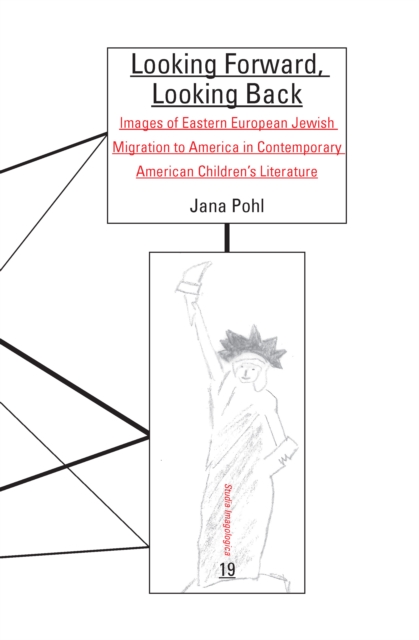
How is the life-altering event of migration narrated for children, especially if it was caused by Anti-Semitism and poverty? What of the country of origin is remembered and what is forgotten, and what of the target country when the migration is imagined there a century later? Looking Forward, Looking Back examines today's representation of Jewish mass migration from Eastern Europe to America around the turn of the last century. It explores the collective story that emerges when American authors look back at this exodus from an Eastern European home to a new one to be established in America. Focusing on children's literature, it investigates a wide range of texts including young adult literature as well as picture books and hence sheds light on the dynamics of the verbal and the visual in generating images of the self and other, the familiar and the strange. This book is of interest to scholars in the field of imagology, children's literature, cultural studies, American studies, Slavic studies, and Jewish studies.
eBook

Made of shores
This book offers to rethink identities within contemporary Judeo-Argentinean fiction by dealing with the transforming notion of Jewishness and of national identity in Argentina. It focuses on the dialogue (and confrontation) between the narrative text and the imaginary national space it questions. By reviewing the new material conditions within Argentina and its diasporic communities, this book imposes a new reflection on what Judeo-Argentinean fiction is all about. It reflects on the shifting notion of identity, abandoning traditional definitions, in order to rather analyze how feelings of alienation and nostalgia echo an era of transculturation and floating borders. The novels that this book studies return to the past from a certain distance created by time and space. This distance leads the reader to question the relevance of geographical, cultural, and linguistic differences within identity formation. Since its beginning, the research of Jewish Latin America has focused on the quest of Jewish immigrants for a consolidated identity, social, and cultural integration in their receiving societies, and recognition within the \"official\" and canonical national history. Traditional scholarship has paid special attention to the construction of collective memory and the dilemma of \"double identity.\" Nonetheless, the transforming notion of otherness in the last few decades, associated traditionally with the Jewish character, requires a new approach when discussing contemporary affiliations of Jews in Argentina and their narrative representations. New waves of emigration from Argentina at the beginning of the new millennium, economic and social disintegration, general disillusion with the state apparatus, and the gaps left in the collective memory following the years of the military dictatorship redefine personal and collective identities and demand a careful reexamination of the concept of argentinidad and its cultural significances.
eBook