
Catalogue Search | MBRL


Are you sure you want to remove the book from the shelf?

{{itemTitle}}
96,218
result(s) for
"Jewish ethics."
Sort by:

To heal a fractured world : the ethics of responsibility
The Chief Rabbi propounds his views on the ethics of responsibility - believing that in this area the Jewish religion has much to contribute to the modern world, a world in urgent need of peace and reconciliation.
BOOK

End of Days Ethics, Tradition, and Power in Israel
End of Days is both a meditation on Jewish morality in the age of Israeli Jewish power, and a
cri du coeur by an Orthodox Israeli Jew, a former combat officer in the IDF, for Israelis to look into the Jewish religious ethical tradition for an alternative to the secular and religious Zionism that sanctifies power, statehood, and sovereignty. Appealing to a wealth of Jewish sources from the Bible to the present, including medieval Jewish ethical literature, rabbinic sources, Jewish law, and contemporary Israeli thought, the book presents an argument against Israel’s occupation of the Palestinians and the suppression of their rights from the perspective of a modern Israeli religious Jew.
eBook

Friendship in Jewish history, religion, and culture
\"A collection of essays exploring the subject of friendship in Jewish culture, history, and religion from ancient Israel to the twenty-first century\"-- Provided by publisher.
BOOK

Ethics at the Center
Ethics at the Center culls the best of Rabbi Elliot N.
Dorff's pioneering thinking in Jewish ethics over nearly five
decades. Dorff shows that our response to moral issues depends
ultimately on our conceptions of the nature of human beings and
God; how Jewish law, theology, prayer, history, and community
should also define and motivate Jewish responses to moral issues;
and how the honorable and divergent stances of Western philosophy
and other religions about moral living shed light on Judaism's
distinctive standpoints. From there Dorff applies Judaism's ethics
to real life: abortion post- Roe v. Wade , sexual
orientation and human dignity, avoiding harm in communication,
playing violent or defamatory video games, modern war ethics,
handling donations of ill-gotten gain after the fact. In conclusion
he explores how Jewish family and community, holidays and rituals,
theology, study, and law have moral import as well. Dorff's
personal introduction to each chapter reflects on why and when he
wrote its contents, its continuing relevance, and if-and if so,
how-he would now change what he wrote earlier. Readers will
experience not only his evolving ethical thought but many facets of
the person and the Jew that Dorff is today.
eBook


A Sufi-Jewish Dialogue
Written in Judeo-Arabic in eleventh-century Muslim Spain but quickly translated into Hebrew, Bahya Ibn Paquda'sDuties of the Heartis a profound guidebook of Jewish spirituality that has enjoyed tremendous popularity and influence to the present day. Readers who know the book primarily in its Hebrew version have likely lost sight of the work's original Arabic context and its immersion in Islamic mystical literature. InA Sufi-Jewish Dialogue, Diana Lobel explores the full extent to whichDuties of the Heartmarks the flowering of the \"Jewish-Arab symbiosis,\" the interpenetration of Islamic and Jewish civilizations. Lobel reveals Bahya as a maverick who integrates abstract negative theology, devotion to the inner life, and an intimate relationship with a personal God. Bahya emerges from her analysis as a figure so steeped in Islamic traditions that an Arabic reader could easily think he was a Muslim, yet the traditional Jewish seeker has always looked to him as a fountainhead of Jewish devotion. Indeed, Bahya represents a genuine bridge between religious cultures. He brings together, as well, a rationalist, philosophical approach and a strain of Sufi mysticism, paving the way for the integration of philosophy and spirituality in the thought of Moses Maimonides.A Sufi-Jewish Dialogueis the first scholarly book in English about a tremendously influential work of medieval Jewish thought and will be of interest to readers working in comparative literature, philosophy, and religious studies, particularly as reflected in the interplay of the civilizations of the Middle East. Readers will discover an extraordinary time when Jewish, Christian, and Islamic thinkers participated in a common spiritual quest, across traditions and cultural boundaries.
eBook

Justice for All
Justice for Alldemonstrates that the Jewish Bible, by radically changing the course of ethical thought, came to exercise enormous influence on Jewish thought and law and also laid the basis for Christian ethics and the broader development of modern Western civilization.Jeremiah Unterman shows us persuasively that the ethics of the Jewish Bible represent a significant moral advance over Ancient Near East cultures. Moreover, he elucidates how the Bible's unique conception of ethical monotheism, innovative understanding of covenantal law, and revolutionary messages from the prophets form the foundation of many Western civilization ideals.Justice for Allconnects these timeless biblical texts to the persistent themes of our times: immigration policy, forgiveness and reconciliation, care for the less privileged, and attaining hope for the future despite destruction and exile in this world.
eBook

The Genesis of Employment Ethics
Given the growing interest in religion and spirituality in the community and workplace, we consider what light one of the oldest sources of human ethics, the Torah, can throw on the vexing issues of contemporary employment ethics and social sustainability. We specifically consider the Torah because it is the primary document of Judaism, the source of all the basic Biblical commandments, and a framework of ethics. A distinctive feature of Jewish ethics is its interpretive approach to moral philosophy: that is, immersion and sense making in a dense, lived-in, complicated moral world, which is particularly useful with regard to ethical analyses of the workplace. Rather than discover or create a new ethic for the employer-employee relationship, we seek to harness general principles and norms from the Torah to contemporary business conditions. In the spirit of sustainability, rather than plunder the new, we recreate from existing resources. Interpretations from the Torah provide a rich source of moral and practical guidance for contemporary business ethics while also responding to academic and popular interest in spirituality and business. These tenets, however, have not to date been specifically directed at current predicaments in employment. We redress this by deriving principles from the Torah and applying them to ethical issues in contemporary employment practices. Practical guidance for both research in and practice of employment ethics is also provided.
Journal Article
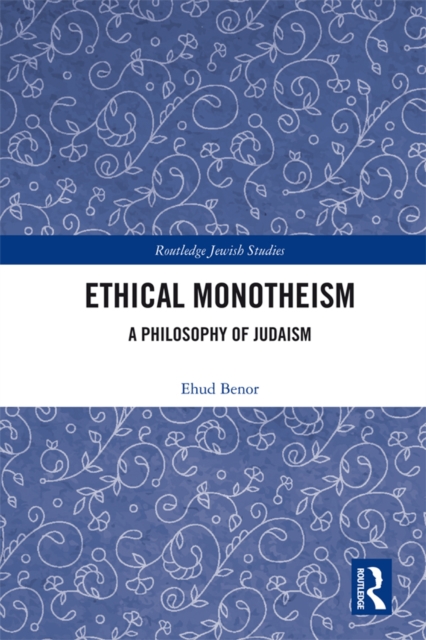
Ethical Monotheism
iThe term Ethical Monotheism is an important marker in Judaism’s tumultuous transition into the modern era. The term emerged in the context of culture-wars concerning the question of whether or not Jews could or should become emancipated citizens of modern European states. It appeared in arguments about whether or not Judaism could be considered a Religion of Reason – a symbolic, motivational representation of a universal morality – and in debates about whether or not Judaism could or should reform itself into a Religion of Reason.
This book is both a decisive departure from such discussions and an attempt to add a further, post-modern statement to their ongoing development. As a departure, it refuses to take for granted a philosophical conception of Religion of Reason as the standard for Ethical Monotheism according to which Judaism was to be evaluated or reformed. As a continuation, the book undertakes a phenomenology of Jewish modes of ethical religiosity that allows it to inquire into what kind of ethical monotheism Judaism might be. Through sophisticated analysis of select “snapshots,” or “fragments of a hologram,” guided by a robust theory of religion, the author discloses Judaic ethical monotheism as an ongoing wrestling with the meaning of justice. By closely examining five main “snapshots” of this long process – the Bible, Rabbinic Judaism, Maimonides, The Zohar, and the modern philosophers Buber and Levinas – the author offers his own constructive philosophy of Judaism and his own distinctive philosophy of religion.
Ethical Monotheism offers a new way to think about Judaism as a religion and as a coherent philosophical debate and demonstrates the need to integrate philosophy, history, cognitive psychology, anthropology, theology, and history of science in the study of “religion.”ii
iii
eBook

I Raise My Voice to Call Out: The Coded Message of Rivkah Bat Meir Tiktiner
This article offers an analysis of the Hebrew preface to Meneket Rivkah , the earliest known book of Jewish teachings to have been written and published by a woman, Rivkah bat Meir Tiktiner (d. 1605), under her own name. Following the scholarship on Hebrew poetic writing ( melitzah ) as code, it traces the roots of this text in biblical and rabbinic literature. The book itself, written in Yiddish, addresses women and focuses on instruction regarding women’s relationships within the home sphere. Earlier scholarship has highlighted the conservative stance of these teachings regarding women’s roles, as well as the ways in which the author softened these positions. Careful multi-layered reading of her preface shows that the author used this complex form of rabbinic writing to address topics that might have been perceived as more controversial by her Yiddish-reading audience, or if stated explicitly. In the preface, the author responds to the challenges facing a woman entering the field of Torah study and teaching, perceived at the time as male territory. She thus provides a glimpse into her personal experience that the Yiddish teachings do not allow.
Journal Article