
Catalogue Search | MBRL


Are you sure you want to remove the book from the shelf?

{{itemTitle}}
37,945
result(s) for
"Jewish law"
Sort by:

Laws of the Spirit
The compelling vision of religious life and practice found in Hasidic sources has made it the most enduring and successful Jewish movement of spiritual renewal of all time. In this book, Ariel Evan Mayse grapples with one of Hasidism's most vexing questions: how did a religious movement known for its radical views about immanence, revelation, and the imperative to serve God with joy simultaneously produce strict adherence to the structures and obligations of Jewish law? Exploring the movement from its emergence in the mid-1700s until 1815, Mayse argues that the exceptionality of Hasidism lies not in whether its leaders broke or upheld rabbinic norms, but in the movement's vivid attempt to rethink the purpose of Jewish ritual and practice. Rather than focusing on the commandments as law, he turns to the methods and vocabulary of ritual studies as a more productive way to reckon with the contradictions and tensions of this religious movement as well as its remarkable intellectual vitality. Mayse examines the full range of Hasidic texts from the eighteenth and early nineteenth centuries, from homilies and theological treatises to hagiography, letters, and legal writings, reading them together with contemporary theories of ritual. Arguing against the notion that spiritual integrity requires unshackling oneself from tradition, Laws of the Spirit is a sweeping attempt to rethink the meaning and significance of religious practice in early Hasidism.
eBook


\DOING RELIGION\ IN A SECULAR WORLD: Women in Conservative Religions and the Question of Agency
Sociological studies of women's experiences with conservative religions are typically framed by a paradox that ponders women's complicity. The prevailing view associates agency with strategic subjects who use religion to further extra-religious ends and pays little attention to the cultural and institutional contexts that shape \"compliance.\" This paper suggests an alternative framing. Rather than asking why women comply, I examine agency as religious conduct and religiosity as a constructed status. Drawing on a study that examined how orthodox Jewish Israeli women observe, negotiate, and make sense of regulations of martial sexuality, this paper explains religious women's agency as religious conduct, or the \"doing\" of religion. I demonstrate that doing religion is associated with a search for authentic religious subjecthood and that religiosity is shaped in accordance with the logics of one's religion, and in the context of controlling messages about threatened symbolic boundaries and cultural Others.
Journal Article


Becoming the People of the Talmud
InBecoming the People of the Talmud, Talya Fishman examines ways in which circumstances of transmission have shaped the cultural meaning of Jewish traditions. Although the Talmud's preeminence in Jewish study and its determining role in Jewish practice are generally taken for granted, Fishman contends that these roles were not solidified until the late eleventh and early twelfth centuries. The inscription of Talmud-which Sefardi Jews understand to have occurred quite early, and Ashkenazi Jews only later-precipitated these developments. The encounter with Oral Torah as a written corpus was transformative for both subcultures, and it shaped the roles that Talmud came to play in Jewish life.
What were the historical circumstances that led to the inscription of Oral Torah in medieval Europe? How did this body of ancient rabbinic traditions, replete with legal controversies and nonlegal material, come to be construed as a reference work and prescriptive guide to Jewish life? Connecting insights from geonica, medieval Jewish and Christian history, and orality-textuality studies,Becoming the People of the Talmudreconstructs the process of cultural transformation that occurred once medieval Jews encountered the Babylonian Talmud as a written text. According to Fishman, the ascription of greater authority to written text was accompanied by changes in reading habits, compositional predilections, classroom practices, approaches to adjudication, assessments of the past, and social hierarchies. She contends that certain medieval Jews were aware of these changes: some noted that books had replaced teachers; others protested the elevation of Talmud-centered erudition and casuistic virtuosity into standards of religious excellence, at the expense of spiritual refinement. The book concludes with a consideration of Rhineland Pietism's emergence in this context and suggests that two contemporaneous phenomena-the prominence of custom in medieval Ashkenazi culture and the novel Christian attack on Talmud-were indirectly linked to the new eminence of this written text in Jewish life.
eBook


Halakhah in the Making
Halakhah in the Making offers the first comprehensive study of the legal material found in the Dead Sea Scrolls and its significance in the greater history of Jewish religious law (halakhah). Aharon Shemesh's pioneering study revives an issue long dormant in religious scholarship: namely, the relationship between rabbinic law, as written more than one hundred years after the destruction of the Second Temple, and Jewish practice during the Second Temple. The monumental discovery of the Dead Sea Scrolls in Qumran led to the revelation of this missing material and the closing of a two-hundred-year gap in knowledge, allowing work to begin comparing specific laws of the Qumran sect with rabbinic laws. With the publication of scroll 4QMMT-a polemical letter by Dead Sea sectarians concerning points of Jewish law-an effective comparison was finally possible. This is the first book-length treatment of the material to appear since the publication of 4QMMT and the first attempt to apply its discoveries to the work of nineteenth-century scholars. It is also the first work on this important topic written in plain language and accessible to nonspecialists in the history of Jewish law.
eBook
Sex Rewarded, Sex Punished
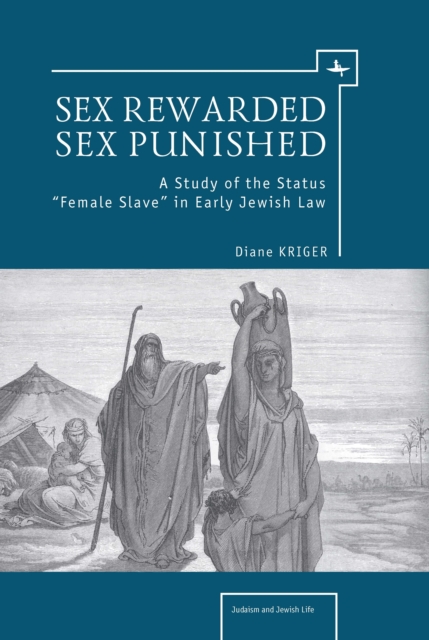
A masterful intersection of Bible Studies, Gender Studies, and Rabbinic law, Diane Kriger explores the laws pertaining to female slaves in Jewish law. Comparing Biblical strictures with later Rabbinic interpretations as well as contemporary Greco-Roman and Babylonian codes of law, Kriger establishes a framework whereby a woman’s sexual identity also indicates her legal status. With sensitivity to the nuances in both ancient laws and ancient languages, Kriger adds greatly to our understanding of gender, slave status, and the matrilineal principle of descent in the Ancient Near East.
eBook

Narrating the Law
InNarrating the LawBarry Scott Wimpfheimer creates a new theoretical framework for considering the relationship between law and narrative and models a new method for studying talmudic law in particular. Works of law, including the Talmud, are animated by a desire to create clear usable precedent. This animating impulse toward clarity is generally absent in narratives, the form of which is better able to capture the subtleties of lived life. Wimpfheimer proposes to make these different forms compatible by constructing a narrative-based law that considers law as one of several \"languages,\" along with politics, ethics, psychology, and others that together compose culture. A narrative-based law is capable of recognizing the limitations of theoretical statutes and the degree to which other cultural languages interact with legal discourse, complicating any attempts to actualize a hypothetical set of rules. This way of considering law strongly resists the divide in traditional Jewish learning between legal literature (Halakhah) and nonlegal literature (Aggadah) by suggesting the possibility of a discourse broad enough to capture both.Narrating the Lawactivates this mode of reading by looking at the Talmud's legal stories, a set of texts that sits uncomfortably on the divide between Halakhah and Aggadah. After noticing that such stories invite an expansive definition of law that includes other cultural voices,Narrating the Lawalso mines the stories for the rich descriptions of rabbinic culture that they encapsulate.
eBook