
Catalogue Search | MBRL


Are you sure you want to remove the book from the shelf?

{{itemTitle}}
78
result(s) for
"Jewish magic-History"
Sort by:

Jewish Magic Before the Rise of Kabbalah
A comprehensive study of Jewish magic in the late antiquity and the early Islamic period—the phenomenon, the sources, and method for its research, and the history of scholarly investigation into its nature and origin.
\"Magic culture is certainly fascinating. But what is it? What, in fact, are magic writings, magic artifacts?\" Originally published in Hebrew in 2010, Jewish Magic Before the Rise of Kabbalah is a comprehensive study of early Jewish magic focusing on three major topics: Jewish magic inventiveness, the conflict with the culture it reflects, and the scientific study of both.
The first part of the book analyzes the essence of magic in general and Jewish magic in particular. The book begins with theories addressing the relationship of magic and religion in fields like comparative study of religion, sociology of religion, history, and cultural anthropology, and considers the implications of the paradigm shift in the interdisciplinary understanding of magic for the study of Jewish magic. The second part of the book focuses on Jewish magic culture in late antiquity and in the early Islamic period. This section highlights the artifacts left behind by the magic practitioners—amulets, bowls, precious stones, and human skulls—as well as manuals that include hundreds of recipes. Jewish Magic before the Rise of Kabbalah also reports on the culture that is reflected in the magic evidence from the perspective of external non-magic contemporary Jewish sources.
Issues of magic and religion, magical mysticism, and magic and social power are dealt with in length in this thorough investigation. Scholars interested in early Jewish history and comparative religions will find great value in this text.
eBook

Studies on Astral Magic in Medieval Jewish Thought
Astral magic is shown to be a major influence in Jewish medieval thought. The book traces its winding course in the work of such figures as Judah Halevi, Nahmanides and others, and provides a new perspective on medieval Jewish rationalism.
eBook

Jewish Aramaic Curse Texts from Late-Antique Mesopotamia
In this book, Dan Levene analyses a corpus of Jewish Babylonian Aramaic incantation bowls from Mesopotamia, whose purpose was to curse or return curses against human adversaries. He presents new editions of thirty texts, with an introduction, commentary and glossaries.
eBook
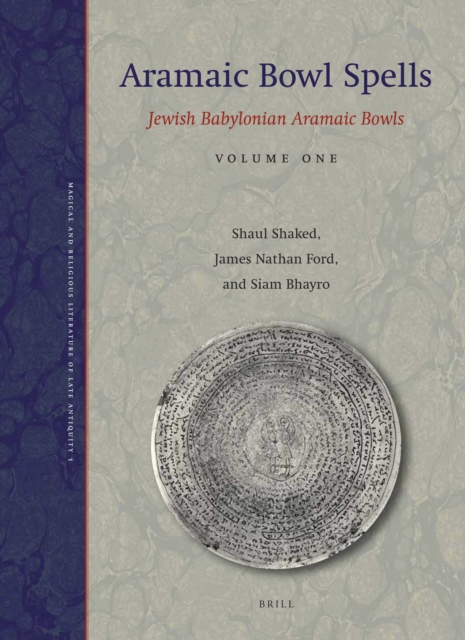
Aramaic bowl spells: Jewish Babylonian Aramaic bowls
The corpus of Aramaic incantation bowls from Sasanian Mesopotamia is perhaps the most important source we have for studying the everyday beliefs and practices of the Jewish, Christian, Mandaean, Manichaean, Zoroastrian and Pagan communities on the eve of the Islamic conquests. The bowls are from the Schøyen Collection, which has some 650 texts in different varieties of Aramaic: Jewish Aramaic, Mandaic and Syriac, and forms the largest collection of its kind anywhere in the world. This volume presents editions of sixty-four Jewish Aramaic incantation bowls, with accompanying introductions, translations, philological notes, photographs and indices. The themes covered include the magical divorce and the accounts of the wonder-working sages ?anina ben Dosa and Joshua bar Pera?ia. It is the first of a multi-volume project that aims to publish the entire Schøyen Collection of Aramaic incantation bowls.
eBook

Magic Formulae and Women’s History
Aramaic incantation bowls dated to the fifth to seventh centuries C.E. contain valuable details about the daily lives, hardships, and fears of named individuals. Despite the bowls’ potential to provide novel insights, previous studies on the women of the bowls have primarily focused on the possibility of female authorship. These studies often disregarded the poetic structure of the incantation bowls, which consist of fixed textual units that recur repeatedly throughout the corpus. This essay argues that the formulaic nature of the bowls challenges the argument of female authorship. Additionally, it suggests that this same formulaic nature can be used to explore new avenues of research on women and gender in Late Antiquity. This involves focusing on common ailments and mishaps related to women, frequent accusations against female adversaries, and aspects of demonology that reflect male and female perspectives alongside gendered social values. The results of this study may be useful for further research on women’s lives and social values in Late Antiquity, as well as for reframing the search for women’s voices and agency in this period.
Journal Article
The Female Body and the Male Gaze
This paper explores the treatment of the female body with a particular focus on its (re)generative properties by critically examining Jewish handbooks of magic written primarily by ba’ale shem, or masters of the (divine) name. These manuscript compilations written in east central Europe between 1600 and 1800 in Hebrew and Yiddish, with occasional Slavic loanwords, integrate diverse genres: practical kabbalah, Jewish magic, medicine, and artisanal practices. Foregrounding the male gaze as a central pivot of analysis, the essay demonstrates that the female body represented a unique epistemological space for the ba’ale shem—a hidden axis mundi—where knowledge of reproduction, creation, and regeneration could be accessed and controlled. As gateways to the sacred or the demonic, parts of the female body (the womb, the breasts, and bodily fluids) demanded urgent attention to prevent illness, death, or physical defect. The essay also analyzes the dichotomous mythical construction of gender espoused by ba’ale shem that contrasted the sacred female figure of Eve/Shekhinah/Jewish woman with the demonic Lilith. The gaze of ba’ale shem and their expert use of apotropaic amulets aimed to enforce the sacrality of the Jewish woman’s body and her household, while at the same time forestalling the persistent demonic attacks of Lilith. Close reading of amulets, charms, and spells shows that the ba’ale shem’s preoccupation with women’s reproductive health aimed to reinforce the holiness and continuity of the Jewish community, which was ultimately dependent on the Jewish woman.
Journal Article

The Vow-Curse in Ancient Jewish Texts
Uttering a vow was an important and popular religious practice in ancient Judaism. It is mentioned frequently in biblical literature, and an entire rabbinic tractate, Nedarim, is devoted to this subject. In this article, I argue that starting from the Second Temple period, alongside the regular use of the vow, vows were also used as an aggressive binding mechanism in interpersonal situations. This practice became so popular that in certain contexts the vow became synonymous with the curse, as in a number of ossuaries in Jerusalem and in the later Aramaic incantation bowls. Moreover, this semantic expansion was not an isolated Jewish phenomenon but echoed both the use of the anathema in the Pauline epistles and contemporary Greco-Roman and Babylonian magical practices.
Journal Article

Geniza Magical Documents
The Cairo Geniza has proved to be a fascinating trove of information about all aspects of Jewish life in the medieval and early modern period, magic being one of them. Hundreds of manuscripts, in different states of conservation, testify to the interest of Jews in composing and copying magical manuals as well as producing amulets and curses and otherwise attempting to harness the supernatural in order to achieve earthly aims. This essay introduces the reader to Geniza magical texts and provides some guidelines for reading these documents.
Journal Article

Catching a Thief: The Jewish Trials of a Christian Ordeal
Catching a Thief: The Jewish Trials of a Christian Ordeal
Journal Article
