
Catalogue Search | MBRL


Are you sure you want to remove the book from the shelf?

{{itemTitle}}
3,671
result(s) for
"Jewish-Arab relations."
Sort by:


Army of shadows
Inspired by stories he heard in the West Bank as a child, Hillel Cohen uncovers a hidden history in this extraordinary and beautifully written book—a history central to the narrative of the Israel-Palestine conflict but for the most part willfully ignored until now. In Army of Shadows, initially published in Israel to high acclaim and intense controversy, he tells the story of Arabs who, from the very beginning of the Arab-Israeli encounter, sided with the Zionists and aided them politically, economically, and in security matters. Based on newly declassified documents and research in Zionist, Arab, and British sources, Army of Shadows follows Bedouins who hosted Jewish neighbors, weapons dealers, pro-Zionist propagandists, and informers and local leaders who cooperated with the Zionists, and others to reveal an alternate history of the mandate period with repercussions extending to this day. The book illuminates the Palestinian nationalist movement, which branded these \"collaborators\" as traitors and persecuted them; the Zionist movement, which used them to undermine Palestinian society from within and betrayed them; and the collaborators themselves, who held an alternate view of Palestinian nationalism. Army of Shadows offers a crucial new view of history from below and raises profound questions about the roots of the Israel-Palestine conflict.
eBook


Colonizing Palestine
Among the most progressive of Zionist settlement movements,
Hashomer Hatzair proclaimed a brotherly stance on
Zionist-Palestinian relations. Until the tumultuous end of the
British Mandate, movement settlers voiced support for a binational
Jewish-Arab state and officially opposed mass displacement of
Palestinians. But, Hashomer Hatzair colonies were also active
participants in the process that ultimately transformed large
portions of Palestine into sovereign Jewish territory. Areej
Sabbagh-Khoury investigates this ostensible dissonance, tracing how
three colonies gained control of land and their engagement with
Palestinian inhabitants on the edges of the Jezreel Valley/Marj Ibn
'Amer.
Based on extensive empirical research in local colony and
national archives, Colonizing Palestine offers a
microhistory of frontier interactions between Zionist settlers and
indigenous Palestinians within the British imperial field. Even as
left-wing kibbutzim of Hashomer Hatzair helped lay the groundwork
for settler colonial Jewish sovereignty, its settlers did not
conceal the prior existence of the Palestinian villages and their
displacement, which became the subject of enduring debate in the
kibbutzim. Juxtaposing history and memory, examining events in
their actual time and as they were later remembered, Sabbagh-Khoury
demonstrates that the dispossession and replacement of the
Palestinians in 1948 was not a singular catastrophe, but rather a
protracted process instituted over decades. Colonizing
Palestine traces social and political mechanisms by which
forms of hierarchy, violence, and supremacy that endure into the
present were gradually created.
eBook

Palestine between Politics and Terror, 1945–1947
British General Sir Allan Cunningham was appointed in 1945 as high commissioner of Palestine, and served in this capacity until the end of the British mandate on May 15, 1948. The three years of Cunningham's tenure were tremendously complex politically: players included the British government in London, the British army, the British administration in Jerusalem, and diverse military forces within the Zionist establishment, both Jew and Arab. Golani revisits this period from the perspective of the high commissioner, examining understudied official documents as well as Cunningham's letters, notes, and cables. He emphasizes especially the challenges of navigating Jewish and Arab terrorists, on the one hand, and the multiple layers of British institutional bureaucracies, on the other, and does an excellent job of establishing Sir Allan's daily trials within the broad frame of the collapse of the British Empire following World War II.
eBook

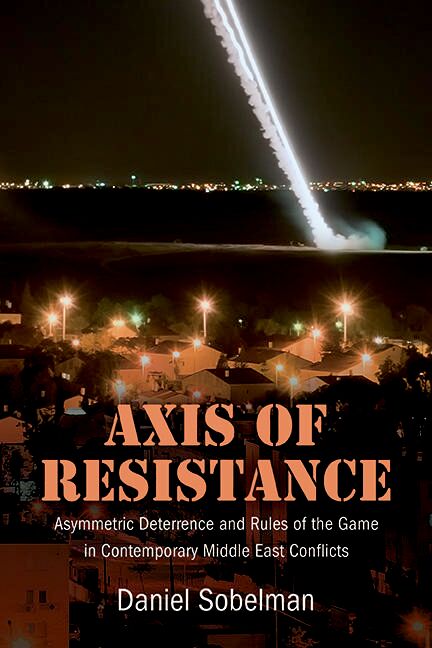
Axis of Resistance
An in-depth analysis of the primary conflicts animating the contemporary struggle over the regional order of the Middle East.
From the conflict between the United States and the Iranian-backed militias in Iraq and Syria to the recent Israel-Hamas war in the Gaza Strip, events in today's Middle East reflect the emergence of what has come to be known as an Iran-led \"axis of resistance.\" A geopolitical network of state- and nonstate actors seeking to promote a new regional order, the \"axis\" primarily includes the Lebanese Hezbollah, Hamas in the Gaza Strip, Yemen's Houthi rebels, Syria, and multiple Iran-supported Shiite militias in Iraq. Drawing on qualitative in-depth research in Hebrew and Arabic, and on exclusive interviews with senior Israeli officials, Axis of Resistance offers the first comprehensive analysis of the evolution of the \"axis\" and its application of a distinct strategic approach to asymmetrical conflicts-that of \"resistance.\" Author Daniel Sobelman shows that the various \"resistance\" forces in the region have pursued an analogous asymmetrical deterrent strategy whose origins trace back to the Israel-Hezbollah conflict in southern Lebanon, whereby the weaker actor attempts to subject the stronger state to limiting \"rules of the game.\"
eBook


Arabs and Jews in Ottoman Palestine
1. This book offers a serious and wide-ranging history of an intractable conflict. It reassesses the Arab-Israeli conflict by looking back to events in the 19th century and the earliest waves settlers. 2. It uses a variety of primary sources from the settlers and their neighbors to show on a grassroots and human level how conflict developed, and it also gives new interpretations of the early attempts to define and analyze the conflict. 3. Author Alan Dowty is a senior political scientist who is well-known for his explorations of the roots of the Arab-Israeli conflict.
eBook