
Catalogue Search | MBRL


Are you sure you want to remove the book from the shelf?

{{itemTitle}}
171
result(s) for
"Jews -- Middle East -- Identity"
Sort by:

Modern Middle Eastern Jewish Thought
This volume opens the canon of modern Jewish thought to the all too often overlooked writings of Jews from the Arab East, from the close of the nineteenth century to the middle of the twentieth. Whether they identified as Sephardim, Mizrahim, anticolonialists, or Zionists, these thinkers engaged the challenges and transformations of Middle Eastern Jewry in this decisive period. Moshe Behar and Zvi Ben-Dor Benite present Jewish culture and politics situated within overlapping Arabic, Islamic, and colonial contexts. The editors invite the reader to reconsider contemporary evocations of Levantine, Mizrahi, and Arab Jewish identities against the backdrop of writings by earlier Middle Eastern Jewish intellectuals who critically assessed or contested the implications of Western presence and Western Jewish presence in the Middle East; religion and secularization; and the rise of nationalism, communism, and Zionism, as well as the State of Israel.
eBook


Were the jews a mediterranean society?
How well integrated were Jews in the Mediterranean society controlled by ancient Rome? The Torah's laws seem to constitute a rejection of the reciprocity-based social dependency and emphasis on honor that were customary in the ancient Mediterranean world. But were Jews really a people apart, and outside of this broadly shared culture? Were the Jews a Mediterranean Society? argues that Jewish social relations in antiquity were animated by a core tension between biblical solidarity and exchange-based social values such as patronage, vassalage, formal friendship, and debt slavery. Seth Schwartz's examinations of the Wisdom of Ben Sira, the writings of Josephus, and the Palestinian Talmud reveal that Jews were more deeply implicated in Roman and Mediterranean bonds of reciprocity and honor than is commonly assumed. Schwartz demonstrates how Ben Sira juxtaposes exhortations to biblical piety with hard-headed and seemingly contradictory advice about coping with the dangers of social relations with non-Jews; how Josephus describes Jews as essentially countercultural; yet how the Talmudic rabbis assume Jews have completely internalized Roman norms at the same time as the rabbis seek to arouse resistance to those norms, even if it is only symbolic.
eBook

Jews and the military
Jews and the Militaryis the first comprehensive and comparative look at Jews' involvement in the military and their attitudes toward war from the 1600s until the creation of the state of Israel in 1948. Derek Penslar shows that although Jews have often been described as people who shun the army, in fact they have frequently been willing, even eager, to do military service, and only a minuscule minority have been pacifists. Penslar demonstrates that Israel's military ethos did not emerge from a vacuum and that long before the state's establishment, Jews had a vested interest in military affairs.
Spanning Europe, North America, and the Middle East, Penslar discusses the myths and realities of Jewish draft dodging, how Jews reacted to facing their coreligionists in battle, the careers of Jewish officers and their reception in the Jewish community, the effects of World War I on Jewish veterans, and Jewish participation in the Spanish Civil War and World War II. Penslar culminates with a study of Israel's War of Independence as a Jewish world war, which drew on the military expertise and financial support of a mobilized, global Jewish community. He considers how military service was a central issue in debates about Jewish emancipation and a primary indicator of the position of Jews in any given society.
Deconstructing old stereotypes,Jews and the Militaryradically transforms our understanding of Jews' historic relationship to war and military power.
eBook

Tours That Bind
Since 1999 hundreds of thousands of young American Jews have visited Israel on an all-expense-paid 10-day pilgrimage-tour known as Birthright Israel. The most elaborate of the state-supported homeland tours that are cropping up all over the world, this tour seeks to foster in the American Jewish diaspora a lifelong sense of attachment to Israel based on ethnic and political solidarity. Over a half-billion dollars (and counting) has been spent cultivating this attachment, and despite 9/11 and the ongoing Israeli-Palestinian conflict the tours are still going strong. Based on over seven years of first-hand observation in modern day Israel, Shaul Kelner provides an on-the-ground look at this hotly debated and widely emulated use of tourism to forge transnational ties. We ride the bus, attend speeches with the Prime Minister, hang out in the hotel bar, and get a fresh feel for young American Jewish identity and contemporary Israel. We see how tourism's dynamism coupled with the vibrant human agency of the individual tourists inevitably complicate tour leaders' efforts to rein tourism in and bring it under control. By looking at the broader meaning of tourism, Kelner brings to light the contradictions inherent in the tours and the ways that people understandtheir relationship to place both materially and symbolically. Rich in detail, engagingly written, and sensitive to the complexities of modern travel and modern diaspora Jewishness, Tours that Bind offers a new way of thinking about tourism as a way through which people develop understandings of place, society, and self.
eBook
Emissaries from the Holy Land
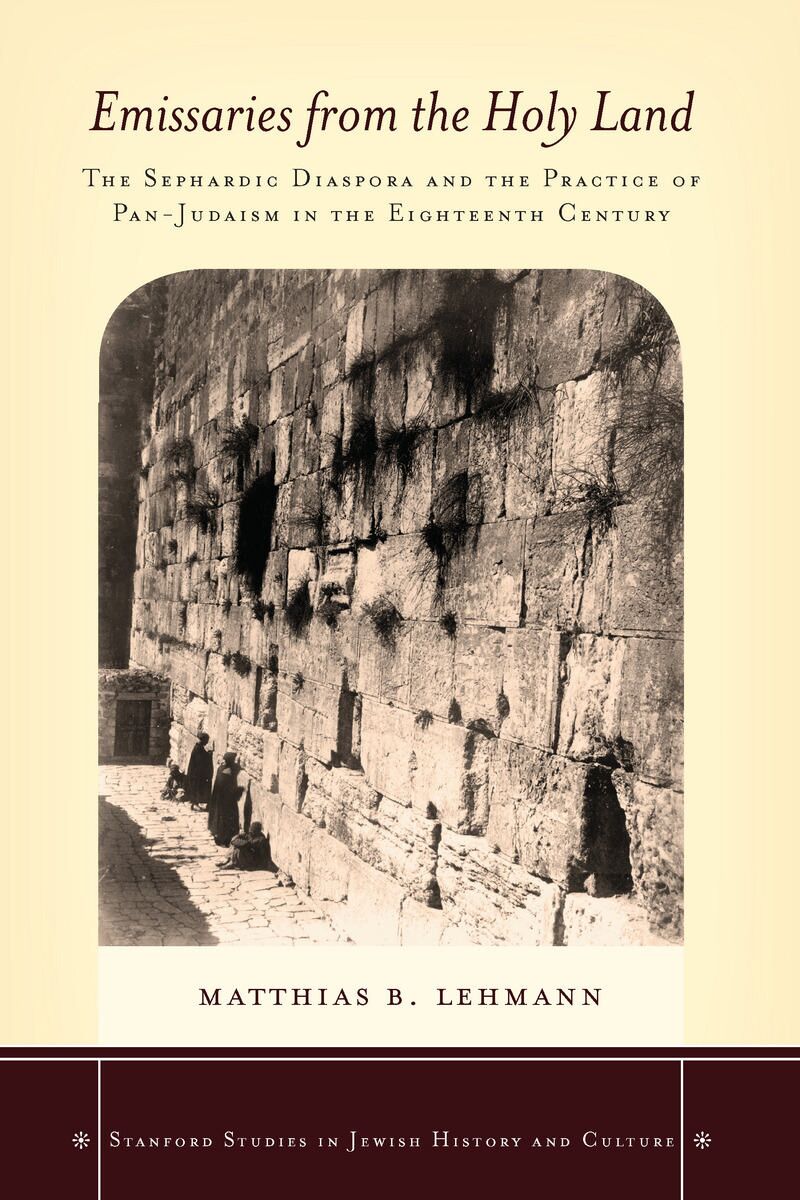
For Jews in every corner of the world, the Holy Land has always been central. But that conviction was put to the test in the eighteenth century when Jewish leaders in Palestine and their allies in Istanbul sent rabbinic emissaries on global fundraising missions. From the shores of the Mediterranean to the port cities of the Atlantic seaboard, from the Caribbean to India, these emmissaries solicited donations for the impoverished of Israel's homeland.
Emissaries from the Holy Land explores how this eighteenth century philanthropic network was organized and how relations of trust and solidarity were built across vast geographic differences. It looks at how the emissaries and their supporters understood the relationship between the Jewish Diaspora and the Land of Israel, and it shows how cross-cultural encounters and competing claims for financial support involving Sephardic, Ashkenazi, and North African emissaries and communities contributed to the transformation of Jewish identity from 1720 to 1820.
Solidarity among Jews and the centrality of the Holy Land in traditional Jewish society are often taken for granted. Lehmann challenges such assumptions and provides a critical, historical perspective on the question of how Jews in the early modern period encountered one another, how they related to Jerusalem and the land of Israel, and how the early modern period changed perceptions of Jewish unity and solidarity. Based on original archival research as well as multiple little-known and rarely studied sources,Emissaries from the Holy Land offers a fresh perspective on early modern Jewish society and culture and the relationship between the Jewish Diaspora and Palestine in the eighteenth century.
eBook

Synagogues in the Islamic World
This beautifully illustrated volume looks at the spaces created by and for Jews in areas under the political or religious control of Muslims in regions such as Central Asia, the Middle East, North Africa and Spain.
eBook

The Mexican Mahjar
Migration from the Middle East brought hundreds of thousands of people to the Americas in the late nineteenth and early twentieth centuries. By the time the Ottoman political system collapsed in 1918, over a third of the population of the Mashriq, i.e. the Levant, had made the transatlantic journey. This intense mobility was interrupted by World War I but resumed in the 1920s and continued through the late 1940s under the French Mandate. Many migrants returned to their homelands, but the rest concentrated in Brazil, Argentina, the United States, Haiti, and Mexico, building transnational lives. The Mexican Mahjar provides the first global history of Middle Eastern migrations to Mexico. Making unprecedented use of French colonial archives and historical ethnography, Camila Pastor examines how French colonial control over Syria and Lebanon affected the migrants. Tracing issues of class, race, and gender through the decades of increased immigration to Mexico and looking at the narratives created by the Mahjaris (migrants) themselves in both their old and new homes, Pastor sheds new light on the creation of transnational networks at the intersection of Arab, French, and Mexican colonial modernisms. Revealing how migrants experienced mobility as conquest, diaspora, exile, or pilgrimage, The Mexican Mahjar tracks global history on an intimate scale.
eBook

Zionism and the roads not taken : Rawidowicz, Kaplan, Kohn
Today, Zionism is understood as a national movement whose primary
historical goal was the establishment of a Jewish state. However, Zionism's
association with national sovereignty was not foreordained. Zionism and the Roads
Not Taken uncovers the thought of three key interwar Jewish intellectuals who
defined Zionism's central mission as challenging the model of a sovereign
nation-state: historian Simon Rawidowicz, religious thinker Mordecai Kaplan, and
political theorist Hans Kohn. Although their models differed, each of these three
thinkers conceived of a more practical and ethical paradigm of national cohesion
that was not tied to a sovereign state. Recovering these roads not taken helps us to
reimagine Jewish identity and collectivity, past, present, and future.
eBook
A Jewish State
Israel is a “Jewish state.” What is the meaning of this and how does it align with the democratic nature of the country? These are the questions at the core of a contentious debate that has been raging since the establishment of the state. This volume includes 75 essays on the question of Jewish — Israeli identity, by some of today’s best thinkers — Jews and non-Jews, from Israel and around the world. Its pages include dreams and nightmares, poetic visions and rational analyses, harsh critiques and songs of praise.
This collection is a first-of-its-kind nexus of thought on nationality, religion, politics, culture, society, environment, economics, and security. It is essential reading for any future discussion of Israeli identity.
eBook