
Catalogue Search | MBRL


Are you sure you want to remove the book from the shelf?

{{itemTitle}}
12
result(s) for
"Jews-Food-History"
Sort by:

Jews and their foodways
\"Bringing together contributions from a diverse group of scholars, Volume XXVIII of Studies in Contemporary Jewry presents a multifaceted view of the subtle and intricate relations between Jews and their foodways. The symposium covers Europe, the Middle East, Africa, and North America from the 20th century to the 21st.\"-- Provided by publisher.
Book

Jews, Food, and Spain
A fascinating study that will appeal to both culinarians
and readers interested in the intersecting histories of food,
Sephardic Jewish culture, and the Mediterranean world of Iberia and
northern Africa. In the absence of any Jewish cookbook
from the pre-1492 era, it requires arduous research and a creative
but disciplined imagination to reconstruct Sephardic tastes from
the past and their survival and transmission in communities around
the Mediterranean in the early modern period, followed by the even
more extensive diaspora in the New World. In this intricate and
absorbing study, Hélène Jawhara Piñer presents readers with the
dishes, ingredients, techniques, and aesthetic principles that make
up a sophisticated and attractive cuisine, one that has had a
mostly unremarked influence on modern Spanish and Portuguese
recipes.
eBook


Iconic Hasidic Food
This essay delves into the historical custom observed by Chabad Hasidim, wherein they partake in buckwheat kasha during the festival of 19 Kislev. This tradition made its initial appearance in Chabad sources during the 1930s and, subsequent to its formalization in Chabad books of customs, has experienced a resurgence in recent years. The story of kasha, however, extends beyond the food consumed during Hasidic celebrations. As a case study, it unveils the shaping of contemporary Hasidic customs and practices, providing an egalitarian, grassroots perspective on the recent history of Hasidism as a lived religion. Utilizing Hasidic sermons, narratives, and personal documents, this essay traces the origins of the “black kasha” custom and endeavors to reintegrate its historical context within the broader framework of Jewish culinary history. It examines the factors contributing to its emergence in Chabad sources during the interwar period (1918–39) and in contemporary times. The argument posits that “black kasha” serves as a prime example of Hasidic religious expression through nostalgic engagement with food. In doing so, this essay highlights this constructed ceremonial and iconic dish as a symbol of the evolving nature of Hasidic communities and their assimilation into broader cultural currents within society. Ultimately, this exploration of Hasidic food practices provides an egalitarian perspective on Hasidism as lived in the twentieth and twenty-first centuries, departing from the prevalent approach of narrating Hasidic history solely through the prism of its elite members and their doctrines.
Journal Article

Sephardi
In this extraordinary cookbook, chef and scholar Helene Jawhara-Piner combines rich culinary history and Jewish heritage to serve up over fifty culturally significant recipes. Steeped in the history of the Sephardic Jews (Jews of Spain) and their diaspora, these recipes are expertly collected from such diverse sources as medieval cookbooks, Inquisition trials, medical treatises, poems, and literature. Original sources ranging from the thirteenth century onwards and written in Arabic, Spanish, Portuguese, Occitan, Italian, and Hebrew, are here presented in English translation, bearing witness to the culinary diversity of the Sephardim, who brought their cuisine with them and kept it alive wherever they went. Jawhara-Piner provides enlightening commentary for each recipe, revealing underlying societal issues from anti-Semitism to social order. In addition, the author provides several of her own recipes inspired by her research and academic studies. Each creation and bite of the dishes herein are guaranteed to transport the reader to the most deeply moving and intriguing aspects of Jewish history. Jawhara-Piner reminds us that eating is a way to commemorate the past.
eBook
Remembering the Fish and Making a Tsimmes: Jewish Food, Jewish Identity, and Jewish Memory
Claudia Roden, in her Book of Jewidh Food later recommended \"slightly fat beef brisket, flank, or rolled rib\" to accompany her \"tzimmes\" for which she provides three recipes, the aforementioned \"meat, potato, and prune\" variety, favored (as she notes) by Jews of Lithuanian origin, as well two vegetarian recipes, one carrot-based and one pumpkin.73 A recipe for a vegetarian version of the Lithuanian variety of tsimmes appears in Yotam Ottolenghi's recent Jerudalem, yet another contribution to the genre of \"cooking as remembrance of past homelands.\"
Journal Article

Food and identity in early rabbinic Judaism
Food often defines societies and even civilizations. Through particular commensality restrictions, groups form distinct identities: Those with whom 'we' eat ('Us') and those with whom 'we' cannot eat ('Them'). This identity is enacted daily, turning the biological need to eat into a culturally significant activity. In this book, Jordan D. Rosenblum explores how food regulations and practices helped to construct the identity of early rabbinic Judaism. Bringing together the scholarship of rabbinics with that of food studies, this volume first examines the historical reality of food production and consumption in Roman-era Palestine. It then explores how early rabbinic food regulations created a distinct Jewish, male, and rabbinic identity. Rosenblum's work demonstrates how rabbinic food practices constructed an edible identity.
eBook

From Canton Restaurant to Panda Express
From Canton Restaurant to Panda Expresstakes readers on a compelling journey from the California Gold Rush to the present, letting readers witness both the profusion of Chinese restaurants across the United States and the evolution of many distinct American-Chinese iconic dishes from chop suey to General Tso's chicken. Along the way, historian Haiming Liu explains how the immigrants adapted their traditional food to suit local palates, and gives readers a taste of Chinese cuisine embedded in the bittersweet story of Chinese Americans.Treating food as a social history, Liu explores why Chinese food changed and how it has influenced American culinary culture, and how Chinese restaurants have become places where shared ethnic identity is affirmed-not only for Chinese immigrants but also for American Jews. The book also includes a look at national chains like P. F. Chang's and a consideration of how Chinese food culture continues to spread around the globe.Drawing from hundreds of historical and contemporary newspaper reports, journal articles, and writings on food in both English and Chinese,From Canton Restaurant to Panda Expressrepresents a groundbreaking piece of scholarly research. It can be enjoyed equally as a fascinating set of stories about Chinese migration, cultural negotiation, race and ethnicity, diverse flavored Chinese cuisine and its share in American food market today.
eBook
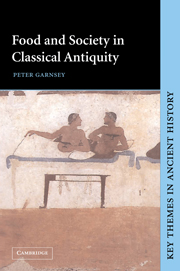
Food and Society in Classical Antiquity
This is the first study of food in classical antiquity that treats it as both a biological and a cultural phenomenon. The variables of food quantity, quality and availability, and the impact of disease, are evaluated and a judgement reached which inclines to pessimism. Food is also a symbol, evoking other basic human needs and desires, especially sex, and performing social and cultural roles which can be either integrative or divisive. The book explores food taboos in Greek, Roman, and Jewish society, and food-allocation within the family, as well as more familiar cultural and economic polarities which are highlighted by food and eating. The author draws on a wide range of evidence new and old, from written sources to human skeletal remains, and uses both comparative historical evidence from early modern and contemporary developing societies and the anthropological literature, to create a case-study of food in antiquity.
eBook

Food in Ancient Judah
First published in 2013. The study of food in the Hebrew Bible and Syro-Palestinian archaeology has tended to focus on kosher dietary laws, the sacrificial system, and feasting in elite contexts. More everyday ritual and practice - the preparation of food in the home - has been overlooked. Food in Ancient Judah explores both the archaeological remains and ancient Near Eastern sources to see what they reveal about the domestic gastronomical daily life of ancient Judahites within the narratives of the Hebrew Bible. Beyond the findings, the methodology of the study is in itself innovative. Biblical passages that deal with domestic food preparation are translated and analysed. Archaeological findings and relevant secondary resources are then applied to inform these passages. Food in Ancient Judah reflects both the shift towards the study of everyday life in biblical studies and archaeology and the huge expansion of interest in food history - it will be of interest to scholars in all these fields
eBook