
Catalogue Search | MBRL


Are you sure you want to remove the book from the shelf?

{{itemTitle}}
801
result(s) for
"Jihad History."
Sort by:

Crusade and Jihad
What really happened in the centuries of conflict between
Europe, Russia, China, America, and the peoples of the Muslim
world Crusade and Jihad is the first book to
encompass, in one volume, the entire history of the catastrophic
encounter between the Global North-China, Russia, Europe, Britain,
and America-and Muslim societies from Central Asia to West Africa.
William R. Polk draws on more than half a century of experience as
a historian, policy planner, diplomat, peace negotiator, and
businessman to explain the deep hostilities between the Muslim
world and the Global North and show how they grew over the
centuries. Polk shows how Islam arose and spread across North
Africa into Europe, climaxed in the vibrant and sophisticated
caliphate of al-Andalus in medieval Spain, and was the bright light
in a European Dark Age. Simultaneously, Islam spread from the
Middle East into Africa, India, and Southeast Asia. But following
the Mongol invasions, Islamic civilization entered a decline while
Europe began its overseas expansion. Portuguese buccaneers
dominated the Indian Ocean; the Dutch and the English established
powerful corporations that turned India and Indonesia into
colonies; Russian armies pushed down the Volga into Central Asia,
destroying its city-states; and the Chinese Qing dynasty
slaughtered an entire Central Asian people. Britain crushed local
industry and drained off wealth throughout its vast colonies.
Defeated at every turn, Muslims tried adopting Western dress,
organizing Westernstyle armies, and embracing Western ideas. None
of these efforts stopped the conquests. For Europe and Russia, the
nineteenth century was an age of colonial expansion, but for the
Muslim world it was an age of brutal and humiliating defeat.
Millions were driven from their homes, starved, or killed, and
their culture and religion came under a century-long assault. In
the twentieth century, brutalized and and disorganized native
societies, even after winning independence, fell victim to
\"post-imperial malaise,\" typified by native tyrannies, corruption,
and massive poverty. The result was a furious blowback. A sobering,
scrupulous, and frank account of imperialism, colonialism,
insurgency, and terrorism, Crusade and Jihad is history
for anyone who wishes to understand the civilizational conflicts of
today's world.
eBook


Jihād : the origin of holy war in Islam
While there is no evidence to date that the indigenous inhabitants of Arabia knew of holy war prior to Islam, holy war ideas and behaviors appear already among Muslims during the first generation. This book focuses on why and how such a seemingly radical development took place. Basing the hypothesis on evidence from the Qurʾān and early Islamic literary sources, this book locates the origin of Islamic holy war and traces its evolution as a response to the changes affecting the new community of Muslims in its transition from ancient Arabian culture to the religious civilization of Islam.
eBook

Reclaiming Jihad
\"This book is a scholarly and necessary critique of why the crime of terrorism is inconsistent with the ethical outlook of the Qur'an. Anyone who wants to understand the Qur'an and its relationship to violence must read this book.\"—Khaled Abou El Fadl, Omar and Azmeralda Alfi Professor of Law and chair of Islamic studies program, UCLA School of Law
\"In addition to illuminating the root causes of terrorism, this book is a real contribution to the interfaith dialogue.\"—Muhammad Abu Layla, professor of the comparative religions at al-Azhar University, Cairo
\"A critique that challenges contemporary perceptions of the relationship between Islam and violence. The book can be seriously commended to both specialists and non-specialists in Qur'anic Studies, theology, and political science.\"—Jabal M. Buaben, associate professor, Universiti Brunei Darussalam, Sultan Omar 'Ali Saifuddien Centre for Islamic Studies
ElSayed Amin critiques misreadings of key verses in the Qur'an that have been used to establish violence as the relational norm between Muslims and non-Muslims. He distinguishes both Islamic jihad and armed deterrence from modern terrorism through examination of the 9/11 attacks, and proposes legal proscriptions for terrorism from the Qur'an on the basis of its political, social, and psychological impacts.
ElSayed Amin is a senior lecturer of Islamic studies in English at al-Azhar University in Egypt and a visiting postdoctoral research fellow at the University of Brunei Darussalam (UBD) in Brunei. He is a member of the Supreme Council of Islamic Affairs in Cairo, and a former Fulbright Scholar.
eBook
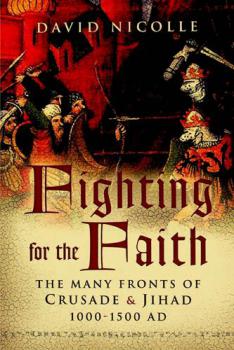
Fighting for the faith : the many fronts of medieval crusade and Jihad, 1000-1500 AD
\"Fighting between Christians and Muslims in the medieval period is often seen in the narrow context of the battle for the Holy Land. Other points of conflict tend to be ignored. But, as David Nicolle's thought provoking survey shows, religions clashed across the medieval world - in the Mediterranean and the Therian peninsula, in the Near East, in Central Asia, India, the Balkans, Anatolia, Russia, the Baltic and Africa. Over 500 years, the struggle in reach theatre of conflict had its own character - methods of warfare differed and developed in different ways and were influenced by local traditions and circumstances. And these campaigns were not waged solely against Christian or Islamic enemies, but against pagan, non-Christian or non-Islamic peoples. As he tells the story of Crusade and Jihad, and describes the organization and tactics of the armies involved, David Nicolle opens up a new understanding of the phenomenon of holy war.\"--Jacket.
Book

Empire and Jihad : the Anglo-Arab wars of 1870-1920
A panoramic, provocative account of the clash between British imperialism and Arab jihadism in Africa between 1870 and 1920 The Ottoman Sultan called for a \"Great Jihad\" against the Entente powers at the start of the First World War. He was building on half a century of conflict between British colonialism and the people of the Middle East and North Africa. Resistance to Western violence increasingly took the form of radical Islamic insurgency. Ranging from the forests of Central Africa to the deserts of Egypt, Sudan, and Somaliland, Neil Faulkner explores a fatal collision between two forms of oppression, one rooted in the ancient slave trade, the other in modern \"coolie\" capitalism. He reveals the complex interactions between anti-slavery humanitarianism, British hostility to embryonic Arab nationalism, \"war on terror\" moral panics, and Islamist revolt. Far from being an enduring remnant of the medieval past, or an essential expression of Muslim identity, Faulkner argues that \"Holy War\" was a reactionary response to the violence of modern imperialism.
eBook

Sword and scimitar : fourteen centuries of war between Islam and the west
A sweeping history of the often-violent conflict between Islam and the West, shedding a revealing light on current hostilities The West and Islam--the sword and the scimitar--have clashed since the mid-seventh century, when, according to Muslim tradition, the Byzantine emperor rejected Prophet Muhammad's order to abandon Christianity and convert to Islam, unleashing a centuries-long jihad on Christendom. Sword and Scimitar chronicles the significant battles that arose from this ages-old Islamic jihad, beginning with the first major Islamic attack on Christian land in 636, through the occupation of the Middle East that prompted the Crusades and the far-flung conquests of the Ottoman Turks, to the European colonization of the Muslim world in the 1800s, when Islam largely went on the retreat--until its reemergence in recent times. Using original sources in Arabic, Greek, Latin, and Turkish, preeminent historian Raymond Ibrahim describes each battle in vivid detail and explains the effect the outcome had on larger historical currents of the age and how the military lessons of the battle reflect the cultural faultlines between Islam and the West. The majority of these landmark battles are now forgotten or considered inconsequential. Yet today, as the West faces a resurgence of this enduring Islamic jihad, Sword and Scimitar provides the needed historical context to understand the current relationship between the West and the Islamic world, and why the Islamic State is merely the latest chapter of an old history.
Book
