
Catalogue Search | MBRL


Are you sure you want to remove the book from the shelf?

{{itemTitle}}
87,801
result(s) for
"John Fitzgerald"
Sort by:

Who was John F. Kennedy?
A biography of the 35th president of the United States, John F. Kennedy.
Book

Zaprudered : the Kennedy assassination film in visual culture
No detailed description available for \"Zaprudered\".
eBook
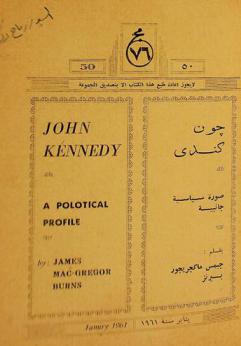
جون كندي : صورة سياسية جانبية
يتحدث الكتاب عن جون فيتزجيرالد \"جاك\" كينيدي منذ ولادته والتحاقة بالجامعة ومن ثم ألتحاقة في منصب أعضاء الكونجرس عضو في الحزب الديمقراطي ؛ وإختصارا للكتاب ولد كينيدي في بروكلين 29 مايو 1917، بماساتشوستس وهو ابن جوزيف كينيدي الأب وروز كينيدي. وهو سليل عائلة كينيدي التي هاجرت من مقاطعة وكسفورد في أيرلندا، ويشار إليه عادة بأحرفه الأولى JFK، هو سياسي أمريكي، كينيدي هو عضو في الحزب الديمقراطي، ومثل ولاية ماساتشوستس في مجلس النواب ومجلس الشيوخ قبل أن يصبح رئيسا. تولى منصب الرئيس الخامس والثلاثين للولايات المتحدة من 20 يناير 1961 خدم كينيدي كرئيس في ذروة الحرب الباردة، وركز في جل فترة رئاسته على إدارة العلاقات مع الاتحاد السوفيتي. حتى اغتياله في 22 نوفمبر 1963.
Book

The making of a Catholic president : Kennedy vs. Nixon 1960
The 1960 presidential election, won ultimately by John F. Kennedy, was one of the closest and most contentious in American history. The country had never elected a Roman Catholic president, and the last time a Catholic had been nominated—New York Governor Al Smith in 1928—he was routed in the general election. From the outset, Kennedy saw the religion issue as the single most important obstacle on his road to the White House. He was acutely aware of, and deeply frustrated by, the possibility that his personal religious beliefs could keep him out of the White House. This book tells the fascinating story of how the Kennedy campaign transformed the “religion question” from a liability into an asset, making him the first (and still only) Catholic president. Drawing on archival research, including many never-before-seen documents, the book travels inside the campaign to show Kennedy's chief advisors—Ted Sorensen, John Kenneth Galbraith, Archibald Cox—grappling with the staunch opposition to the candidate's Catholicism. The book also reveals many of the Nixon campaign's efforts to tap in to anti-Catholic sentiment, with the aid of Billy Graham and the National Association of Evangelicals, among others. The alliance between conservative Protestants and the Nixon campaign, it shows, laid the groundwork for the rise of the Religious Right.
eBook

Big bang : a nonfiction novel
Set in the 1950's, this epic, Warholian novel presents a brilliant and wholly original take on the years leading up to the Kennedy assassination. Where were you when you first heard President Kennedy had been shot? This is a question most people can answer, even if the answer is \"I wasn't born yet.\" In this epic novel, David Bowman makes the strong case that the shooting on November 22nd, 1963 was the major, defining turning point that catapulted the world into an entirely new stratosphere. It was the second big bang.
Book

Campaign of the Century
Based on massive new research, a compelling and surprising
account of the twentieth century's closest election The
1960 presidential election between John F. Kennedy and Richard
Nixon is one of the most frequently described political events of
the twentieth century, yet the accounts to date have been
remarkably unbalanced. Far more attention is given to Kennedy's
side than to Nixon's. The imbalance began with the first book on
that election, Theodore White's The Making of the President
1960 -in which (as he later admitted) White deliberately cast
Kennedy as the hero and Nixon as the villain-and it has been
perpetuated in almost every book since then. Few historians have
attempted an unbiased account of the election, and none have done
the archival research that Irwin F. Gellman has done. Based on
previously unused sources such as the FBI's surveillance of JFK and
the papers of Leon Jaworski, vice-presidential candidate Henry
Cabot Lodge, and many others, this book presents the first
even-handed history of both the primary campaigns and the general
election. The result is a fresh, engaging chronicle that shatters
long†'held myths and reveals the strengths and weaknesses of both
candidates.
eBook

The anti-landscape
There have always been some uninhabitable places, but in the last century human beings have produced many more of them. These anti-landscapes have proliferated to include the sandy wastes of what was once the Aral Sea, severely polluted irrigated lands, open pit mines, blighted nuclear zones, coastal areas inundated by rising seas, and many others. The Anti-Landscape examines the emergence of such sites, how they have been understood, and how some of them have been recovered for habitation. The anti-landscape refers both to artistic and literary representations and to specific places that no longer sustain life. This history includes T.S. Eliot's Wasteland and Cormac McCarthy's The Road as well as air pollution, recycled railway lines, photography and landfills. It links theories of aesthetics, politics, tourism, history, geography, and literature into the new synthesis of the environmental humanities. The Anti-Landscape provides an interdisciplinary appraoch that moves beyond the false duality of nature vs. culture, and beyond diagnosis and complaint to the recuparation of damaged sites into our complex heritage. -- cover verso.
BOOK

Cruising for Conspirators
New Orleans district attorney Jim Garrison's decision to arrest
Clay Shaw on March 1, 1967, set off a chain of events that
culminated in the only prosecution undertaken in the assassination
of John F. Kennedy. In the decades since Garrison captured
headlines with this high-profile legal spectacle, historians,
conspiracy advocates, and Hollywood directors alike have fixated on
how a New Orleans-based assassination conspiracy might have worked.
Cruising for Conspirators settles the debate for good,
conclusively showing that the Shaw prosecution was not based in
fact but was a product of the criminal justice system's
long-standing preoccupation with homosexuality. Tapping into the
public's willingness to take seriously conspiratorial explanations
of the Kennedy assassination, Garrison drew on the copious files
the New Orleans police had accumulated as they surveilled,
harassed, and arrested increasingly large numbers of gay men in the
early 1960s. He blended unfounded accusations with homophobia to
produce a salacious story of a New Orleans-based scheme to
assassinate JFK that would become a national phenomenon. At once a
dramatic courtroom narrative and a deeper meditation on the
enduring power of homophobia, Cruising for Conspirators
shows how the same dynamics that promoted Garrison's unjust
prosecution continue to inform conspiratorial thinking to this day.
eBook

The Propaganda of Freedom
The perils of equating notions of freedom with artistic
vitality
Eloquently extolled by President John F. Kennedy, the idea that
only artists in free societies can produce great art became a
bedrock assumption of the Cold War. That this conviction defied
centuries of historical evidence--to say nothing of achievements
within the Soviet Union--failed to impact impregnable cultural Cold
War doctrine.
Joseph Horowitz writes: \"That so many fine minds could have
cheapened freedom by over-praising it, turning it into a
reductionist propaganda mantra, is one measure of the intellectual
cost of the Cold War.\" He shows how the efforts of the CIA-funded
Congress for Cultural Freedom were distorted by an
anti-totalitarian \"psychology of exile\" traceable to its secretary
general, the displaced Russian aristocrat/composer Nicolas Nabokov,
and to Nabokov's hero Igor Stravinsky.
In counterpoint, Horowitz investigates personal, social, and
political factors that actually shape the creative act. He here
focuses on Stravinsky, who in Los Angeles experienced a \"freedom
not to matter,\" and Dmitri Shostakovich, who was both victim and
beneficiary of Soviet cultural policies. He also takes a fresh look
at cultural exchange and explores paradoxical similarities and
differences framing the popularization of classical music in the
Soviet Union and the United States. In closing, he assesses the
Kennedy administration's arts advocacy initiatives and their
pertinence to today's fraught American national identity.
Challenging long-entrenched myths, The Propaganda of
Freedom newly explores the tangled relationship between the
ideology of freedom and ideals of cultural achievement.
eBook

The Space-Age Presidency of John F. Kennedy
This engaging and unprecedented work captures the compelling story of John F. Kennedy's role in advancing the United States' space program, set against the Cold War with the Soviet Union. The stunning collection of history and photographs crafted by authors John Bisney and J. L. Pickering illustrates Kennedy's close association with the race to space during his legendary time in office. In addition to the exhaustive research and rare photographs, the authors have also included excerpts from Kennedy's speeches, news conferences, and once-secret White House recordings to provide the reader with more context through the president's own words. While Kennedy did not live to see the fruition of many of the endeavors he supported, his legacy lives on in many ways—many of which are captured in this important work.
eBook