
Catalogue Search | MBRL


Are you sure you want to remove the book from the shelf?

{{itemTitle}}
576
result(s) for
"Jones, Inigo."
Sort by:

Inigo Jones and the classical tradition
\"Inigo Jones worked as hard on the creation of his architectural persona as he did on the design of the buildings for the early Stuart court. Through his study of continental architectural and art theory, humanist education, and courtly behavior, Jones redefined the intellectual status of architecture in England and forged a new role for the architect in public life. Since the time of his death, he has been variously described as the first educated architect, the first classicist, the first Renaissance architect in Britain, and the savior of British building from the long winter of the Elizabethan style. This reputation has overlooked the many ways that Jones drew on English customs in order to shape classical architecture for a domestic audience.
Book
Palladio drawings in Britain: half a century of research
The Royal Institute of British Architects possesses one of the finest collections of architectural drawings and one of the jewels in its crown are over three hundred drawings by the celebrated Renaissance architect Andrea Palladio. Although cataloguing these drawings began in the 1960s as of late 2023 no printed catalogue has been published. This article examines the historiography of Palladio drawings in Britain: half a century of research, in order to set out what many of the issues regarding the project have been in the last fifty years.
Journal Article


Finding Wroth's Loughton Hall
[...]as the home of a major literary figure whose work draws heavily on her life, we might expect that the home environment she created was both shaped by and informed her evocation of place and space in her work. [...]Wroth had a role in remodeling the old house, and there is a tantalizing but unproven association with Inigo Jones, known to Wroth from the Court. Wroth wrote to Queen Anne in support of her husband's application to the King.9 The details that Wroth revealed are significant, promising that Robert \"will build, and make the house fit for both your Majesties to rest in, and will also make his chief dwelling there ... it will be much for my good, Mr. Wroth having promised to add it to my jointure, all the rest of his lands being entailed. The mannor or mansion house contains a Hall, a Buttry, Kitchen, Larder, Bakehouse, Pastry, Mylkhowse, Wash-howse, and eight other Lodgings, with faire Lodginge and great Roomes over the said Roomes new built and redified at the chardgs [sic] of Sir Robert Wroth ... with two barnes ... two duble stables ... sundry other out offices and Lodgings; with an orchard and a garden now in plantinge, all consisting of Six acres.14 The survey noted that the property included repairs and recent new building, probably a new wing to provide modern standards of bedrooms (lodgings) on the ground floor and reception rooms on the upper floor.
Journal Article

The Vitruvian Stonehenge: Inigo Jones, William Stukeley and John Wood the Elder
Stonehenge has always been veiled in mystery of ancient times past. It had featured in the Arthurian legend as a war monument where King Aurelius, Arthur’s uncle, was buried and, this made it not only mysterious but an important political tool. To be aligned with King Arthur, was an astute political move and was one practiced by all of the Tudors and the Stuarts. James I was particularly keen to be aligned with the legend and he had several family trees made which showed that he was a direct descendant from Arthur. Additionally in 1620, he sent his architect Inigo Jones to survey and examined Stonehenge. Jones’ work on Stonehenge was posthumously published by his assistant John Webb. Webb had edited it from a ‘few indigested notes’ that Jones had left. The book contained a reconstruction and an explanation of Stonehenge’s origins. For Jones, it was an early Roman temple. In 1720, William Stukeley carried out his own survey of Stonehenge and from this survey he also reconstructed it. He disagreed with Jones (but he blamed Webb), since for Stukeley it was a Druid temple. He did not publish his work for another twenty year by which time it had gained mystical elements, but the actual reconstruction over these twenty years did not change. In 1747, Bath architect John Wood the Elder published his reconstruction. He disagreed with both Jones’ and Stukeley’s reconstructions and although he agreed with Stukeley that it was a Druid temple he completely disagreed with his rationale and the architecture of his reconstruction. However, there was one thing they all agreed on was that Stonehenge was built to ‘Vitruvian’ principles. Each developed harmonious and symmetrical plans which were built to strict architectural principles. This paper examines the late seventeenth and eighteenth century concepts of the rationale for the building of Stonehenge and its development from its association with the Arthurian legend to its alignment with British nationhood and the Druids.
Journal Article

Is St. Paul’s Cathedral the “Finest Building in the World”?
For the October 1900 issue of The Strand Magazine , Frederick Dolman asked nine leading architects of the day “Which is the Finest Building in the World?” Among the eight responses he received, three architects selected works by Sir Christopher Wren, with St. Paul’s Cathedral heading the list. Dolman framed his question as a search for a “present-day ideal” in architecture, and the architects’ answers reveal how in the late nineteenth century Wren’s works, and St. Paul’s in particular, served as architectural models in the creation of a “Wrenaissance.” At the same time as this renewal of interest in Wren’s work occurred the demolition of over a dozen of Wren’s city churches, raising the question of whether Wren’s works were understood as having value in their own right. Given The Strand was a magazine aimed at the general public, Dolman’s article points to a broader interest in Wren and his works beyond the architectural profession. This public interest in Wren is also evident in several late Victorian novels— Mrs. J. H. Riddell’s Mitre Court: A Tale of the Great City (1883), Sir Walter Bessant’s The Bell of St. Paul’s (1889), and Emma Marshall’s Under the Dome of St. Paul’s: A Story of Sir Christopher Wren’s Days (1898)—where Wren and his works are vividly portrayed. In addition to the fictional portrayals of Wren and architects’ commentaries on his works was the use of St. Paul’s Cathedral as a backdrop to some of the most prominent moments in London history, including funerals of dignitaries, and The Illustrated London News prominently displayed St. Paul’s Cathedral as a symbol of London on its masthead. This curious combination of popular and professional portrayals of Sir Christopher Wren and St. Paul’s Cathedral solidified their prominence in the Victorian imagination as symbolic of both the city of London and English nationalism.
Journal Article

Who designed the king post truss?
This paper has been developed from the Keynote Lecture given at the 2022 Cambridge Conference. I was asked to give this when Elwin Robison, who had originally been asked could not come. Robison had published a paper in Architectural History but relevant work by Simona Valeriani also suggests the origins of this type of structure in Italy. I have previously described the introduction of this type of structure into England with its origins in Italy but then assumed that the earlier origins of the roof were lost to us. The work of these two scholars seems to suggest otherwise and I have drawn on their work for much of this paper.
It was a surprise to me to discover a number of other ‘English’ king post roofs of the Tudor period that could not possibly have been derived from Italian sources and which must therefore have been inspired by French carpentry. These roofs are described in a paper written for the conference but it also seemed appropriate to consider the origin of French king post roofs. For a Keynote Lecture it was possible to be fairly speculative about that but here, as well as considering the findings of Robison and Valeriani I have attempted to gather what evidence there is from those who have examined French roofs to try to trace the development of this type of structure.
In both cases the story presented draws on the principle first put forward by Gilfillan that technological changes come about through a succession of small improvements.
Journal Article

Ruzante's Moscheta as a New Possible Source for Ben Jonson's Volpone
This paper sheds light on the intertextuality of Ben Jonson's Volpone (1605) by looking at the textual affinities between the Volpone and Celia subplot in acts I-II-III of Jonson's play and the Moscheta (1528), a play written and directed by Italian actor and playwright Angelo Beolco, also known as Ruzante. Considering the current impossibility of documenting the presence of Ruzante's works in England, this essay also takes into account the series of relationships that link Angelo Beolco to England and to Ben Jonson specifically, via the commedia dell'arte on the one hand and the figure of Inigo Jones on the other. This essay begins by describing the framework of known performances and textual influences of Italian, and especially Veneto, theater on English theater and of known personal contacts between Englishmen and Italians active in and around the theater, including visits of both to the others’ country. The paper will then move to specific comparisons between the two plays in their multi-layered complexity.
Journal Article
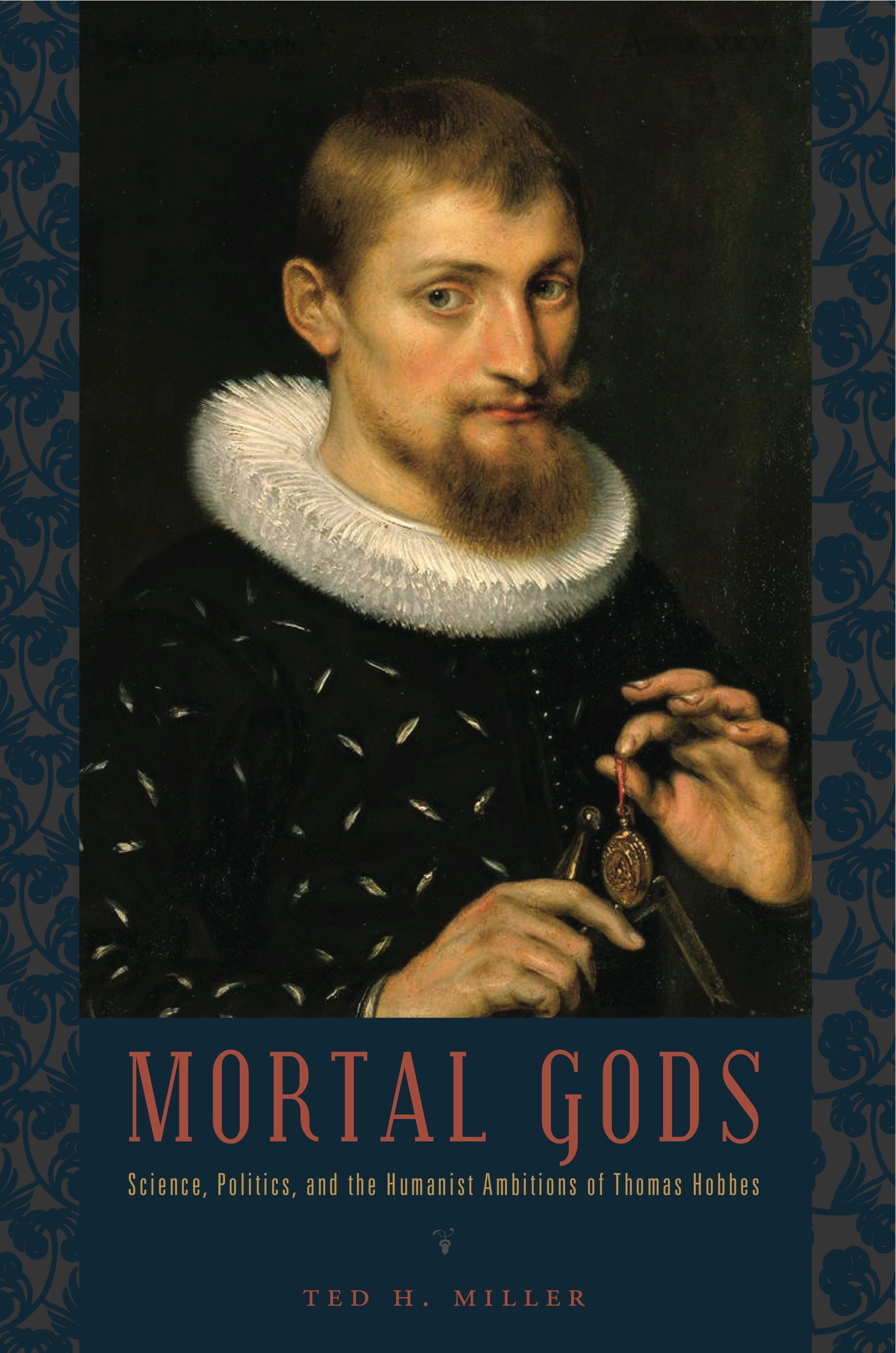
Mortal Gods
According to the commonly accepted view, Thomas Hobbes began his intellectual career as a humanist, but his discovery, in midlife, of the wonders of geometry initiated a critical transition from humanism to the scientific study of politics. In Mortal Gods, Ted Miller radically revises this view, arguing that Hobbes never ceased to be a humanist. While previous scholars have made the case for Hobbes as humanist by looking to his use of rhetoric, Miller rejects the humanism/mathematics dichotomy altogether and shows us the humanist face of Hobbes’s affinity for mathematical learning and practice. He thus reconnects Hobbes with the humanists who admired and cultivated mathematical learning—and with the material fruits of Great Britain’s mathematical practitioners. The result is a fundamental recasting of Hobbes’s project, a recontextualization of his thought within early modern humanist pedagogy and the court culture of the Stuart regimes. Mortal Gods stands as a new challenge to contemporary political theory and its settled narratives concerning politics, rationality, and violence.
eBook

“Stonehenge in the Mind” and “Stonehenge on the Ground”
In Stone-Heng Restored (1655), Inigo Jones, the father of English neoclassicism, used drawings, histories, and questionable logic to argue that Stonehenge was built by the ancient Romans and that it originally exhibited perfect Platonic geometries. This argument was never given much credence, but by 1725 the subject matter and the architect had received enough attention that two book-length responses (a challenge and a defense) were published, and both were then republished in a single volume alongside Jones's original text. While most Jones scholars have neglected this work because of its logical and historical shortcomings, Ryan Roark argues in “Stonehenge in the Mind” and “Stonehenge on the Ground”: Reader, Viewer, and Object in Inigo Jones's Stone-Heng Restored (1655) that it was in fact exemplary of what made Jones, for many, a protomodern architect and scholar. Rather than viewing Jones's book as an earnest attempt to prove a historical inaccuracy, Roark considers it as an exercise in formal analysis, one that set the precedent for the contemporary pedagogical trend of using geometric simplifications of existing structures as a first step in new design. Jones's idiosyncratic reading of Stonehenge belied the idea that such analysis could be anything but intensely reliant on the subjectivity of both architect and viewer.
Journal Article