
Catalogue Search | MBRL


Are you sure you want to remove the book from the shelf?

{{itemTitle}}
89
result(s) for
"Jordan -- History -- 20th century"
Sort by:


State, society and land in Jordan
Detailing state land policies in Jordan from the late Ottoman period through the 1950s, this work discusses the social reaction to these policies, the different conceptualizations of land held by state and society, and notes these policies' ultimate political significance.
eBook

A history of Jordan
\"Since the publication of the first edition, substantial changes have occurred in the political landscape of Jordan and the Middle East. King Abdullah II has cemented his rule amidst an onslaught of threats which have faced his kingdom since he succeeded his father in 1999. The Syrian civil war has fundamentally shifted the political context of its neighbouring countries, with Jordan experiencing a huge population explosion as people moved across the border from Syria. This second edition of Robins' accessible and succinct survey of Jordanian political history is an account of a century of events within a country whose fortunes are closely identified with its heads of state. Beginning in the early 1920s in the Mandate years, and now benefiting from new material on the rise of the Muslim Brotherhood, attempts at democratisation, the collapse of the economy, the Jordan Spring and refugee crisis, this new edition featuring original research brings Jordan's political history into the twenty-first century.\"--Page i.
Book

Cooperating rivals
This book examines the politics of water scarcity in the Middle East's Jordan River Basin (Syria, Lebanon, Jordan, Israel, and the Palestinian Authority) between 1920 and 2006. Jeffrey K. Sosland demonstrates that while water scarcity might generate political tension, it does not by itself precipitate war, nor is it likely to do so. At the same time, efforts to promote water cooperation, such as those initiated by the United States, have an identifiable political benefit by creating rules, building confidence, and reducing tensions among adversaries. Sosland concludes that while this alone might not resolve the overall conflict, it does create positive long-term value in achieving peace.
eBook

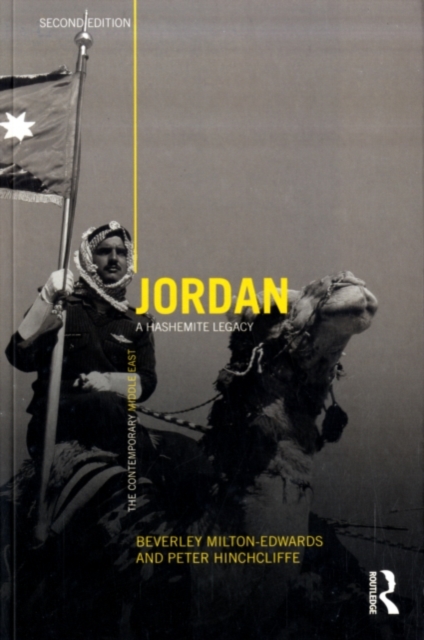
Jordan
Created as a mechanism for maintaining British influence through a local patron, Jordan’s future never looked certain. Nevertheless, under the leadership of the Hashemite monarchy led by Abdullah and then his grandson Hussein, the Kingdom of Jordan became a permanent feature on the map of the modern Middle East.
Under the rule of King Abdullah II, Jordan has remained an influential regional player in the Middle East Peace Process, its strategic position on the borders of Palestine, Israel, Egypt, Saudi Arabia and Iraq ensuring that it cannot be overlooked in the regional and international politics.
Updated and expanded to include recent developments in Jordan and the Middle East, the new edition includes coverage and discussion of:
the reign of King Abdullah II
the involvement of the US in the Iraq war and the effect on this on Jordan’s alignment with the West
the country’s recent economic growth, with an emphasis on economic liberalisation, privatisation, promotion of tourism and encouragement of foreign investment
the position of Jordan as a point of continuity in an increasingly unstable Middle East.
This volume, intended for both academic and general readers, offers an overview of the history, politics and economics of this fascinating country and its role in a region disfigured by the Arab-Israeli conflict.
Beverley Milton-Edwards is Professor in the School of Politics, International Studies and Philosophy at Queen's University Belfast. She is the author of Islamic Fundamentalism since 1945 (Routledge, 2004) and The Israeli-Palestinian Conflict (Routledge, 2008).
Peter Hinchcliffe is an Honorary Fellow at the University of Edinburgh and was British Ambassador to Jordan 1994-97.
Introduction 1. The Formation of the Hashemite Kingdom 2. Contemporary Politics in Jordan 3. The Economy 4. International Relations 5. Whither Jordan?
eBook


emergence of genetic rationality
The emergence of genetic science has profoundly shaped how we think about biology. Indeed, it is difficult now to consider nearly any facet of human experience without first considering the gene. But this mode of understanding life is not, of course, transhistorical. Phillip Thurtle takes us back to the moment just before the emergence of genetic rationality at the turn of the twentieth century to explicate the technological, economic, cultural, and even narrative transformations necessary to make genetic thinking possible.
The rise of managerial capitalism brought with it an array of homologous practices, all of which transformed the social fabric. With transformations in political economy and new technologies came new conceptions of biology, and it is in the relationships of social class to breeding practices, of middle managers to biological information processing, and of transportation to experiences of space and time, that we can begin to locate the conditions that made genetic thinking possible, desirable, and seemingly natural.
In describing this historical moment, The Emergence of Genetic Rationality is panoramic in scope, addressing primary texts that range from horse breeding manuals to eugenics treatises, natural history tables to railway surveys, and novels to personal diaries. It draws on the work of figures as diverse as Thorstein Veblen, Jack London, Edith Wharton, William James, and Luther Burbank. The central figure, David Starr Jordan - naturalist, poet, eugenicist, educator - provides the book with a touchstone for deciphering the mode of rationality that genetics superseded.
Building on continental philosophy, media studies, systems theory, and theories of narrative, The Emergence of Genetic Rationality provides an inter-disciplinary contribution to intellectual and scientific history, science studies, and cultural studies. It offers a truly encyclopedic cultural history that challenges our own ways of organizing knowledge even as it explicates those of an earlier era. In a time in which genetic rationality has become our own common sense, this discussion of its emergence reminds us of the interdependence of the tools we use to process information and the conceptions of life they animate.
eBook


The Eastern Mediterranean and the making of global radicalism, 1860-1914
In this groundbreaking book, Ilham Khuri-Makdisi establishes the existence of a special radical trajectory spanning four continents and linking Beirut, Cairo, and Alexandria between 1860 and 1914. She shows that socialist and anarchist ideas were regularly discussed, disseminated, and reworked among intellectuals, workers, dramatists, Egyptians, Ottoman Syrians, ethnic Italians, Greeks, and many others in these cities. In situating the Middle East within the context of world history, Khuri-Makdisi challenges nationalist and elite narratives of Mediterranean and Middle Eastern history as well as Eurocentric ideas about global radical movements. The book demonstrates that these radical trajectories played a fundamental role in shaping societies throughout the world and offers a powerful rethinking of Ottoman intellectual and social history.
eBook