
Catalogue Search | MBRL


Are you sure you want to remove the book from the shelf?

{{itemTitle}}
11
result(s) for
"Jordan -- Politics and government -- 1952-1999"
Sort by:

King Hussein of Jordan : a political life
A towering figure in the history of Jordan, King Hussein reigned for nearly half a century, from his grandfather's assassination in 1953 to his own death in 1999. In this biography, Ashton recounts the eventful life of the king who not only survived but flourished amidst crisis after crisis.
Book

The Arab Center
Marwan Muasher, a prominent Jordanian diplomat, has been instrumental in shaping Middle East peace efforts for nearly twenty years. He served as Jordan's first ambassador to Israel and was also ambassador to the United States, spokesperson at peace talks in Madrid and Washington, minister of foreign affairs, and deputy prime minister in charge of reform. Here he recounts the behind-the-scenes details of diplomatic ventures over the past two decades, including such recent undertakings as the Arab Peace Initiative and the Middle East Road Map.
Muasher's insights into internal Arab politics and the successes and failures of the Arab Center are uniquely informed and deeply felt. He assesses how the middle road approach to reform is faring and explains why current tactics used by the West to deal with Islamic groups are doomed to failure. He examines why the Arab Center has made so little progress and which Arab, Israeli, and American policies need rethinking. Part memoir and part analysis, this book reveals the human side of the Arab-Israeli conflict. It is essential reading for all who share the hope that moderate, pragmatic Arab voices will be heard in today's vitriolic debates over how to achieve an enduring peace in the Middle East.
eBook

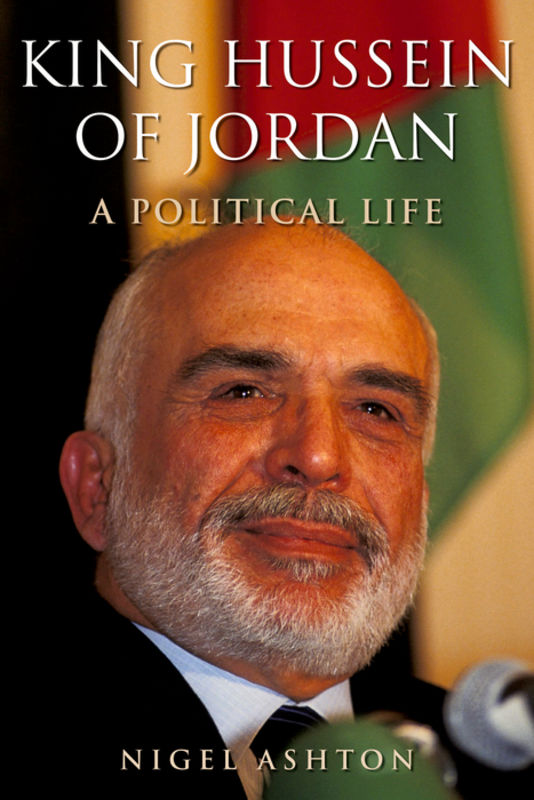
King Hussein of Jordan
A towering figure in the history of Jordan, King Hussein reigned for nearly half a century, from his grandfather's assassination in 1953 to his own death in 1999. In this fascinating biography, Nigel Ashton recounts the eventful life of the king who not only survived but flourished amidst crisis after crisis as ruler of a poor desert nation surrounded by powerful and hostile neighbors. Hussein skillfully navigated complicated relationships with the British, his fellow Arab leaders, the new bordering state of Israel, masses of dispossessed Palestinians within his kingdom, every U.S. president from Eisenhower to Clinton, and every British prime minister from Churchill to Blair. This book illuminates the private man, his key relationships, and his achievements and disappointments as a central player in the tough world of Middle Eastern politics.
Ashton has had unique access to King Hussein's private papers, including his secret correspondence with U.S., British, and Israeli leaders, and he has also conducted numerous interviews with members of Hussein's circle and immediate family. The resulting book brings new depth to our understanding of the popular and canny king while also providing new information about the wars of 1967 and 1973, President Reagan's role in the Iran-Contra affair, the evolution of the Middle East peace process, and much more.
eBook

King Hussein of Jordan : a political life
A towering figure, King Hussein reigned for nearly half a century, from his grandfather's assassination in 1953 to his own death in 1999. In this biography, Nigel Ashton recounts the eventful life of the king who not only survived but flourished amidst crisis after crisis as ruler of a poor desert nation surrounded by powerful and hostile neighbors. Hussein skillfully navigated complicated relationships with the British, his fellow Arab leaders, the new bordering state of Israel, masses of dispossessed Palestinians within his kingdom, every U.S. president from Eisenhower to Clinton, and every British prime minister from Churchill to Blair. This book illuminates the private man, his key relationships, and his achievements and disappointments as a central player in the tough world of Middle Eastern politics.--From publisher description.
BOOK

King Hussein and the challenge of Arab radicalism : Jordan 1955-1967
When the young Hussein became the King of Jordan in 1953, conventional wisdom held that his days were numbered. Yet Hussein and the Jordanian monarchy have not only endured, they have thrived and continue to play a vital role in Middle Eastern politics. Uriel Dann here explores the political history of the formative years of the Jordanian state, uncovering the sources of its durability against forces seeking to fundamentally alter the traditional bases of Arab politics.
eBook

Lion of Jordan : the life of King Hussein in war and peace
From the Publisher: During his long reign (1953-1999), King Hussein of Jordan was one of the most dominant figures in Middle Eastern politics and a consistent proponent of peace with Israel. This is the first major account of his life, written with access to his official documents and with the cooperation (but not approval) of his family and staff, and also extensive interviews with international policy makers. For more than forty years, Hussein walked a tightrope between the Palestinians and Arab radicals on the one hand and Israel on the other. Avi Shlaim reveals that, for the sake of dynastic and national survival, Hussein initiated a secret dialogue with Israel in 1963 that encompassed more than one thousand hours with Golda Meir, Shimon Peres, Yitzhak Shamir, Yitzhak Rabin, and countless others. Shlaim reconstructs this dialogue across battle lines from previously untapped Israeli records and the firsthand accounts of key participants, and makes clear that it was Israeli intransigence that was largely responsible for the failure to achieve a peaceful settlement between 1967 and 1994. At Hussein's memorial service at St. Paul's Cathedral, the Prince of Wales hailed him as \"a man amongst men, a king amongst kings.\" Lion of Jordan illuminates the triumphs and disappointments, the qualities and character of this extraordinary soldier and statesman, and significantly rewrites the history of the Middle East over the past fifty years.
Book

Institutions and the politics of survival in Jordan : domestic responses to external challenges, 1988-2001
Weaving together accounts of historical developments, cultural elements, economic factors, and regional and international dynamics, Russell E. Lucas explores how the monarchy in Jordan survived economic crisis and regional political instability during the 1990s. Lucas analyzes the factors behind the successful liberalization and deliberalization of laws regulating political parties, the parliament, and the press that helped preserve the monarchy. These institutional survival strategies co-opted the opposition, kept it divided, and reinforced the unity of the regime’s coalition of supporters. The author also compares survival strategies in Jordan with those of Morocco, Kuwait, Iran, and Egypt to explain the surprising durability of authoritarian regimes in the Middle East.
eBook


The social and economic origins of monarchy in Jordon : the moral economy of Hashemite rule in Jordan
\"The Social and Economic Origins of Monarchy in Jordan endeavors to explain the resilience of the Hashemite monarchy in Jordan. In contrast to much of the existing literature, it seeks answers to the puzzle of the persistence of monarchical rule neither in the statecraft of the Hashemite monarchs, nor in the dynamics of their policies on the Palestinian issue. Instead, it focuses on the historical political economy of Trans-Jordan, locating the durability of Hashemite rule in the evolution of a monarchical social pact that exchanged loyalty for economic security and bound the peasants and pastoralists of the East Bank to the throne\"-- Provided by publisher.
Book