
Catalogue Search | MBRL


Are you sure you want to remove the book from the shelf?

{{itemTitle}}
6,890
result(s) for
"Journalism Editing."
Sort by:


Art of Editing
Editing is an art and it`s not everyone`s cup of tea. One has to have an extra eye to make out a seemingly right sentence, with a serious mistake deeply buried in it. A person drinking from the jar of editing should be equiped with the particular skill and up to date knowledge of his area of work. He should be innovative and creative, with always pursing fresh vistas of knowledge, through all the sources available. An editor is a person, who makes addition and edition is a person, who makes addition and edition on a well-written piece of literature, very often by renowned literary personalities.
eBook


Physiologie du correcteur d'imprimerie
Extrait: \"Parmi la foule des illustrations que le monde scientifique, artistique, littéraire et industriel étale pompeusement sous nos yeux depuis quelques années, au milieu de tous ces types peints par eux-mêmes ou par une main tantôt hostile, tantôt amie, il est encore, à Paris même, ce centre incontesté des sciences, des arts, de la littérature et de l'industrie, un type complètement inconnu, et cependant bien digne des regards de l'observateur: ce type oublié ou... \"\"À PROPOS DES ÉDITIONS LIGARANLes éditions LIGARAN proposent des versions numériques de qualité de grands livres de la littérature classique mais également des livres rares en partenariat avec la BNF. Beaucoup de soins sont apportés à ces versions ebook pour éviter les fautes que l'on trouve trop souvent dans des versions numériques de ces textes. LIGARAN propose des grands classiques dans les domaines suivants: • Livres rares • Livres libertins • Livres d'Histoire • Poésies • Première guerre mondiale • Jeunesse • Policier
eBook


Ford Madox Ford, modernist magazines and editing
The controversial British writer Ford Madox Ford (1873-1939) is increasingly recognized as a major presence in early twentieth-century literature. This series of International Ford Madox Ford Studies was founded to reflect the recent resurgence of interest in him. Each volume is based upon a particular theme or issue; and relates aspects of Ford's work, life, and contacts, to broader concerns of his time. Modernist periodicals and editorial theory have been very productive areas in recent research. This volume focuses on Ford and editing. Ford was one of the greatest editors of Modernist magazines. He founded the English Review in Edwardian London, publishing Henry James, Joseph Conrad, H. G. Wells, Ezra Pound, Wyndham Lewis, and D. H. Lawrence. His editorial relationships with all of these writers are examined in detail here, as are those with Jean Rhys, Ernest Hemingway, and Basil Bunting, connected with the transatlantic review launched by Ford in post-war Paris, which also carried experimental work by James Joyce, Gertrude Stein, and Tristan Tzara. These seventeen essays bring together distinguished scholars and poets, as well as younger experts on Modernism and its magazine culture. This collection provides a wealth of new research on the management, cultural politics, and editorial stance of Ford's magazines; on the impact of his editorial contacts on his own and others' work; and on editorial approaches to his writing, including his best-known novels, The Good Soldier and Parade's End.
eBook
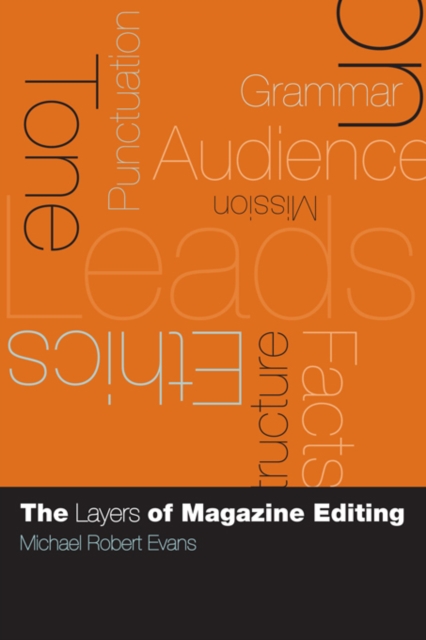
The Layers of Magazine Editing
Unlike the myriad writing manuals that emphasize grammar, sentence structure, and other skills necessary for entry-level editing jobs, this engaging book adopts a broader view, beginning with the larger topics of audience, mission, and tone, and working its way down, layer by layer, to the smaller questions of grammar and punctuation. Based on Michael Evans's years of experience as an editor and supplemented by invaluable observations from the editors of more than sixty magazines—including The Atlantic, Better Homes and Gardens, Ebony, Esquire, and National Geographic—this book reveals the people-oriented nature of the job.
eBook

Inside the Hollywood Fan Magazine
The fan magazine has often been viewed simply as a publicity tool, a fluffy exercise in self-promotion by the film industry. But as an arbiter of good and bad taste, as a source of knowledge, and as a gateway to the fabled land of Hollywood and its stars, the American fan magazine represents a fascinating and indispensable chapter in journalism and popular culture.Anthony Slide's Inside the Hollywood Fan Magazine provides the definitive history of this artifact. It charts the development of the fan magazine from the golden years when Motion Picture Story Magazine and Photoplay first appeared in 1911 to its decline into provocative headlines and titillation in the 1960s and afterward. Slide discusses how the fan magazines dealt with gossip and innuendo, and how they handled nationwide issues such as Hollywood scandals of the 1920s, World War II, the blacklist, and the death of President Kennedy. Fan magazines thrived in the twentieth century, and they presented the history of an industry in a unique, sometimes accurate, and always entertaining style.This major cultural history includes a new interview with 1970s media personality Rona Barrett, as well as original commentary from a dozen editors and writers. Also included is a chapter on contributions to the fan magazines from well-known writers such as Theodore Dreiser and e. e. cummings. The book is enhanced by an appendix documenting some 268 American fan magazines and includes detailed publication histories.
eBook

Why Editing Matters
Careful editing improves the clarity and accuracy of published material. The Journal of Southern History staff carefully checks every citation, every quotation, every statement of fact, every mathematical expression, and finds enough errors to justify its practice. Authors typically make a wide range of mistakes in both articles and book reviews, and exhortations to be accurate have little effect. The readers are the ultimate beneficiaries of intensive editing practices.
Journal Article
From Sloppy Copy to Polished Prose
\"Magazine articles don't just magically appear on the page. Good writers grab your attention. Then they keep you reading.\" (Appleseeds) Learn how a magazine article is written and proofread.
Magazine Article