
Catalogue Search | MBRL


Are you sure you want to remove the book from the shelf?

{{itemTitle}}
15
result(s) for
"Judaism -- History -- Modern period, 1750"
Sort by:

The Shtiebelization of Modern Jewry
Custom and ritual, or their Hebrew equivalent minhag, has intrigued rabbis and scholars for generations. Here, Simcha Fishbane treats minhag from a socio-anthropological perspective. She discusses the theory and model of minhagim, using the Mishnah Berurah and the Arukh Hashulkhan, analyses rabbinic texts concerned with custom, and describes current rituals from a socio-anthropological viewpoint.
eBook
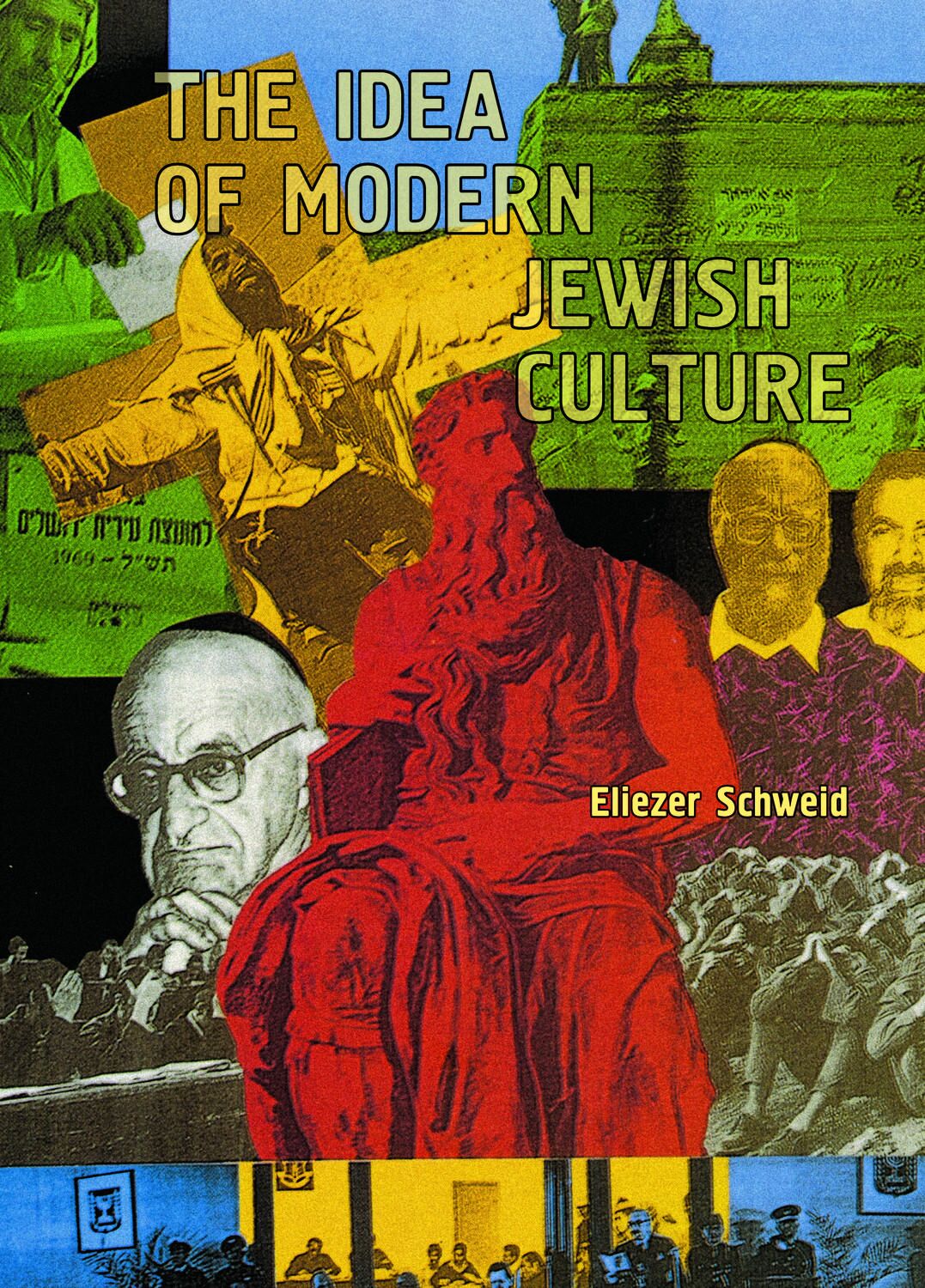
The Idea of Modern Jewish Culture
The vast majority of intellectual, religious, and national developments in modern Judaism revolve around the central idea of \"\"Jewish culture\"\". This book is the first synoptic view of these developments that organises and relates them from this vantage point.
eBook

An introduction to modern Jewish philosophy
The book is divided into three sections. The first provides a general historical overview for the Jewish thought that follows. The second summarizes the variety of basic kinds of popular, positive Jewish commitment in the twentieth century. The third and major section summarizes the basic thought of those modern Jewish philosophers whose thought is technically the best and/or the most influential in Jewish intellectual circles. The Jewish philosophers covered include Spinoza, Mendelssohn, Hermann Cohen, Martin Buber, Franz Rosenzweig, Mordecai Kaplan, and Emil Fackenheim.
eBook

Judaism today
For nearly four millennia Judaism was essentially a unified religious system based on shared traditions. Despite the emergence of various sub-groups through the centuries such as the Sadducees, Pharisees, Essenes, Karaites, Shabbateans and Hasadim, Jewry was united in the belief in a providential God who had chosen the Jews as his special people and given them a code of law.In the modern period, however, the Jewish religion has fragmented into a series of separate denominations with competing ideologies and theological views. Despite the creation of the State of Israel, the Jewish people are deeply divided concerning the most fundamental issues of belief and practice. Judaism Today gives an account of the nature of traditional Judaism, provides an introduction to the various divisions that currently exist in the Jewish world and identifies and discusses contemporary issues with which the Jewish faith engages in the twenty-first century. This refreshing new approach focuses on how Judaism is actually perceived and practised by Jews themselves and the problems currently facing Jews worldwide.
eBook

Political Economy as a Test of Modern Judaism
According to a common narrative, Jews entered the modern world at a steep price. From an autonomous corporation, ruling themselves internally according to their own standards and law, Judaism became a “religion,” divested of political power and responsible only for the internal sphere of “faith” or belief. The failure of this project, in turn, gave rise to the sharp split between Jewish nationalism and religion-based conceptions of Judaism. Many modern Jewish thinkers sought to resolve this antinomy by imagining ways for Judaism to once again form the basis of a “complete life”. This essay seeks to challenge this narrative by examining the extent to which economics, another one of the “spheres” emerging together with modernity and often considered under the same broadly Weberian process of rationalization, ever truly formed part of the holistic, self-contained Jewish autonomous life for which modern thinkers expressed so much nostalgia. It will argue that rather than forming part of the internal world of Judaism and then being fragmented outward into a separate sphere under the pressure of modernity, the “economic sphere” was imagined and defined for the first time in modernity, and projected backwards into earlier eras. This projection was then taken as proof of Judaism’s ability to “be about everything,” whether in a religious or nationalist idiom.
Journal Article
Between Jewish Tradition and Modernity
Although the ideas of \"tradition\" and \"modernity\" may seem to be directly opposed, David Ellenson, a leading contemporary scholar of modern Jewish thought, understood that these concepts can also enjoy a more fluid relationship. In honor of Ellenson, editors Michael A. Meyer and David N. Myers have gathered contributors for Between Jewish Tradition and Modernity: Rethinking an Old Opposition to examine the permutations and adaptations of these intertwined forms of Jewish expression. Contributions draw from a range of disciplines and scholarly interests and vary in subject from the theological to the liturgical, sociological, and literary. The geographic and historical focus of the volume is on the United States and the State of Israel, both of which have been major sites of inquiry in Ellenson's work. In twenty-one essays, contributors demonstrate that modernity did not simply replace tradition in Judaism, but rather entered into a variety of relationships with it: adopting or adapting certain elements, repossessing rituals that had once been abandoned, or struggling with its continuing influence. In four parts—Law, Ritual, Thought, and Culture—contributors explore a variety of subjects, including the role of reform in Israeli Orthodoxy, traditions of twentieth-century bar/bat mitzvah, end-of-life ethics, tensions between Zionism and American Jewry, and the rise of a 1960s New York Jewish counterculture. An introductory essay also presents an appreciation of Ellenson's scholarly contribution. Bringing together leading Jewish historians, anthropologists, sociologists, philosophers and liturgists, Between Jewish Tradition and Modernity offers a collective view of a historically and culturally significant issue that will be of interest to Jewish scholars of many disciplines.
eBook
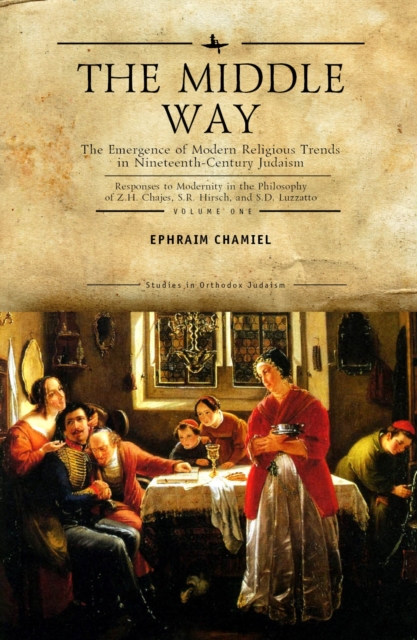
The middle way: the emergence of modern religious trends in nineteenth-century Judaism : responses to modernity in the philosophy of Z.H. Chajes, S.R. Hirsch, and S.D. Luzzatto
This book in two volumes is devoted to examining the first encounter between traditional Judaism and modern European culture, and the first thinkers who sought to combine the Torah with science, revelation with reason, prophecy with philosophy, Jewish ethics with European culture, worldliness with sanctity, and universalism with the particular redemption of the Jews. These religious thinkers of the nineteenth century struggled with challenges of the modern age that continue to confront the modern Jews to this day. This objective work of scholarship, neither simplistic and isolationist nor destructive and arrogant, will be of interest to the modern thinker and to scholars of the history of religions. It is relevant to comparative study between Judaism and the various denominations of Christianity and other faiths that seek to find a middle way between their traditions and modernity.
eBook

Judaism Today
For nearly four millennia Judaism was essentially a unified religious system based on shared traditions.Despite the emergence of various sub-groups through the centuries such as the Sadducees, Pharisees, Essenes, Karaites, Shabbateans and Hasadim, Jewry was united in the belief in a providential God who had chosen the Jews as his special people.
eBook

Encountering the Medieval in Modern Jewish Thought
How does the \"medieval\" function as a bearer of Jewish identity in a changing secular world? Each chapter in Encountering the Medieval in Modern Jewish Thought addresses a different Jewish return to the medieval by using a language of renewal.
eBook