
Catalogue Search | MBRL


Are you sure you want to remove the book from the shelf?

{{itemTitle}}
1,344
result(s) for
"Judentum"
Sort by:

RELIGIOUS IDENTITY AND ECONOMIC BEHAVIOR
We find using laboratory experiments that primes that make religion salient cause subjects to identify more with their religion and affect their economic choices. The effect on choices varies by religion. For example, priming causes Protestants to increase contributions to public goods, whereas Catholics decrease contributions to public goods, expect others to contribute less to public goods, and become less risk averse. A simple model implies that priming effects reveal the sign of the marginal impact of religious norms on preferences. We find no evidence of religious priming effects on disutility of work effort, discount rates, or dictator game generosity.
Journal Article

People under Power
At the time when the New Testament texts were written, the ultimate worldly power lay with the Roman Emperor and his delegates. Scholars have given different answers to questions of how the Roman Empire, its propaganda, and its policies affected the life and religious practices of different Jewish and early Christian groups. Several scholars have found, for instance, marks of anti-imperial polemics or other traces of imperial discourse in different New Testament writings. Others point out that many NT writers seem to have ignored the political system as part of the world that is passing away. Meanwhile the official attitude toward religious minorities ranged from indifference and scorn to active persecution. What impact did this have on the self-understanding of these minorities?
People under Power: Early Jewish and Christian Responses to the Roman Empire discusses these themes from fresh and varied perspectives using an array of methodological approaches ranging from interpreting archaeological evidence to postcolonial readings. Source materials include Jewish, Christian, and pagan texts.
The book contains contributions by George Brooke, Birgit van der Lans, Nóra Dávid, Anders Klostergaard Petersen, Martin Meiser, Klaus Scholtissek, Mark Grundeken, Paul Middleton, and Marco Frenschkowski.
eBook

Reclaiming the Wicked Son
Reclaiming the Wicked Son: Finding Judaism in Secular Jewish Philosophers takes the ideas of six well-known secular Jewish philosophers from Karl Marx and Ludwig Wittgenstein to Noam Chomsky and Judith Butler and views them through a wide range of Jewish lenses from the Talmudic tradition and prophetic Judaism to Kabbalist approaches, thereby understanding the twentieth century secular thinkers as on-going elements of a living Jewish intellectual tradition.
eBook
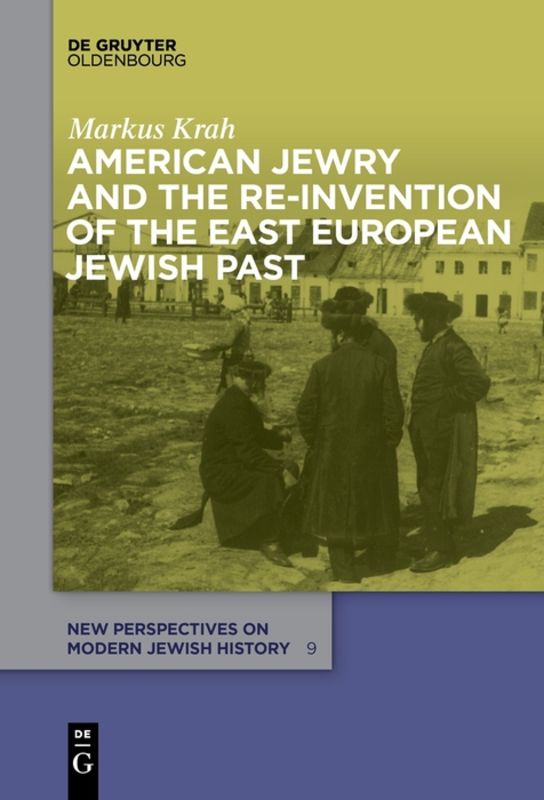
American Jewry and the Re-Invention of the East European Jewish Past
The postwar decades were not the \"golden era\" in which American Jews easily partook in the religious revival, liberal consensus, and suburban middle-class comfort. Rather it was a period marked by restlessness and insecurity born of the shock about the Holocaust and of the unprecedented opportunities in American society. American Jews responded to loss and opportunity by obsessively engaging with the East European past. The proliferation of religious texts on traditional spirituality, translations of Yiddish literature, historical essays , photographs and documents of shtetl culture, theatrical and musical events, culminating in the Broadway musical Fiddler on the Roof, illustrate the grip of this past on post-1945 American Jews. This study shows how American Jews reimagined their East European past to make it usable for their American present. By rewriting their East European history, they created a repertoire of images, stories, and ideas that have shaped American Jewry to this day.
eBook

People under Power
This volume presents a batch of incisive new essays on the relationship between Roman imperial power and ideology and Christian and Jewish life and thought within the empire. Employing diverse methodologies that include historical criticism, rhetorical criticism, postcolonial criticism, and social historical studies, the contributors offer fresh perspectives on a question that is crucial for our understanding not only of the late Roman Empire, but also of the growth and change of Christianity and Judaism in the imperial period.
eBook

Blessings Beyond the Binary
Transparent made history as the first television show to feature a transgender character in the main role, as the first streaming series to win the Golden Globe for Best Television Series, and as, in the words of journalist Debra Nussbaum Cohen, \"the Jewiest show ever.\" No television show in history has depicted the lives of American Jews with as.
eBook

Ritual, Spectacle, and Theatre in Late Medieval Seville
From the fall of Islamic Išbīliya in 1248 to the conquest of the New World, Seville was a nexus of economic and religious power where interconfessional living among Christians, Jews, and Muslims was negotiated on public stages. From out of seemingly irreconcilable ideologies of faith, hybrid performance culture emerged in spectacles of miraculous transformation, disciplinary processionals, and representations of religious identity.
Ritual, Spectacle, and Theatre in Late Medieval Seville reinvigorates the study of medieval Iberian theatre by revealing the ways in which public expressions of devotion, penance, and power fostered cultural reciprocity, rehearsed religious difference, and ultimately helped establish Seville as the imperial centre of Christian Spain.
eBook

Jewish Allegory in Eighteenth-Century Christian Imagination
Rebecca K. Esterson explores how Christian methods of biblical
interpretation shifted during the eighteenth century, producing a
rhetorical rejection of allegory while embracing literalism. Under
the influence of Enlightenment concepts of human reason and
advances in the experimental sciences, Christian interpreters began
casting Jewish biblical interpretation as allegorical, while
presenting Christian interpretation as literal. This shift in
self-understanding allowed Christians to portray their own
interpretations as scientifically, philosophically, and
historically superior, resulting in a new way of othering the
Jewish people. This study of biblical exegesis, theology,
philosophy, and the arts in English, Swedish, and German contexts
is an essential resource for scholars interested in biblical
reception history and the history of Jewish-Christian
relations.
eBook

What Is Hellenistic Judaism?
Abstract
Martin Hengel argued effectively that all Judaism in the Hellenistic period was Hellenistic Judaism, but Judaism in the land of Israel remained very different from its counterpart in the Diaspora. Recent study of globalization and \"glocalization\" has shown that local cultures are not obliterated by globalization but react to it in various ways. There is also a new and growing appreciation of the differences between the Seleucid and Ptolemaic empires. The category of Hellenism, understood as the ways of thinking of all the peoples subjected to Greek influence, remains useful, but it must be understood to embrace considerable local diversity, and not limited to the use of the Greek language.
Journal Article

Tours That Bind
Since 1999 hundreds of thousands of young American Jews have visited Israel on an all-expense-paid 10-day pilgrimage-tour known as Birthright Israel. The most elaborate of the state-supported homeland tours that are cropping up all over the world, this tour seeks to foster in the American Jewish diaspora a lifelong sense of attachment to Israel based on ethnic and political solidarity. Over a half-billion dollars (and counting) has been spent cultivating this attachment, and despite 9/11 and the ongoing Israeli-Palestinian conflict the tours are still going strong. Based on over seven years of first-hand observation in modern day Israel, Shaul Kelner provides an on-the-ground look at this hotly debated and widely emulated use of tourism to forge transnational ties. We ride the bus, attend speeches with the Prime Minister, hang out in the hotel bar, and get a fresh feel for young American Jewish identity and contemporary Israel. We see how tourism's dynamism coupled with the vibrant human agency of the individual tourists inevitably complicate tour leaders' efforts to rein tourism in and bring it under control. By looking at the broader meaning of tourism, Kelner brings to light the contradictions inherent in the tours and the ways that people understandtheir relationship to place both materially and symbolically. Rich in detail, engagingly written, and sensitive to the complexities of modern travel and modern diaspora Jewishness, Tours that Bind offers a new way of thinking about tourism as a way through which people develop understandings of place, society, and self.
eBook