
Catalogue Search | MBRL


Are you sure you want to remove the book from the shelf?

{{itemTitle}}
9,553
result(s) for
"Judicial decision making"
Sort by:

Preserving the rule of law in the era of artificial intelligence (AI)
The study of law and information technology comes with an inherent contradiction in that while technology develops rapidly and embraces notions such as internationalization and globalization, traditional law, for the most part, can be slow to react to technological developments and is also predominantly confined to national borders. However, the notion of the rule of law defies the phenomenon of law being bound to national borders and enjoys global recognition. However, a serious threat to the rule of law is looming in the form of an assault by technological developments within artificial intelligence (AI). As large strides are made in the academic discipline of AI, this technology is starting to make its way into digital decision-making systems and is in effect replacing human decision-makers. A prime example of this development is the use of AI to assist judges in making judicial decisions. However, in many circumstances this technology is a ‘black box’ due mainly to its complexity but also because it is protected by law. This lack of transparency and the diminished ability to understand the operation of these systems increasingly being used by the structures of governance is challenging traditional notions underpinning the rule of law. This is especially so in relation to concepts especially associated with the rule of law, such as transparency, fairness and explainability. This article examines the technology of AI in relation to the rule of law, highlighting the rule of law as a mechanism for human flourishing. It investigates the extent to which the rule of law is being diminished as AI is becoming entrenched within society and questions the extent to which it can survive in the technocratic society.
Journal Article


Two Forms of Conservatism
The period between 1860 and 1920-inclusive of the Gilded Age and
much of the Lochner era in legal history-is typically
regarded as the heyday of conservative jurisprudence. According to
this received wisdom, conservative judges and much of the legal
profession were on the side of big business and the rich. Judges in
this period subscribed to \"classical\" legal thought, and it was
only when this was supplanted by \"progressive\" legal thought that
courts reached decisions critical of business.
Renowned legal historian William E. Nelson seeks to correct this
narrative by examining in close detail the work of judges in the
single jurisdiction of New York as well as the rulings of U.S.
Supreme Court justices. What he finds is another type of
conservatism besides the one that favors the rich. Instead, the
judges in this period often reached decisions that were critical of
business. Many of their accomplishments were forward-looking and
progressive in character but conservative for another reason: they
rigidly followed precedent, with only occasional exceptions. While
some legal realists see the emphasis on precedent as a veneer to
hide the judges' policy preferences, Nelson shows that this
explanation does not fit the evidence. The judges had no consistent
policy preferences, and their decisions favored a wide array of
policies.
Two Forms of Conservatism is the work of an expert
historian with an eye for detail and a deep understanding of legal
thought. He shows that these New York judges, who were quite
conservative regarding the law, nevertheless laid the foundation
for the liberalism of later political leaders.
eBook

Decision making by the modern Supreme Court
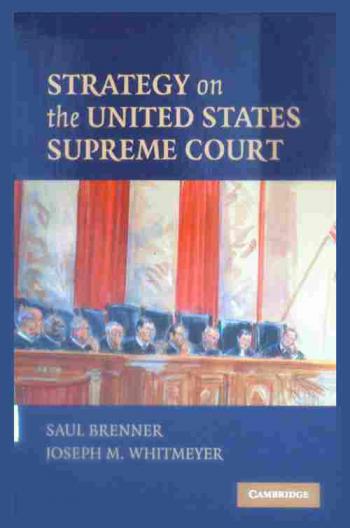
\"There are three general models of Supreme Court decision making: the legal model, the attitudinal model and the strategic model. But each is somewhat incomplete. This book advances an integrated model of Supreme Court decision making that incorporates variables from each of the three models. In examining the modern Supreme Court, since Brown v. Board of Education, the book argues that decisions are a function of the sincere preferences of the justices, the nature of precedent, and the development of the particular issue, as well as separation of powers and the potential constraints posed by the president and Congress. To test this model, the authors examine all full, signed civil liberties and economic cases decisions in the 1953-2000 period. Decision Making by the Modern Supreme Court argues, and the results confirm, that judicial decision making is more nuanced than the attitudinal or legal models have argued in the past\"--Provided by publisher.
BOOK

Challenged Justice: In Pursuit of Judicial Independence
Challenged Justice: In Pursuit of Judicial Independence is an academic continuation of the previous volumes on judicial Independence edited by Shimon Shetreet, with others: Jules Deschenes, Christopher Forsyth, and Wayne McCormack. All books were published by Brill Nijhoff: Judicial Independence: The Contemporary Debate (1985), The Culture of Judicial Independence: Conceptual Foundations and Practical Challenges (2012), The Culture of Judicial Independence: Rule of Law and World Peace (2014) and The Culture of Judicial Independence in a Globalised World (2016).This book offers academic articles by distinguished jurists on judicial independence and judicial process in many jurisdictions including indicators of justice and analysis of international Standards on judicial independence and judicial ethics.
eBook


Justice Outsourced
Nonjudicial officers (NJOs) permeate the criminal justice and the forensic mental health systems in hidden ways. But what are the impact and consequences of non-lawyers and non- \"real judges\" hearing cases? Across the nation, numerous cases are outsourced to administrative and other NJOs to decide issues ranging from family court cases involving custody disputes and foster care, to alcohol, substance abuse, as well as mental health and institutionalization issues. Moreover, NJOs may also deal with probation sentencing, conditions of confinement, release restrictions, and even capital punishment.
The editors and contributors to the indispensable Justice Outsourced examine the hidden role of these non-judicial officers in the courtroom and administrative settings, as well as the ethical and practical considerations of using NJOs. Written from the perspective of therapeutic jurisprudence by judges, criminologists, lawyers, law professors, psychologists, and sociologists, this volume provides a much-needed wake-up call that emphasizes why the removal of a judge weakens a defendant's rights and dignity and corrupts the administration of justice. However, Justice Outsourced also suggests effective employments of NJOs, revealing the potential of therapeutic principles and procedures to enhance the practical knowledge supplied by nonjudicial decision-makers.
eBook