
Catalogue Search | MBRL


Are you sure you want to remove the book from the shelf?

{{itemTitle}}
11
result(s) for
"Judicial error Great Britain."
Sort by:

The Criminal Cases Review Commission : hope for the innocent?
\"This book focuses on the world's first publicly-funded body- the Criminal Cases Review Commission- to review alleged miscarriages of justice, set up following notorious cases such as the Birmingham Six in the UK. Providing a critique of its operations, the book shows that its help to innocent victims of wrongful conviction is merely incidental\"--Provided by publisher.
Book
The Longest Injustice
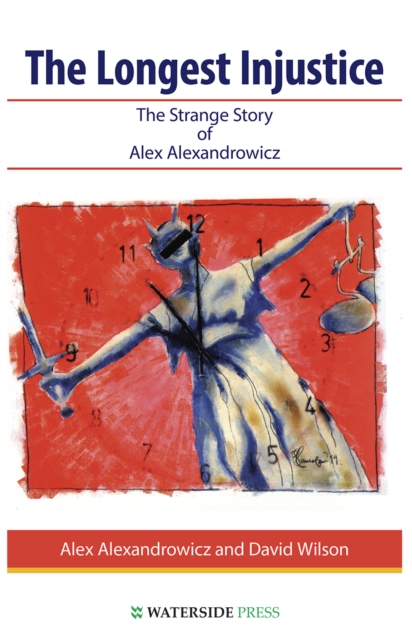
Alex Alexandrowicz spent 22 years in custody protesting his innocence. This book explains how something which began with a plea bargain in the belief that he would serve a 'short' sentence turned into a Kafkaesque nightmare. His 'Prison Chronicles' are placed in perspective by Professor David Wilson. The Longest Injustice contains the full story of Anthony Alexandrovich - known universally as 'Alex'. Principally, the book is about his 29-year fight against his conviction as a seventeen-year-old for aggravated burglary, wounding with intent, and assault occasioning actual bodily harm. Twenty-two of these years were spent in prison where Alex was a discretionary life sentenced prisoner, and where he steadfastly maintained his innocence. He continues to do so after release, and is taking his case through the Criminal Cases Review Commission (CCRC), which was set up in 1995 to investigate alleged miscarriages of justice. Alex's own recollections are supplemented by analysis of the dilemma facing people in British prisons who are determined to maintain their innocence, and the book highlights the considerable disincentives and disadvantages to them of doing so. Authors Alex Alexandrowicz spent 22 years in some of Britain's most notorious gaols much of this time as a Category A high security prisoner. His Prison Chronicles are a first hand account in which he explains why he believes he was wrongly convicted (a matter currently with the Criminal Cases Review Commission) and vividly recreates his experiences of the early years following his arrest. Institutionalised by the system and apprehensive of the outside world he now lives alone in Milton Keynes where he continues the long fight to clear his name from a flat which has grown to resemble a prison cell. David Wilson is professor of criminology at the Centre for Criminal Justice Policy and Research at the University of Central England in Birmingham. A former prison governor, he is editor of the Howard Journal and a well-known author, broadcaster and presenter for TV and radio, including for the BBC, C4 and Sky Television. He has written three other books for Waterside Press: Prison(er) Education: Stories of Change and Transformation (with Ann Reuss) (2000), Images of Incarceration: Representations of Prison in Film and Television Drama (with Sean O'Sullivan) (2004), and Serial Killers: Hunting Britons and Their Victims (2007).
eBook

The fortune men
\"Based on a true event, The Fortune Men tells the intimate, harrowing story of the last man in Britain to be sentenced to death. In Cardiff, Wales in 1952, Mahmood Mattan, a young Somali sailor, is accused of a crime he did not commit: the brutal killing of Violet Volacki, a shopkeeper from Tiger Bay. At first, Mahmood believes he can ignore the fingers pointing his way; he may be a gambler and a petty thief, but he is no murderer. He is a father of three, secure in his innocence and his belief in British justice. But as the trial draws closer, his prospect for freedom dwindles. Now, Mahmood must stage a terrifying fight for his life, with all the chips stacked against him: a shoddy investigation, an inhumane legal system, and, most evidently, pervasive and deep-rooted racism at every step. Under the shadow of the hangman's noose, Mahmood begins to realize that even the truth may not be enough to save him. A haunting tale of miscarried justice, this book offers a chilling look at the dark corners of our humanity.\" -- Provided by publisher.
Book

The Ouija Board Jurors
The Ouija board jury incident of 1994 is one of the most disconcerting in English legal history. In this first full-length treatment he emphasises the known facts, the constitutional dilemma of investigating even bizarre jury misbehaviour and how the trial involved one of the most serious murder cases of the decade in which two people were shot in cold blood.
eBook

'THIS IS NOT JUSTICE': Ian Tomlinson, Institutional Failure and the Press Politics of Outrage
This article contributes to research on the sociology of scandal and the role of national newspapers and, more particularly, newspaper editorials in setting the agenda for public debate around police accountability and miscarriages of justice. In previous work, we analysed how citizen journalism framed news coverage of the policing of the G20 Summit, London 2009, and the death of Ian Tomlinson (Greer and McLaughlin 2010). In this article, we consider the next stage of the Ian Tomlinson case. Our empirical focus is the controversy surrounding the Crown Prosecution Service (CPS) decision not to prosecute the police officer filmed striking Tomlinson shortly before he collapsed and died. We illustrate how the press's relentless agenda-setting around 'institutional failure', initially targeted at the Metropolitan Police Service, expanded to implicate a network of criminal justice institutions. The Tomlinson case offers insights into the shifting nature of contemporary relations between the British press and institutional power. It is a paradigmatic example of a politically ambitious form of 'attack journalism', the scope of which extends beyond the criminal justice system. In a volatile information-communications marketplace, journalistic distrust of institutional power is generating a 'press politics of outrage', characterized by 'scandal amplification'.
Journal Article
Execution
An absorbing account of the life and times of William Watkins - 'an ordinary Englishman' - who, having fathered ten children, was executed in 1951 for the murder of his eleventh child.With a Foreword by Sir Michael Davies, former High Court Judge, and one of Watkins' defence counsel at his trial. Covers William Watkins' life through to his execution for murder. John Pugh, then an articled clerk, was in court as the death sentence was passed and has never forgotten that experience. He has undertaken prodigious research to create a unique historical and social record from the era of 'appalling policing and justice' that followed on from the Second World War - a time when such events could, it seems, be a matter of some indifference to the public and authorities alike.
eBook

Wrongful Convictions: The American Experience
The increasing number of high-profile cases of wrongful conviction, often brought to light by DNA exonerations, and the publicity associated with those errors have increased the salience of this issue on the public policy agendas of a number of U.S. states, as well as in Canada. Scholarly research on this subject has also increased over the past two decades. This article discusses the extent to which these errors may occur; the major factors contributing to false convictions; recent and current developments regarding legislation in the United States; innocence projects and innocence commissions in the United States, Britain, and Canada; and the significance of wrongful conviction as a factor in the current challenges to the death penalty in the United States. It is important that we develop a better understanding of wrongful conviction and its causes so that we can both better protect the rights of the innocent and better protect citizens from being victimized by offenders who remain free while the wrongly convicted are sent to prison.
Journal Article

Multiculturalism, Institutional Law, and Imaginary Justice
Following Le Pen's relative successin the French presidential vote and the BritishNational Party's historic return in our own2002 local elections, the article considers theprospects for the production of morecommunicative race relations in contemporaryBritain. To this end we reassess the media'streatment of the Stephen Lawrence case andexplore the political logic of the Macphersonreport, the policy document which followed theapparent miscarriage of justice that allowedLawrence's alleged killers to walk free. Interms of our analysis of the media we areconcerned to show how the real of Britain'sordinary racism was hidden behind an ideologyof multiculturalism that scapegoated singularindividuals to cover for the structuralinequalities of wider society. The article aimsto show how the media upheld the notion ofobjective justice that institutional law wasapparently unable to secure. But while the media supported the ideology ofthe law, its exposure of the failings ofinstitutional law also led to calls for legalreform to guarantee the realisation ofinstitutional justice. Although we accept thatthe attempt to achieve legal totality isimpossible, our argument is that the critiqueof legal objectivity, which takes in subjectiverights claims, may present the possibility forthe realisation of a novel, inclusive, model ofrace relations. That is to say that althoughthe media supports the ideology of the law, thefact that this support requires a critique ofpractical law forces the law to modernisearound the idealistic demands of its ownideological structure. Akin toDouzinas,^sup 1^ who has argued for theendless expansion of rights as post-modernutopianism, we believe that this process ofmodernisation, which is arranged to maintainthe status quo through minimal reform, is thecondition of possibility of a more inclusivesystem of race relations.[PUBLICATION ABSTRACT]
Journal Article