
Catalogue Search | MBRL


Are you sure you want to remove the book from the shelf?

{{itemTitle}}
3,094
result(s) for
"Judicial error."
Sort by:

Miscarriages of justice in Canada : causes, responses, remedies
\"Innocent people are regularly convicted of crimes they did not commit. A number of systemic factors have been found to contribute to wrongful convictions, including eyewitness misidentification, false confessions, informant testimony, official misconduct, and faulty forensic evidence. In Miscarriages of Justice in Canada, Kathryn M. Campbell offers an extensive overview of wrongful convictions, bringing together current sociological, criminological, and legal research, as well as current case-law examples. For the first time, information on all known and suspected cases of wrongful conviction in Canada is included and interspersed with discussions of how wrongful convictions happen, how existing remedies to rectify them are inadequate, and how those who have been victimized by these errors are rarely compensated. Campbell reveals that the causes of wrongful convictions are, in fact, avoidable, and that those in the criminal justice system must exercise greater vigilance and openness to the possibility of error if the problem of wrongful conviction is to be resolved.\"-- Provided by publisher.
Book

Life after Death Row
Life after Death Rowexamines the post-incarceration struggles of individuals who have been wrongly convicted of capital crimes, sentenced to death, and subsequently exonerated.Saundra D. Westervelt and Kimberly J. Cook present eighteen exonerees' stories, focusing on three central areas: the invisibility of the innocent after release, the complicity of the justice system in that invisibility, and personal trauma management. Contrary to popular belief, exonerees are not automatically compensated by the state or provided adequate assistance in the transition to post-prison life. With no time and little support, many struggle to find homes, financial security, and community. They have limited or obsolete employment skills and difficulty managing such daily tasks as grocery shopping or banking. They struggle to regain independence, self-sufficiency, and identity.
Drawing upon research on trauma, recovery, coping, and stigma, the authors weave a nuanced fabric of grief, loss, resilience, hope, and meaning to provide the richest account to date of the struggles faced by people striving to reclaim their lives after years of wrongful incarceration.
eBook

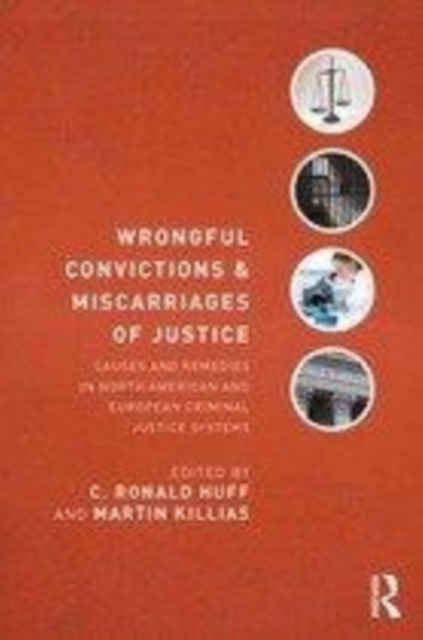
Wrongful Convictions and Miscarriages of Justice: Causes and Remedies in North American and European Criminal Justice Systems
This innovative work builds on Huff and Killias' earlier publication (2008), but is broader and more thoroughly comparative in a number of important ways: (1) while focusing heavily on wrongful convictions, it places the subject of wrongful convictions in the broader contextual framework of miscarriages of justice and provides discussions of different types of miscarriages of justice that have not previously received much scholarly attention by criminologists; (2) it addresses, in much greater detail, the questions of how, and how often, wrongful convictions occur; (3) it provides more in-depth consideration of the role of forensic science in helping produce wrongful convictions and in helping free those who have been wrongfully convicted; (4) it offers new insights into the origins and current progress of the innocence movement, as well as the challenges that await the exonerated when they return to \"free\" society; (5) it assesses the impact of the use of alternatives to trials (especially plea bargains in the U.S. and summary proceedings and penal orders in Europe) in producing wrongful convictions; (6) it considers how the U.S. and Canada have responded to 9/11 and the increased threat of terrorism by enacting legislation and adopting policies that may exacerbate the problem of wrongful conviction; and (7) it provides in-depth considerations of two topics related to wrongful conviction: voluntary false confessions and convictions which, although technically not wrongful since they are based on law violations, represent another type of miscarriage of justice since they are due solely to unjust laws resulting from political repression.
eBook


The confession
Travis Boyette is a murderer. In 1998, in the small East Texas city of Sloan, he abducted, raped, and strangled a popular high-school cheerleader. He buried her body so that it would never be found, then watched and waited as police and prosecutors arrested Donte Drumm, a local football star with no connection to the crime. Tried, convicted and sentenced, Drumm was sent to death row: his fate had been decided. Nine years later, Donte Drumm is four days from executions. Over 400 miles away in Kansas, Travis faces a fate of his own: an inoperable brain tumour will soon deliver the end. Reflecting on his miserable life, he decides to do what's right. After year of silence he ist ready to confess. But how can a guilty man convince lawyers, judges and politicians that they're about to execute an innocent man?
Book

Shattered Justice
Shattered Justice presents original crime victims' experiences with violent crime, investigations and trials, and later exonerations in their cases. Using in-depth interviews with 21 crime victims across the United States, Cook reveals how homicide victims' family members and rape survivors describe the painful impact of the primary trauma, the secondary trauma of the investigations and trials, and then the tertiary trauma associated with wrongful convictions and exonerations. Important lessons and analyses are shared related to grief and loss, and healing and repair. Using restorative justice practices to develop and deliver healing retreats for survivors also expands the practice of restorative justice. Finally, policy reforms aimed at preventing, mitigating, and repairing the harms of wrongful convictions is covered.
eBook

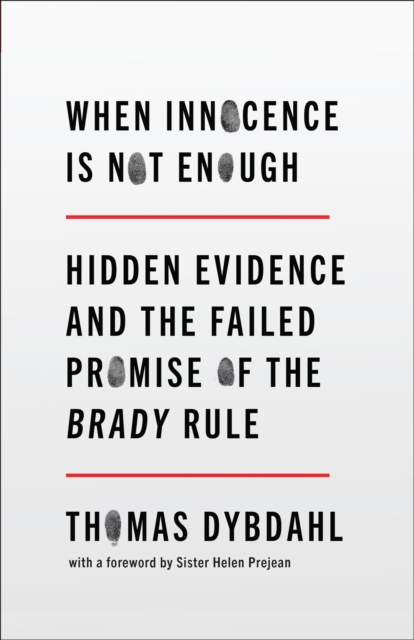
When Innocence Is Not Enough
Finalist, Colorado Book Award
A gripping work of narrative nonfiction, told across
time, that exposes what’s at stake when prosecutors
conceal evidence—and what we can do about it The
Brady rule was meant to transform the U.S. justice
system. In soaring language, the Supreme Court decreed in 1963
that prosecutors must share favorable evidence with the
defense—part of a suite of decisions of that
reform-minded era designed to promote fairness for those
accused of crimes. But reality intervened. The opinion faced
many challenges, ranging from poor legal reasoning and shaky
precedent to its clashes with the very foundations of the
American criminal legal system and some of its most powerful
enforcers: prosecutors.
In this beautifully wrought work of narrative nonfiction,
Thomas L. Dybdahl illustrates the promise and shortcomings of
the
Brady rule through deft storytelling and attention to
crucial cases, including the infamous 1984 murder of Catherine
Fuller in Washington, DC. This case led to eight young Black
men being sent to prison for life after the prosecutor, afraid
of losing the biggest case of his career, hid information that
would have proven their innocence.
With a seasoned defense lawyer’s unsparing eye for
detail, Thomas L. Dybdahl chronicles the evolution of the
Brady rule—from its unexpected birth to the
series of legal decisions that left it defanged and
ineffective. Yet Dybdahl shows us a path forward by
highlighting promising reform efforts across the country that
offer a blueprint for a legislative revival of
Brady ’s true spirit.
eBook