
Catalogue Search | MBRL


Are you sure you want to remove the book from the shelf?

{{itemTitle}}
2,438
result(s) for
"Jurisprudence Methodology."
Sort by:


The methodology of Maurice Hauriou : legal, sociological, philosophical
This book shows that Hauriou's positivist and pragmatic jurisprudence and social theory, as well as their application to the study of institutions, is satisfactorily supported by his idealistic philosophy. The nine chapters first locate Hauriou's influences, then situate his disciplinary methodologies within methodology in general. The central chapters concern each of the three methodologies in turn.
eBook


Âmm Lafızların Delaletleri Bağlamında Tefsir-Fıkıh Usulü İlişkisi
Bu makale, Kur’an’ın ȃmm lafızlarının delaleti bağlamında tefsir ilmi ile fıkıh usulünün ilişkisini araştırmaktadır Esasen İslami ilimler bağlamında ȃmm lafızların delaleti, İslam’ın temel metinlerindeki lafızlarla ilgili olduğu için sadece fıkıh usulü veya tefsir ilminin özel konusu değil, tüm İslami ilimlerin ortak konusudur. İslami ilimlerin üzerinde çalıştığı temel dini metinlerin aynılığı, bu ilimler arasında disiplinlerarası ilişkileri zorunlu hale getirmektedir. Tefsir ilmi ile fıkıh usulü arasındaki ilişkinin ȃmm lafızlar bağlamında işlenmesinin nedeni de budur. Fıkıh usulü, bu konuyu Kur’an’ın lafızlarından ve ibarelerinden hukuki normlar çıkarmak için incelemektedir. Yani lafızların vaz‘ȋ delaleti, fıkıh usulünün hukuki normlar çıkarmak için müracaat ettiği temel istidlal yöntemlerinden biridir. Tefsir ilmi ise Arap dilinin kaide ve teamüllerine dayanan bu istidlal yöntemini, ilgili lafızlarla Allah’ın neyi murad ettiğini belirleyebilmek için konu edinmektedir. Lafızların vaz‘ȋ delaleti konusunda tefsir ilmi ile fıkıh usulünün birbirinden ayrıldığı esas nokta da budur. Ayrıca lafızların delaletleri, İslam bilginlerine ilahi hitabı, farklı zamanlar ve mekânlardaki muhataplarının vakıalarıyla ilişkilendirme imkânını vermektedir.
Journal Article

En busqueda de la estructura ontologica del derecho
La tarea central de la teoría del derecho es la de explicar la ontología del derecho o, como comúnmente se señala, su naturaleza. El objetivo de este ensayo es describir de manera general una metodología que permita llevar a cabo investigaciones acerca de la naturaleza del derecho. Se sostiene que investigaciones de este tipo deben empezar con una comprensión pre-reflexiva del derecho en tanto entidad basada en una práctica social. Asimismo, que dichas investigaciones deben tratar de reducir la explicación acerca de la naturaleza del derecho a un catálogo de condiciones necesarias y suficientes para la existencia del derecho, y que el éxito en esta empresa no depende solo del análisis conceptual, sino que precisa también de una construcción teórica que tenga por objeto el logro de un equilibrio reflexivo. PALABRAS CLAVE Metodología de la teoría del derecho, análisis conceptual, equilibrio reflexivo, ontología jurídica, naturaleza del derecho. The central task of jurisprudence is explaining the ontology of law or, as it is commonly said, its nature. The aim of this paper is to outline a methodology for carrying out inquiries into the nature of law. I argue that enquiries of this kind ought to begin with a pre-reflective understanding of law as an entity grounded in a social practice, that they should attempt to provide reductive necessary and sufficient conditions for the existence of law, and that success in this enterprise depends on conceptual analysis although it also requires a theory construction aiming at achieving a reflective equilibrium. KEYWORDS Methodology of jurisprudence, conceptual analysis, reflective equilibrium, legal ontology, nature of law.
Journal Article
Methodologies of legal research
Until quite recently, questions about methodology in legal research have been largely confined to understanding the role of doctrinal research as a scholarly discipline. In turn, this has involved asking questions not only about coverage but, fundamentally, questions about the identity of the discipline. Is it (mainly) descriptive, hermeneutical, or normative? Should it also be explanatory? Legal scholarship has been torn between, on the one hand, grasping the expanding reality of law and its context, and, on the other, reducing this complex whole to manageable proportions. The purely internal analysis of a legal system, isolated from any societal context, remains an option, and is still seen in the approach of the French academy, but as law aims at ordering society and influencing human behavior, this approach is felt by many scholars to be insufficient. Consequently, many attempts have been made to conceive legal research differently. Social scientific and comparative approaches have proven fruitful. However, does the introduction of other approaches leave merely a residue of 'legal doctrine,' to which pockets of social sciences can be added, or should legal doctrine be merged with the social sciences? What would such a broad interdisciplinary field look like and what would its methods be? This book answers these questions, focusing on the growing need to concentrate on the various methods of legal research. It will be extremely useful to Ph.D students, as well as other legal scholars.
eBook

Research involving adults lacking capacity to consent: a content analysis of participant information sheets for consultees and legal representatives in England and Wales
Background
Research involving adults who lack the capacity to provide informed consent can be challenging. In England and Wales there are legal provisions for consulting with others who know the person with impaired capacity. The role of the ‘proxy’ (or ‘surrogate’) is to advise researchers about the person’s wishes and feelings or to provide consent on the person’s behalf for a clinical trial of a medicine. Information about the study is usually provided to the proxy; however, little information is available to proxies about their role, or the appropriate legal and ethical basis for their decision, to help inform their decision-making. The aim of this study was to analyse the written information that is provided to consultees and legal representatives.
Methods
Studies including adults lacking capacity to consent which utilised consultees or legal representatives were identified using the UK Clinical Trials Gateway database. A representative sample (
n
= 30) were randomly selected. Information sheets and other study documents provided to proxies were obtained, and relevant content was extracted. Content analysis was conducted through four stages: decontextualisation of the unit of analysis, recontextualisation, categorisation, and compilation. The data were summarised narratively according to each theme and category.
Results
Considerable variation was found in the written information sheets provided to proxies. Most directed proxies to consider the wishes and feelings of the person who lacked capacity and to consult with others during the decision-making process. However, a small number of studies extended the scope of the proxy’s role to consider the person’s suitability or eligibility for the study. Particular discrepancies were found in information provided to those acting as consultees or legal representatives in a professional, as opposed to a personal, capacity. Incorrect uses of terminology were frequently found, and a small number of studies inaccurately interpreted the law.
Conclusions
Despite undergoing ethical review, study documents lacked essential information, incorrectly used terminology, and conflated professionals’ clinical and representation roles. Future recommendations include ensuring proxies are provided with adequate and accurate information which complies with the legal frameworks. Further research is needed to explore the information and decision-making needs of those acting as consultees and legal representatives.
Journal Article
A Legal Knowledge Management System Based on Core Ontology
This chapter mainly focuses on describing the legal ontology construction approach and presenting the methodology for decision structuring. It begins by giving an insight into technologies that can be considered as part of the knowledge management (KM) resources in the legal field. Then, the functional architecture is presented. The chapter describes the legal ontology construction approach by detailing the domain concept extraction step, the reference ontological framework, and the authors' contribution over the existing legal ontologies. In the second part of the chapter, the jurisprudence decision structuring methodology is presented. An overview of related works of the thematic document structuring, is provided. Then, the linguistic analysis and the linguistic marker extraction steps, are explained. Next, the extraction pattern construction is described. Finally, it is shown how the legal ontology and the extraction patterns are used to structure the jurisprudence decisions.
Book Chapter

The influence of COVID-19 on agricultural economy and emergency mitigation measures in China: A text mining analysis
Understanding the influence of COVID-19 on China's agricultural economy and the Chinese government's emergency measures to ease the economic impacts of viral spread can offer urgently-needed lessons while this virus continues to spread across the globe. Thus, this study collected over 750,000 words upon the topic of COVID-19 and agriculture from the largest two media channels in China: WeChat and Sina Weibo, and employed web crawler technology and text mining method to explore the influence of COVID-19 on agricultural economy and mitigation measures in China. The results show that: (1) the impact of COVID-19 on China's agricultural economy at the very first phase is mainly reflected in eight aspects as crop production, agricultural products supply, livestock production, farmers' income and employment, economic crop development, agricultural products sales model, leisure agriculture development, and agricultural products trade. (2) The government's immediate countermeasures include resuming agricultural production and farmers' work, providing financial support, stabilizing agricultural production and products supply, promoting agricultural products sale, providing subsidies, providing agricultural technology guidance and field management, and providing assistance to poor farmers to reduce poverty. (3) The order of government's immediate countermeasures is not all in line with the order of impact aspects, which indicates that more-tailored policies should be implemented to mitigate the strikes of COVID-19 on China's agricultural economy in the future.
Journal Article
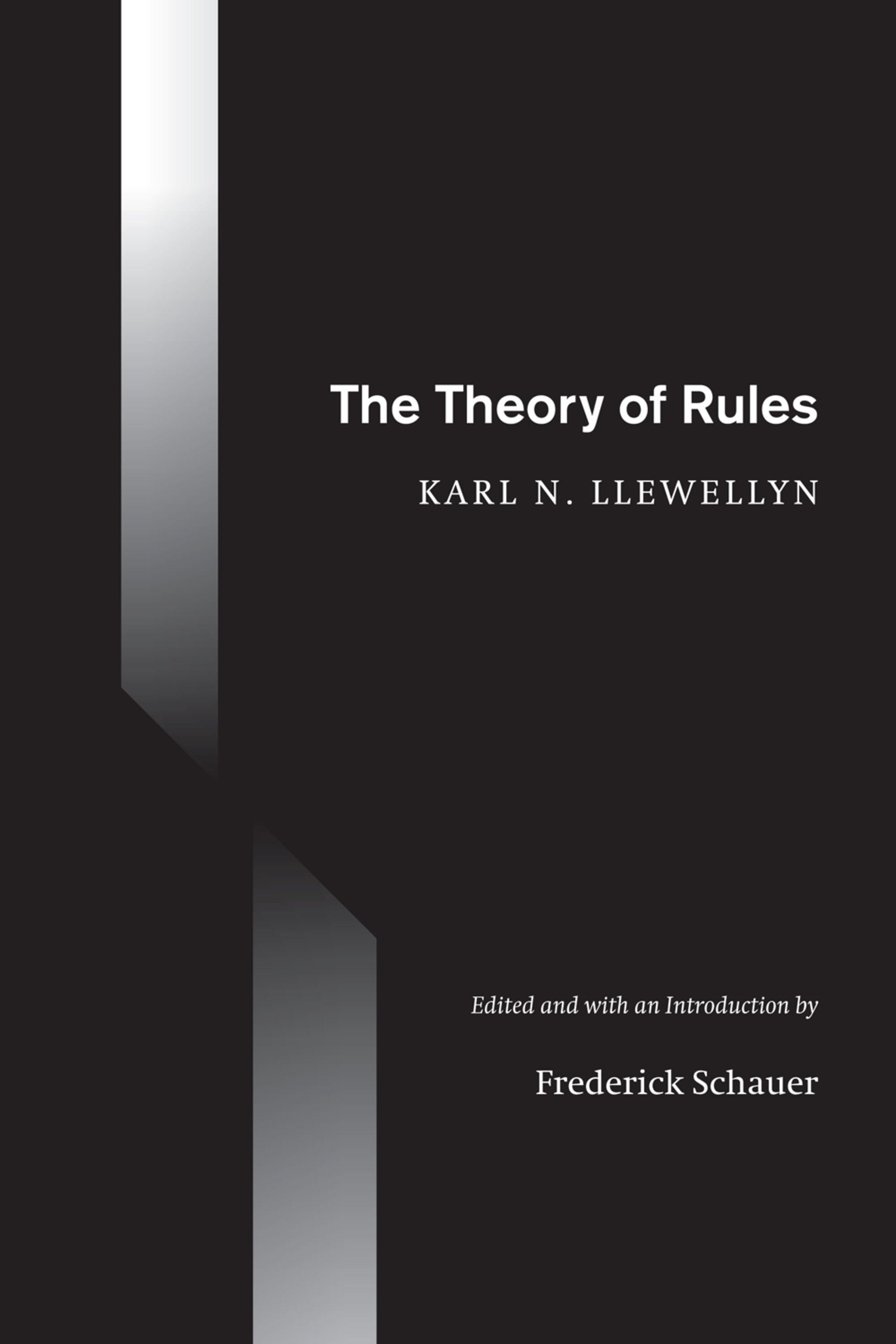
The theory of rules
Karl N. Llewellyn was one of the founders and major figures of legal realism, and his many keen insights have a central place in American law and legal understanding. Key to Llewellyn's thinking was his conception of rules, put forward in his numerous writings and most famously in his often mischaracterized declaration that they are \"pretty playthings.\" Previously unpublished, The Theory of Rules is the most cogent presentation of his profound and insightful thinking about the life of rules.
This book frames the development of Llewellyn's thinking and describes the difference between what rules literally prescribe and what is actually done, with the gap explained by a complex array of practices, conventions, professional skills, and idiosyncrasies, most of which are devoted to achieving a law's larger purpose rather than merely following the letter of a particular rule. Edited, annotated, and with an extensive analytic introduction by leading contemporary legal scholar Frederick Schauer, this rediscovered work contains material not found elsewhere in Llewellyn's writings and will prove a valuable contribution to the existing literature on legal realism.
eBook