
Catalogue Search | MBRL


Are you sure you want to remove the book from the shelf?

{{itemTitle}}
4,956
result(s) for
"Juvenile Delinquency - prevention "
Sort by:

'Soft' policing : the collaborative control of anti-social behaviour
Examining multi-agency working in response to anti-social behaviour, Daniel McCarthy investigates the way in which the police, social work teams and the youth justice service work together on early intervention initiatives to help young people, and explores the complexities and practical struggles of these partnerships.
Book

Saving children from a life of crime : early risk factors and effective interventions
After decades of rigorous study in the United States and across the Western world, a great deal is known about the early risk factors for offending. High impulsiveness, low attainment, criminal parents, parental conflict, and growing up in a deprived, high-crime neighborhood are among the most important factors. There is also a growing body of high quality scientific evidence on the effectiveness of early prevention programs designed to prevent children from embarking on a life of crime. Drawing on the latest evidence, this is the first book to assess the early causes of offending and what works best to prevent it. Preschool intellectual enrichment, child skills training, parent management training, and home visiting programs are among the most effective early prevention programs. The authors of this book, who are both criminologists, outline a policy strategy—early prevention—that uses this current research knowledge and brings into sharper focus what America's national crime fighting priority ought to be. At a time when unacceptable crime levels in America, rising criminal justice costs, and a punitive crime policy have spurred a growing interest in the early prevention of delinquency, the book lays the groundwork for change with a comprehensive national prevention strategy to save children from a life of crime.
eBook

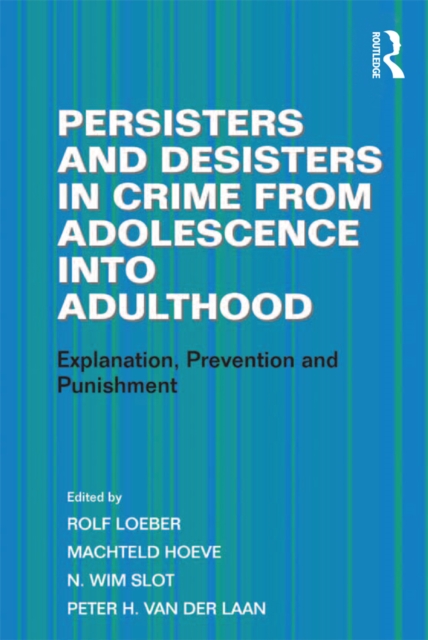
Persisters and Desisters in Crime from Adolescence into Adulthood
Too many juvenile delinquents persist in their offending into adulthood. They constitute a major burden for individual victims, for businesses and the justice system, all contributing to the total cost of crime for society. Focusing on the transition between juvenile offending and adult crime, this book examines research based on Dutch, European and North-American studies on the persistence and discontinuity of offending between late adolescence and early adulthood. Presenting empirical studies showing why persistence or discontinuity take place, the book provides up-to-date information on preventive and remedial interventions to promote discontinuity of offending amongst young adults. From the same team who produced 'Tomorrow's Criminals', this book will be a valuable resource for criminologists, criminal justice professionals, psychologists, sociologists, and psychiatrists interested in juvenile and young adult offenders, as well as those interested in what makes career criminals and youth who reform.
eBook


PROSPER delivery of universal preventive interventions with young adolescents: long-term effects on emerging adult substance misuse and associated risk behaviors
Substance misuse and associated health-risking behaviors are prevalent in emerging adulthood. There is a knowledge gap concerning the post-high school effects of community-based delivery systems for universal preventive interventions implemented during young adolescence. This study reports effects of the PROSPER delivery system through age 19, 7.5 years past baseline.
A cohort sequential design included 28 public school districts randomly assigned to the PROSPER partnership delivery system or usual-programming conditions. PROSPER community teams implemented a family-focused intervention in 6th grade and a school-based intervention in 7th grade. Outcomes for the age 19, post-high school report included lifetime, current, and frequency of substance misuse, as well as antisocial and health-risking sexual behaviors. Intent-to-treat, multi-level analyses of covariance of point-in-time outcomes were conducted, along with analyses of risk-related moderation of intervention effects.
Results showed emerging adults from PROSPER communities reported significantly lower substance misuse across a range of types of substances, with relative reduction rates of up to 41.0%. No significant findings were observed for associated antisocial and health-risking sexual behavior indices; or for lifetime rates of sexually transmitted infections. Risk-related moderation effects were non-significant, suggesting generally comparable outcomes across higher- and lower-risk subgroups of emerging adults.
The PROSPER delivery system for brief universal preventive interventions has potential for public health impact by reducing long-term substance misuse, with positive results extending beyond high school.
Journal Article

Foundations for youth justice : positive approaches to practice
How can youth justice refocus its attention on the rights and perspectives of young people in transition? This book outlines youth justice practices in their current state of flux in the United Kingdom as New Labour policies receive direction under the vastly different Coalition Government. This book explores opportunities for a fresh orientation that places young people at the center. She outlines the risks and problems that modern society creates for them and asks when, and how, society should respond to youth behaviors that cause harm to others. The result is a bold and realistic remodelling of youth justice practices.
Book

The Effects of the Fast Track Preventive Intervention on the Development of Conduct Disorder Across Childhood
The impact of the Fast Track intervention on externalizing disorders across childhood was examined. Eight hundred-ninety-one early-starting children (69% male; 51% African American) were randomly assigned by matched sets of schools to intervention or control conditions. The 10-year intervention addressed parent behavior-management, child social cognitive skills, reading, home visiting, mentoring, and classroom curricula. Outcomes included psychiatric diagnoses after grades 3, 6, 9, and 12 for conduct disorder, oppositional defiant disorder, attention deficit hyperactivity disorder, and any externalizing disorder. Significant interaction effects between intervention and initial risk level indicated that intervention prevented the lifetime prevalence of all diagnoses, but only among those at highest initial risk, suggesting that targeted intervention can prevent externalizing disorders to promote the raising of healthy children.
Journal Article

How Does the Fast Track Intervention Prevent Adverse Outcomes in Young Adulthood?
Numerous studies have shown that childhood interventions can foster improved outcomes in adulthood. Less well understood is precisely how—that is, through which developmental pathways—these interventions work. This study assesses mechanisms by which the Fast Track project (n = 891), a randomized intervention in the early 1990s for high-risk children in four communities (Durham, NC; Nashville, TN; rural PA; and Seattle, WA), reduced delinquency, arrests, and general and mental health service utilization in adolescence through young adulthood (ages 12–20). A decomposition of treatment effects indicates that about a third of Fast Track's impact on later crime outcomes can be accounted for by improvements in social and self-regulation skills during childhood (ages 6–11), such as prosocial behavior, emotion regulation, and problem solving. These skills proved less valuable for the prevention of general and mental health problems.
Journal Article