
Catalogue Search | MBRL


Are you sure you want to remove the book from the shelf?

{{itemTitle}}
20
result(s) for
"KCZ"
Sort by:

Masters of the universe
How did American and British policymakers become so enamored with free markets, deregulation, and limited government? This book--the first comprehensive transatlantic history of the rise of neoliberal politics--presents a surprising answer. Based on archival research and interviews with leading participants in the movement,Masters of the Universetraces the ascendancy of neoliberalism from the academy of interwar Europe to supremacy under Reagan and Thatcher and in the decades since. Daniel Stedman Jones argues that there was nothing inevitable about the victory of free-market politics. Far from being the story of the simple triumph of right-wing ideas, the neoliberal breakthrough was contingent on the economic crises of the 1970s and the acceptance of the need for new policies by the political left.
Masters of the Universedescribes neoliberalism's road to power, beginning in interwar Europe but shifting its center of gravity after 1945 to the United States, especially to Chicago and Virginia, where it acquired a simple clarity that was developed into an uncompromising political message. Neoliberalism was communicated through a transatlantic network of think tanks, businessmen, politicians, and journalists that was held together by Friedrich Hayek and Milton Friedman. After the collapse of Bretton Woods in 1971, and the \"stagflation\" that followed, their ideas finally began to take hold as Keynesianism appeared to self-destruct. Later, after the elections of Reagan and Thatcher, a guileless faith in free markets came to dominate politics.
Fascinating, important, and timely, this is a book for anyone who wants to understand the history behind the Anglo-American love affair with the free market, as well as the origins of the current economic crisis.
eBook

Why Australia Prospered
This book is the first comprehensive account of how Australia attained the world's highest living standards within a few decades of European settlement, and how the nation has sustained an enviable level of income to the present. Why Australia Prospered is a fascinating historical examination of how Australia cultivated and sustained economic growth and success. Beginning with the Aboriginal economy at the end of the eighteenth century, Ian McLean argues that Australia's remarkable prosperity across nearly two centuries was reached and maintained by several shifting factors. These included imperial policies, favorable demographic characteristics, natural resource abundance, institutional adaptability and innovation, and growth-enhancing policy responses to major economic shocks, such as war, depression, and resource discoveries. Natural resource abundance in Australia played a prominent role in some periods and faded during others, but overall, and contrary to the conventional view of economists, it was a blessing rather than a curse. McLean shows that Australia's location was not a hindrance when the international economy was centered in the North Atlantic, and became a positive influence following Asia's modernization. Participation in the world trading system, when it flourished, brought significant benefits, and during the interwar period when it did not, Australia's protection of domestic manufacturing did not significantly stall growth. McLean also considers how the country's notorious origins as a convict settlement positively influenced early productivity levels, and how British imperial policies enhanced prosperity during the colonial period. He looks at Australia's recent resource-based prosperity in historical perspective, and reveals striking elements of continuity that have underpinned the evolution of the country's economy since the nineteenth century.
eBook
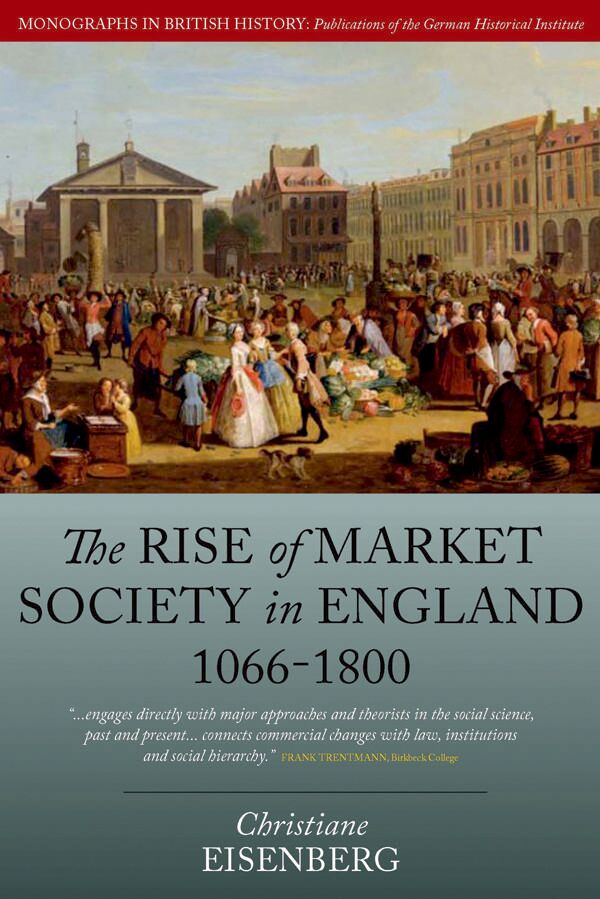
The Rise of Market Society in England, 1066-1800
Focusing on England, this study reconstructs the centuries-long process of commercialization that gave birth to the modern market society. It shows how certain types of markets (e.g. those for real estate, labor, capital, and culture) came into being, and how the social relations mediated by markets were formed. The book deals with the creation of institutions like the Bank of England, the Stock Exchange, and Lloyd's of London, as well as the way the English dealt with the uncertainty and the risks involved in market transactions. Christiane Eisenberg shows that the creation of a market society and modern capitalism in England occurred under circumstances that were utterly different from those on the European continent. In addition, she demonstrates that as a process, the commercialization of business, society, and culture in England did not lead directly to an industrial society, as has previously been suggested, but rather to a service economy.
eBook
Debtor nation
Before the twentieth century, personal debt resided on the fringes of the American economy, the province of small-time criminals and struggling merchants. By the end of the century, however, the most profitable corporations and banks in the country lent money to millions of American debtors. How did this happen? The first book to follow the history of personal debt in modern America,Debtor Nationtraces the evolution of debt over the course of the twentieth century, following its transformation from fringe to mainstream--thanks to federal policy, financial innovation, and retail competition.
How did banks begin making personal loans to consumers during the Great Depression? Why did the government invent mortgage-backed securities? Why was all consumer credit, not just mortgages, tax deductible until 1986? Who invented the credit card? Examining the intersection of government and business in everyday life, Louis Hyman takes the reader behind the scenes of the institutions that made modern lending possible: the halls of Congress, the boardrooms of multinationals, and the back rooms of loan sharks. America's newfound indebtedness resulted not from a culture in decline, but from changes in the larger structure of American capitalism that were created, in part, by the choices of the powerful--choices that made lending money to facilitate consumption more profitable than lending to invest in expanded production.
From the origins of car financing to the creation of subprime lending,Debtor Nationpresents a nuanced history of consumer credit practices in the United States and shows how little loans became big business.
eBook

Mass Flourishing
In this book, Nobel Prize-winning economist Edmund Phelps draws on a lifetime of thinking to make a sweeping new argument about what makes nations prosper--and why the sources of that prosperity are under threat today. Why did prosperity explode in some nations between the 1820s and 1960s, creating not just unprecedented material wealth but \"flourishing\"--meaningful work, self-expression, and personal growth for more people than ever before? Phelps makes the case that the wellspring of this flourishing was modern values such as the desire to create, explore, and meet challenges. These values fueled the grassroots dynamism that was necessary for widespread, indigenous innovation. Most innovation wasn't driven by a few isolated visionaries like Henry Ford and Steve Jobs; rather, it was driven by millions of people empowered to think of, develop, and market innumerable new products and processes, and improvements to existing ones. Mass flourishing--a combination of material well-being and the \"good life\" in a broader sense--was created by this mass innovation. Yet indigenous innovation and flourishing weakened decades ago. In America, evidence indicates that innovation and job satisfaction have decreased since the late 1960s, while postwar Europe has never recaptured its former dynamism. The reason, Phelps argues, is that the modern values underlying the modern economy are under threat by a resurgence of traditional, corporatist values that put the community and state over the individual. The ultimate fate of modern values is now the most pressing question for the West: will Western nations recommit themselves to modernity, grassroots dynamism, indigenous innovation, and widespread personal fulfillment, or will we go on with a narrowed innovation that limits flourishing to a few? A book of immense practical and intellectual importance, Mass Flourishing is essential reading for anyone who cares about the sources of prosperity and the future of the West.
eBook

The Roman Market Economy
The quality of life for ordinary Roman citizens at the height of the Roman Empire probably was better than that of any other large group of people living before the Industrial Revolution.The Roman Market Economyuses the tools of modern economics to show how trade, markets, and the Pax Romana were critical to ancient Rome's prosperity.
Peter Temin, one of the world's foremost economic historians, argues that markets dominated the Roman economy. He traces how the Pax Romana encouraged trade around the Mediterranean, and how Roman law promoted commerce and banking. Temin shows that a reasonably vibrant market for wheat extended throughout the empire, and suggests that the Antonine Plague may have been responsible for turning the stable prices of the early empire into the persistent inflation of the late. He vividly describes how various markets operated in Roman times, from commodities and slaves to the buying and selling of land. Applying modern methods for evaluating economic growth to data culled from historical sources, Temin argues that Roman Italy in the second century was as prosperous as the Dutch Republic in its golden age of the seventeenth century.
The Roman Market Economyreveals how economics can help us understand how the Roman Empire could have ruled seventy million people and endured for centuries.
eBook

The Battle of Bretton Woods
When turmoil strikes world monetary and financial markets, leaders invariably call for 'a new Bretton Woods' to prevent catastrophic economic disorder and defuse political conflict. The name of the remote New Hampshire town where representatives of forty-four nations gathered in July 1944, in the midst of the century's second great war, has become shorthand for enlightened globalization. The actual story surrounding the historic Bretton Woods accords, however, is full of startling drama, intrigue, and rivalry, which are vividly brought to life in Benn Steil's epic account.
Upending the conventional wisdom that Bretton Woods was the product of an amiable Anglo-American collaboration, Steil shows that it was in reality part of a much more ambitious geopolitical agenda hatched within President Franklin D. Roosevelt's Treasury and aimed at eliminating Britain as an economic and political rival. At the heart of the drama were the antipodal characters of John Maynard Keynes, the renowned and revolutionary British economist, and Harry Dexter White, the dogged, self-made American technocrat. Bringing to bear new and striking archival evidence, Steil offers the most compelling portrait yet of the complex and controversial figure of White--the architect of the dollar's privileged place in the Bretton Woods monetary system, who also, very privately, admired Soviet economic planning and engaged in clandestine communications with Soviet intelligence officials and agents over many years.
A remarkably deft work of storytelling that reveals how the blueprint for the postwar economic order was actually drawn,The Battle of Bretton Woodsis destined to become a classic of economic and political history.
eBook

Cities of Commerce
Cities of Commerce develops a model of institutional change in European commerce based on urban rivalry. Cities continuously competed with each other by adapting commercial, legal, and financial institutions to the evolving needs of merchants. Oscar Gelderblom traces the successive rise of Bruges, Antwerp, and Amsterdam to commercial primacy between 1250 and 1650, showing how dominant cities feared being displaced by challengers while lesser cities sought to keep up by cultivating policies favorable to trade. He argues that it was this competitive urban network that promoted open-access institutions in the Low Countries, and emphasizes the central role played by the urban power holders--the magistrates--in fostering these inclusive institutional arrangements. Gelderblom describes how the city fathers resisted the predatory or reckless actions of their territorial rulers, and how their nonrestrictive approach to commercial life succeeded in attracting merchants from all over Europe. Cities of Commerce intervenes in an important debate on the growth of trade in Europe before the Industrial Revolution. Challenging influential theories that attribute this commercial expansion to the political strength of merchants, this book demonstrates how urban rivalry fostered the creation of open-access institutions in international trade.
eBook

The Last Pharaohs
The history of Ptolemaic Egypt has usually been doubly isolated--separated both from the history of other Hellenistic states and from the history of ancient Egypt.The Last Pharaohs, the first detailed history of Ptolemaic Egypt as a state, departs radically from previous studies by putting the Ptolemaic state firmly in the context of both Hellenistic and Egyptian history. More broadly still, J. G. Manning examines the Ptolemaic dynasty in the context of the study of authoritarian and premodern states, shifting the focus of study away from modern European nation-states and toward ancient Asian ones. By analyzing Ptolemaic reforms of Egyptian economic and legal structures,The Last Pharaohsgauges the impact of Ptolemaic rule on Egypt and the relationships that the Ptolemaic kings formed with Egyptian society. Manning argues that the Ptolemies sought to rule through--rather than over--Egyptian society. He tells how the Ptolemies, adopting a pharaonic model of governance, shaped Egyptian society and in turn were shaped by it. Neither fully Greek nor wholly Egyptian, the Ptolemaic state within its core Egyptian territory was a hybrid that departed from but did not break with Egyptian history. Integrating the latest research on archaeology, papyrology, theories of the state, and legal history, as well as Hellenistic and Egyptian history,The Last Pharaohsdraws a dramatically new picture of Egypt's last ancient state.
eBook

The challenges of globalization
In the mid nineteenth century a process began that appears, from a present-day perspective, to have been the first wave of economic globalization. Within a few decades global economic integration reached a level that equaled, and in some respects surpassed, that of the present day. This book describes the interpenetration of the German economy with an emerging global economy before the First World War, while also demonstrating the huge challenge posed by globalization to the society and politics of the German Empire. The stakes for both the winners and losers of the intensifying world market played a major role in dividing German society into camps with conflicting socio-economic priorities. As foreign trade policy moved into the center stage of political debates, the German government found it increasingly difficult to pursue a successful policy that avoided harming German exports and consumer interests while also seeking to placate a growing protectionist movement.
eBook