
Catalogue Search | MBRL


Are you sure you want to remove the book from the shelf?

{{itemTitle}}
324
result(s) for
"Kernwaffe."
Sort by:


Unraveling the Gray Area Problem
In Unraveling the Gray Area
Problem , Luke Griffith examines the US role
in why the Intermediate-Range Nuclear Forces (INF) Treaty took
almost a decade to negotiate and then failed in just thirty
years. The INF Treaty enhanced Western security by
prohibiting US and Russian ground-based missiles with maximum
ranges of 500 to 5,500 kilometers. Significantly, it eliminated
hundreds of Soviet SS-20 missiles, which could annihilate targets
throughout Eurasia in minutes. Through close scrutiny of US theater
nuclear policy from 1977 to 1987, Griffith describes the Carter
administration's masterminding of the dual-track decision of
December 1979, the North Atlantic Treaty Organization (NATO)
initiative that led to the INF Treaty. The Reagan administration,
in turn, overcame bureaucratic infighting, Soviet intransigence,
and political obstacles at home and abroad to achieve a
satisfactory outcome in the INF negotiations.
Disagreements between the US and Russia undermined the INF
Treaty and led to its dissolution in 2019. Meanwhile, the US is
developing a new generation of ground-based, INF-type missiles that
will have an operational value on the battlefield. Griffith urges
policymakers to consider the utility of INF-type missiles in new
arms control negotiations. Understanding the scope and consistency
of US arms control policy across the Carter and Reagan
administrations offers important lessons for policymakers in the
twenty-first century.
eBook


Strategy in the Missile Age
Strategy in the Missile Age first reviews the development of modern military strategy to World War II, giving the reader a reference point for the radical rethinking that follows, as Dr. Brodie considers the problems of the Strategic Air Command, of civil defense, of limited war, of counterforce or pre-emptive strategies, of city-busting, of missile bases in Europe, and so on. The book, unlike so many on modern military affairs, does not present a program or defend a policy, nor is it a brief for any one of the armed services. It is a balanced analysis of the requirements of strength for the 1960's, including especially the military posture necessary to prevent war. A unique feature is the discussion of the problem of the cost of preparedness in relation to the requirements of the national economy, so often neglected by other military thinkers.
Originally published in 1959.
The Princeton Legacy Library uses the latest print-on-demand technology to again make available previously out-of-print books from the distinguished backlist of Princeton University Press. These editions preserve the original texts of these important books while presenting them in durable paperback and hardcover editions. The goal of the Princeton Legacy Library is to vastly increase access to the rich scholarly heritage found in the thousands of books published by Princeton University Press since its founding in 1905.
eBook

Cleaning Up the Bomb Factory
Housewives, hard hats, and an Ohio town's restoration of
the radioactive wasteland in its backyard In 1984, a
uranium leak at Ohio's outdated Fernald Feed Materials Production
Center highlighted the decades of harm inflicted on Cold War
communities by negligent radioactive waste disposal. Casey A.
Huegel tells the story of the unlikely partnership of grassroots
activists, regulators, union workers, and politicians that
responded to the event with a new kind of environmental movement.
The community group Fernald Residents for Environmental Safety and
Health (FRESH) drew on the expertise of national organizations
while maintaining its autonomy and focus on Fernald. Leveraging
local patriotism and employment concerns, FRESH recruited
blue-collar allies into an innovative program that fought for both
local jobs and a healthier environment. Fernald's transformation
into a nature reserve with an on-site radioactive storage facility
reflected the political compromises that left waste sites improved
yet imperfect. At the same time, FRESH's outsized influence
transformed how the government scaled down the Cold War weapons
complex, enforced health and safety standards, and reckoned with
the immense environmental legacy of the nuclear arms race. A
compelling history of environmental mobilization, Cleaning Up
the Bomb Factory details the diverse goals and mixed successes
of a groundbreaking activist movement.
eBook

Death Dust
The postwar period saw increased interest in the idea of relatively easy-to-manufacture but devastatingly lethal radiological munitions whose use would not discriminate between civilian and military targets. Death Dust explores the largely unknown history of the development of radiological weapons (RW)-weapons designed to disperse radioactive material without a nuclear detonation-through a series of comparative case studies across the United States, the Soviet Union, the United Kingdom, Iraq, and Egypt. The authors illuminate the historical drivers of and impediments to radiological weapons innovation. They also examine how new, dire geopolitical events-such as the war in Ukraine-could encourage other states to pursue RW and analyze the impact of the spread of such weapons on nuclear deterrence and the nonproliferation regime. Death Dust presents practical, necessary steps to reduce the likelihood of a resurgence of interest in and pursuit of radiological weapons by state actors.
eBook
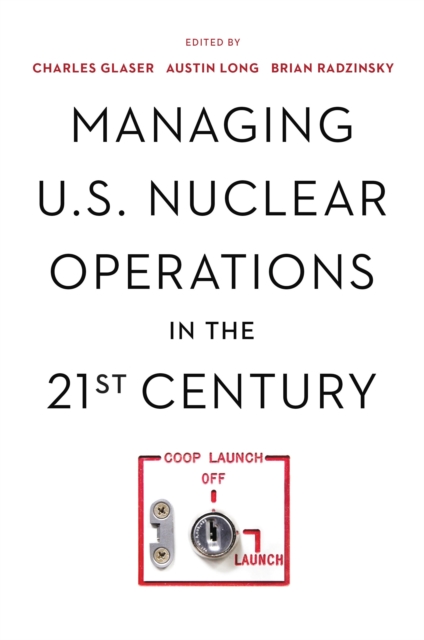
Managing U.S. Nuclear Operations in the 21st Century
Exploring how the United States manages its still-powerful nuclear arsenal
Arms control agreements and the end of the Cold War have made the prospect of nuclear war a distant fear for the general public. But the United States and its principal rivals—China and Russia—still maintain sizable arsenals of nuclear weapons, along with the systems for managing them and using them if that terrible day ever comes.
Managing U.S. Nuclear Operations in the 21st Century focuses on how theories and policies are put into practice in managing nuclear forces in the United States.
It addresses such questions as: What have been the guiding priorities of U.S. nuclear strategy since the end of the Cold War? What nuclear attack options would the president have during a war? How are these war plans developed and reviewed by civilian and military leaders? How would presidential orders be conveyed to the uniformed men and women who are entrusted with U.S. nuclear weapons systems? And are these communications systems and supporting capabilities vulnerable to disruption or attack?
The answers to such questions depend on the process by which national strategy for nuclear deterrence, developed by civilian leaders, is converted into nuclear war plans and the entire range of procedures for implementing those plans if necessary.
The chapter authors have extensive experience in government, the armed forces, and the analytic community. Drawing on their firsthand knowledge, as well as the public record, they provide unique, authoritative accounts of how the United States manages it nuclear forces today.
This book will be of interest to the national security community, particularly younger experts who did not grow up in the nuclear-centric milieu of the Cold War. Any national security analyst, professional, or government staffer seeking to learn more about nuclear modernization policy and the U.S. nuclear arsenal should be interested in this book. It should also be of interest to professors and students who want a deep understanding of U.S. nuclear policy.
eBook

Hinge points : an inside look at North Korea's nuclear program
North Korea remains a puzzle to Americans. How did this country—one of the most isolated in the world and in the policy cross hairs of every U.S. administration during the past 30 years—progress from zero nuclear weapons in 2001 to a threatening arsenal of perhaps 50 such weapons in 2021?
Hinge Points brings readers literally inside the North Korean nuclear program, joining Siegfried Hecker to see what he saw and hear what he heard in his visits to North Korea from 2004 to 2010. Hecker goes beyond the technical details—described in plain English from his on-the-ground experience at the North's nuclear center at Yongbyon—to put the nuclear program exactly where it belongs, in the context of decades of fateful foreign policy decisions in Pyongyang and Washington.
Describing these decisions as \"hinge points,\" he traces the consequences of opportunities missed by both sides. The result has been that successive U.S. administrations have been unable to prevent the North, with the weakest of hands, from becoming one of only three countries in the world that might target the United States with nuclear weapons. Hecker's unique ability to marry the technical with the diplomatic is well informed by his interactions with North Korean and U.S. officials over many years, while his years of working with Russian, Chinese, Indian, and Pakistani nuclear officials have given him an unmatched breadth of experience from which to view and interpret the thinking and perspective of the North Koreans.
eBook

EU Orchestration in the Nuclear Weapons Regime Complex
While often recognised as a difficult actor in global efforts addressing the proliferation, control, and disarmament of nuclear weapons, the EU is also assumed to have the potential to play a more cohesive “state-like” role, especially in multilateral forum such as the Treaty on the Non-Proliferation of Nuclear Weapons review cycle. Such assumptions raise expectations of EU external action and influence, which the EU then invariably fails to meet. This article offers a reframing of how we understand the EU as an actor, focusing on its role in the nuclear weapons regime complex. Specifically, the article considers how, and under what conditions, the EU orchestrates within and across the nuclear weapons regime complex. Drawing on the orchestration and regime complex scholarship, alongside empirical data of EU external action from 2003 to 2019, the article shows how the EU’s natural proclivity for effective multilateralism, coupled with its functional limitations, the political cleavages impeding both the EU and multilateral progress within the regime complex, and the presence of like-minded intermediaries, create ripe conditions for EU orchestration in this field. It further argues that while the EU has struggled to inject agency within individual nuclear negotiation forums, its use of orchestration as a soft and indirect mode of governance is not only well-established but advancing. Orchestration is therefore found to serve as an important metric for understanding and evaluating the scope of EU agency in the nuclear weapons regime complex.
Journal Article

The social construction of Russia's resurgence : aspirations, identity, and security interests
Shortlisted, 2010 Jospeh Rothschild Prize in Nationalism and Ethnic Studies, Association for the Study of Nationalities.
Once again, it appears that Russia is marching to the forefront of the international stage. Anne L. Clunan's analysis of Russia's resurgence convincingly argues that traditional security concerns, historical aspirations, and human agency are coalescing around a new national identity and reconfigured national interests in the post-Soviet nation. Her work moves beyond balance-of-power and realist politics to posit a new, interdisciplinary theory: aspirational constructivism.
This groundbreaking theory draws on international relations research and social psychology. Clunan argues that the need for collective self-esteem creates aspirations—often based in a nation's past—that directly shape its national and security interests. In applying this theory to Russia, she points to the nation's continuing efforts to exert influence over former Soviet satellite states and relates the desire for international status found in five broad Russian national self-images—Western, statist, Slavophile, neocommunist, and nationalist—to Russia's definition of its security interests with respect to Europe, Eurasia, and nuclear weapons.
Clunan's examination of how sociology, social psychology, and traditional international politics affect post-Soviet Russian identity and security concerns is truly cross-disciplinary. A concluding chapter discusses the policy implications of aspirational constructivism for Russia and other nations and a methodological appendix lays out a framework for testing the theory.
eBook