
Catalogue Search | MBRL


Are you sure you want to remove the book from the shelf?

{{itemTitle}}
1,866
result(s) for
"Kim Sun"
Sort by:


Movement and the Watery Imaginary in the Contemporary North American Feminist Poetic
What can hybridity teach us? The answer I posit is–like water–to embrace movement in all its forms. We are currently experiencing the sixth mass extinction event on earth and yet few scholars give prolonged attention to how we are to sustainably move our human inheritances forward on this increasingly uninhabitable planet. Reflecting on the work of transnational poets, specifically South Korean poet Kim Hyesoon translated through Korean American poet Don Mee Choi and Lebanese American poet Etel Adnan, we are reminded of the myriad ways in which humans can move and survive in a foreign yet familiar world. This paper finds its support in the confluence of transnational contemporary feminist poetics, formalism, environmentalism, and posthumanism. Through the use of various critical discourses, this paper considers how movement and its hybrid capacities offer a new understanding of contemporary North American poetics. In this sense, a poem should be viewed as a dynamic temporal cybernetic system, a vessel, full of energy, simultaneously pulsing with the changing movements and constrictions of everyday life.
Journal Article
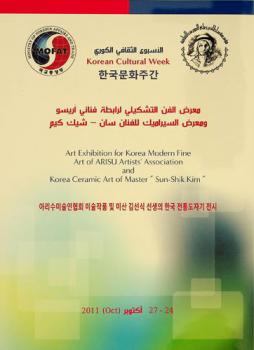
معرض الفن التشكيلي لرابطة فناني آريسو ومعرض السيراميك للفنان سان-شيك كيم : الأسبوع الثقافي الكوري = Art exhibition for Korea modern fine art of Arisu artists association and Korea ceramic art of master Sun-Shik Kim : Korean cultural week : 24-27 أكتوبر 2011
تقدم رابطة فناني أريسو معرضا للفن الكوري المعاصر بعنوان \"البحث عن الجمال في الحب والسلام\"، وذلك في إطار الأسبوع الثقافي الكوري الذي تنظمه وتستضيفه مؤسسة سلطان بن علي العويس الثقافية بالتعاون مع القنصلية العامة لجمهورية كوريا بدبي . ويقام المعرض في قاعة المعارض بمقر المؤسسة بدبي في الفترة من 24 إلى 27 أكتوبر، 2011. وتقدم رابطة فناني أريسو من خلال هذا المعرض مايقرب من مائة عمل فني (متضمنة 90 عمل ثنائي الأبعاد و10 أعمال ثلاثية الأبعاد) لمائة من أبرز الفنانين الكوريين المعاصرين. وتهدف الرابطة من خلال هذا المعرض إلى تعريف الجمهور العالم العربي بالفن الكوري المعاصر والثقافة الكورية. ويحمل المعرض الفني الذي تقدمه الرابطة في دبي عنوان\" البحث عن الجمال في الحب والسلام\". ويأمل فنانو الرابطة أن يكون هذا المعرض فرصة للتواصل بين الشعب الكوري والشعب الإماراتي وفرصة لتعزيز التفاهم المتبادل والتعاطي الثقافي بين البلدين. وينشد الفنانون في كلا البلدين نشر قيم الحب والجمال من خلال التبادل الثقافي مع الآخر برغم الحدود الإقليمية والعرقية. إن رابطة فناني أريسو على يقين أن هذا المعرض الفني سيلعب دورا هاما في تعزيز أواصر الصداقة بين كوريا والإمارات العربية المتحدة وتنمية الثقافة الفنية في البلدين من خلال التبادل الثقافي الفعال.
Book

Cli-Fi, Noir, and The Nonhuman Subject in Netflix's The Silent Sea (2021)
The various elements explored by American noir scholars such as Stewart King and Homer B. Pettey include an analysis of how the hardboiled private investigator and the dangerous femme fatale reflect gender and sexual norms of the era, or how the anti-hero reflects a conception of the individual as isolated or fragmented. [...]The Silent Sea depicts what Timothy Morton calls a \"dark ecology,\" in his book of the same name, that renders nature as ruined or destroyed as a result of anthropogenic climate change; the series relies on a fusion of noir and cli-fi conventions with the hope that humanity may halt the violence humans inflict on the nonhuman, and the potential violence that a destroyed nature may wreak upon humanity in return. Because eco-catastrophes are often experienced on a global level, especially when they pertain to water usage and drought, it is important to consider how this series adopts a global perspective-how it links South Korean and American conventions-to highlight the widespread effects of climate change. Because The Silent Sea depicts space exploration and the dystopic effects of climate change by fusing elements of speculative fiction with mystery, violence, and thrill, one might name the series as a \"crimate\" television series, a term that Stewart King coined in \"Crimate Fiction and the Environmental Imagination of Place.\" [...]we can expand upon our ecocritical approaches when examining expression of environmental concern, and one way of doing so is by using the conventions of noir as tools for \"discussing ecological crises and abuses [...] exposing the criminal acts they involve in their violent effects on people and the environment\" (1236).
Journal Article

I AM NO HERO, THE ALTERNATIVE TO BEING A ROLE MODEL: THE YEAR IN KOREA
In order to point to a few changes that have recently occurred in how one represents oneself in Korea, the essay more closely examines the poet Kim Hyesoon's Ana nün irök'e mal haetta (2016) and the composite artist Enzo's (Yi Hyok's) Nallari chaso chon (2016).1 But Kim's and Enzo's works suggest changing trends in autobiographical representations in Korea that will likely continue to appear in the future and further modify the current picture of Korean life writing. Ryu is correct in her claim about the scarcity of such writings across different periods, but it is significant that while her study acknowledges autobiographical content in poems as well as in prose, she does not seem to consider Korean writers' poetry as a mode of autobiography, and perhaps more surprisingly, she does seem to assume that autobiographies can represent the self in its entirety.
Journal Article
