
Catalogue Search | MBRL


Are you sure you want to remove the book from the shelf?

{{itemTitle}}
50,065
result(s) for
"King, Stephen"
Sort by:


Stephen King
This companion provides a two-part introduction to best-selling author Stephen King, whose enormous popularity over the years has gained him an audience well beyond readers of horror fiction, the genre with which he is most often associated.
eBook


Stephen King on the small screen
In this follow up to Stephen King on the Big Screen, Mark Browning turns his critical eye to the much-neglected subject of the best-selling author's work in television, examining what it is about King's fiction that makes it particularly suitable for the small screen.
By focusing on this body of work, from the highly successful The Stand and The Night Flier to the lesser-known TV films Storm of the Century, Rose Red, Kingdom Hospital, and the 2004 remake of Salem's Lot, Browning is able to articulate how these adaptations work and, in turn, suggest new ways of viewing them. This book is the first written by a film specialist to consider King's television work in its own right, and it rejects previous attempts to make the films and books fit rigid thematic categories. Browning examines what makes a written or visual text successful at evoking fear on a case-by-case basis, in a highly readable and engaging way. He also considers the relationship between the big and small screen. Why, for instance, are some TV versions more effective than movie adaptations and vice versa? In the process, Stephen King on the Small Screen is able to shed new light on what it is that makes King's novels so successful and reveal the elements of style and approach that have helped make King one of the world's best-selling authors.
eBook

On writing : a memoir of the craft
\"King's [writing] advice is grounded in his ... memories from childhood through his emergence as a writer, from his struggling early career to his widely reported, near-fatal accident in 1999--and how the inextricable link between writing and living spurred his recovery\"--Amazon.com.
BOOK

Timeless Moments
What happens to us after death is one of the oldest and most difficult questions. Even the standard response of many Christians, that we go to either Heaven, Hell, or Purgatory, can only partly satisfy, because while we experience the passing of time in a linear manner, those places are said to exist completely outside of time. How, then, can it make sense to speak of “going” to Heaven or Hell after death? Must we not always and forever be there—even during our lifetimes? Russell Kirk, a Catholic historian from Michigan who often speculated about the afterlife in his fiction and non-fiction, developed the idea of “timeless moments” to explain how our mortal lives could be placed within the context of an immortal afterlife. Such moments represent a fusion of the human and divine, in which past, present, and future come together. Timeless moments both help to determine whether we end up in Heaven or Hell and constitute our experience of those places. This paper applies Kirk’s framework to the depictions of Purgatory and Hell in certain novels by Charles Williams and Stephen King. All three authors characterize the afterlife as a state of mind that is nevertheless closely associated with specific physical locations where the living and dead work out their salvation or suffer damnation at one and the same time. The timeless nature of Hell, finally, ensures that it is never too late to try to escape from it and seek redemption.
Journal Article

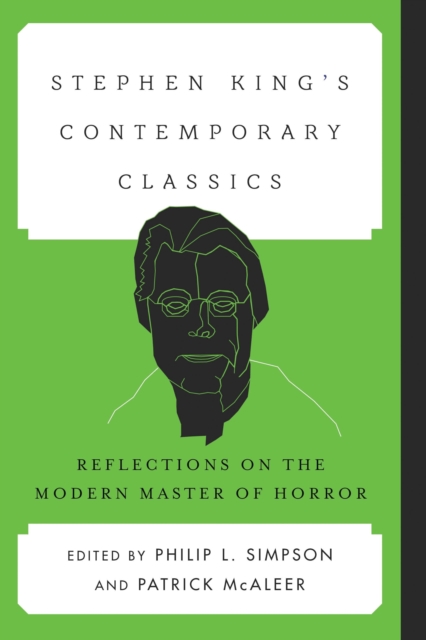
Stephen king's contemporary classics
Many readers know Stephen King for his early works of horror, from his fiction debut Carrie to his blockbuster novels The Shining, The Stand, and Misery, among others. While he continues to be a best-selling author, King's more recent fiction has not received the kind of critical attention that his books from the 1970s and 1980s enjoyed. Recent novels like Duma Key and 1/22/63 have been marginalized and, arguably, cast aside as anomalies within the author's extensive canon.
In Stephen King's Contemporary Classics: Reflections on the Modern Master of Horror, Philip L. Simpson and Patrick McAleer present a collection of essays that analyze, assess, and critique King's post-1995 compositions. Purposefully side-stepping studies of earlier work, these essays are arranged into three main parts: the first section examines five King novels published between 2009 and 2013, offering genuinely fresh scholarship on King; the second part looks at the development of King's distinct brand of horror; the third section departs from probing the content of King's writing and instead focuses on King's process.
By concentrating on King's most recent writings, this collection offers provocative insights into the author's work, featuring essays on Dr. Sleep, Duma Key, The Girl Who Loved Tom Gordon, Joyland, Under the Dome, and others. As such, Stephen King's Contemporary Classics will appeal to general fans of the author's work as well as scholars of Stephen King and modern literature.
eBook


The Derridean Gaze of the “Wholly Other” in Stephen King’s “Rat”
Building upon the rich theoretical framework that Derrida conceives in his posthumous environmental reflections and the interdiscipline of biosemiotics, this essay delves into the ethical questions posed by Stephen King related to other-than-human sentience, suffering, and subjecthood in “Rat.” Derrida and King generate thought-provoking portrayals of what happens when we are confronted with the gaze of the “wholly other.” When the other-than-human gaze falls upon us, Derrida and King insist that we cannot disregard the ethical summons that accompanies it. This transformative gaze compels us to think and live otherwise. The limitrophic reflection actuated by the other-than-human gaze eliminates the sharp ontological gap between humans and other animals. Owing to the strength of these encounters with other-than-human alterity, species boundaries erected on the shaky foundation of binary logic become unclear and unstable. The epiphany that the biosphere is replete with other semiotic agents that are capable of conceiving, transmitting, and decoding signs further erodes the pervasive doctrine of human exceptionalism.
Journal Article