
Catalogue Search | MBRL


Are you sure you want to remove the book from the shelf?

{{itemTitle}}
136
result(s) for
"Kissinger, Henry, 1923"
Sort by:

Nixon's Back Channel to Moscow
Most Americans consider détente -- the reduction of tensions between the United States and the Soviet Union -- to be among the Nixon administration's most significant foreign policy successes. The diplomatic back channel that national security advisor Henry Kissinger established with Soviet ambassador Anatoly Dobrynin became the most important method of achieving this thaw in the Cold War. Kissinger praised back channels for preventing leaks, streamlining communications, and circumventing what he perceived to be the US State Department's unresponsive and self-interested bureaucracy. Nixon and Kissinger's methods, however, were widely criticized by State Department officials left out of the loop and by an American press and public weary of executive branch prevarication and secrecy.
Richard A. Moss's penetrating study documents and analyzes US-Soviet back channels from Nixon's inauguration through what has widely been heralded as the apex of détente, the May 1972 Moscow Summit. He traces the evolution of confidential-channel diplomacy and examines major flashpoints, including the 1970 crisis over Cienfuegos, Cuba, the Strategic Arms Limitations Talks (SALT), US dealings with China, deescalating tensions in Berlin, and the Vietnam War. Moss argues that while the back channels improved US-Soviet relations in the short term, the Nixon-Kissinger methods provided a poor foundation for lasting policy.
Employing newly declassified documents, the complete record of the Kissinger-Dobrynin channel -- jointly compiled, translated, annotated, and published by the US State Department and the Russian Foreign Ministry -- as well as the Nixon tapes, Moss reveals the behind-the-scenes deliberations of Nixon, his advisers, and their Soviet counterparts. Although much has been written about détente, this is the first scholarly study that comprehensively assesses the central role of confidential diplomacy in shaping America's foreign policy during this critical era.
eBook

The trial of Henry Kissinger
In this incendiary book, Hitchens takes the floor as prosecuting counsel and mounts a devastating indictment of Henry Kissinger, whose ambitions and ruthlessness have directly resulted in both individual murders and widespread, indiscriminate slaughter.
Book
The African foreign policy of Secretary of State Henry Kissinger
The African Foreign Policy of Secretary of State Henry Kissinger outlines in clear, comprehensive terms the details of Secretary of State Henry Kissinger's foreign policy toward Africa and how that policy related to other aspects of his global viewpoint. For the first time, editors Hanes Walton, Jr., Robert Louis Stevenson, and James Bernard Rosser bring together a diverse collection of public documents, speeches, and congressional presentations for critical analysis and in-depth discussion. This book presents an intellectual evaluation of governmental sources to determine the kinds of foreign policy proposals and programs that Kissinger developed for the various crises and problems which were under way in Africa. The essays demonstrate how Kissinger used his brand of shuttle diplomacy to set up delicate negotiations to ease the new international tensions and the power-rivalry. The African Foreign Policy of Secretary of State Henry Kissinger offers important insight that will stimulate debate and be a lively read for those interested in international politics and political science.
eBook
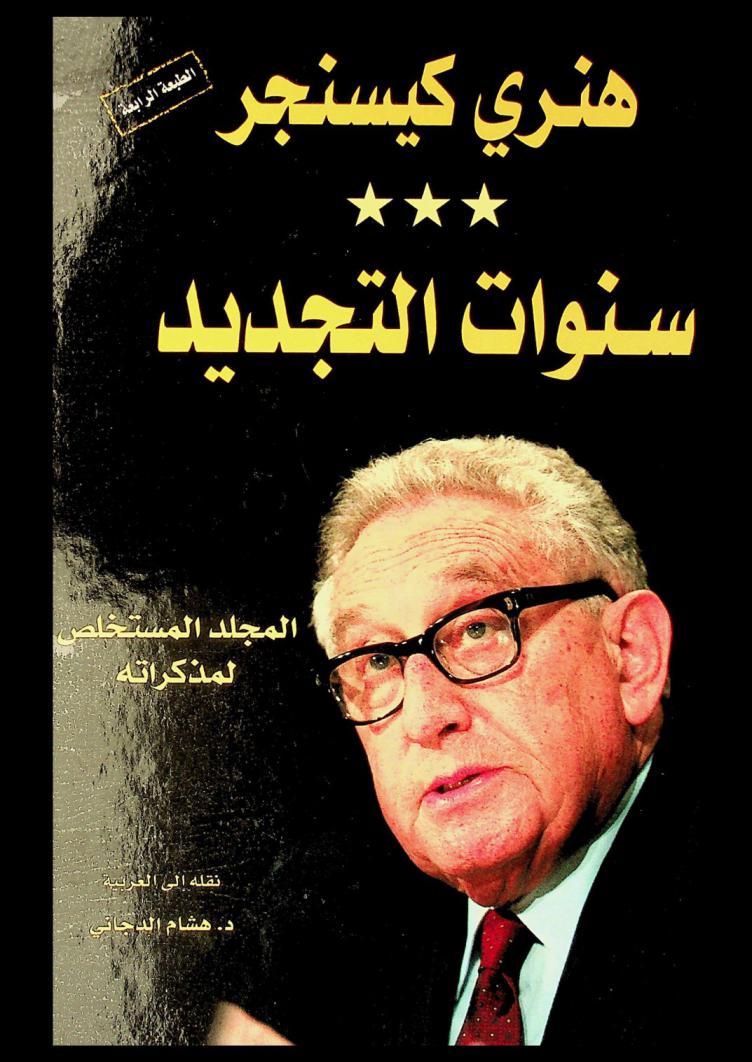
سنوات التجديد : المجلد المستخلص لمذكراته
هذا الكتاب الذي طال انتظاره عن ذكرياته يكمل عملاً كبيراً في التاريخ المعاصر، وهو وثيقة تاريخية مهمة ورواية رائعة ذات طابع شكسبيري في قوتها، مليئة بالنظرات العميقة غير المعتادة. والصادقة وإحساس عميق بالتاريخ سنوات التجديد هو الاستنتاج الناجح لإنجاز عظيم، والذي سيظل وثيقة تاريخية من الدرجة الأولى.
Book

Henry Kissinger and the American Century
What made Henry Kissinger the kind of diplomat he was? What experiences and influences shaped his worldview and provided the framework for his approach to international relations? Suri offers a thought-provoking, interpretive study of one of the most influential and controversial political figures of the twentieth century.
eBook

الحل والحرب : التسابق وراء السرب إلى جنيف لن يصل إلى نتيجة في الظروف الراهنة-السلام الذي ضاع لن يعود بغير الاستعداد للقتال مرة أخرى-كارتر وكيسنجر.. وأزمة الشرق الأوسط وفلسطين
يحتوي هذا الكتاب على أربعة مجموعات من الأحاديث كان المحلل السياسي \"محمد حسنين هيكل\" قد كتبها في الفترة ما بين بدايات سنة 1976 وبدايات سنة 1977، وهي ليست كل ما كتب في هذه الفترة وإنما هي مجرد نماذج منه أراد الكاتب جمعها بين دفتي كتاب لتكون ملفا مختصرا يحتوي على وجهة نظره في تحليل الأمور الراهنة، وفي نقد سياسة الولايات المتحدة الأميركية، وفي تحذير الطرف العربي من أهداف زعماء هذه السياسة، أو حتى لفت نظر الزعماء العرب إلى ما تريد الولايات المتحدة تحقيقه في الشرق الأوسط خصوصا العالم العربي عموما.
Book

The Eccentric Realist
InThe Eccentric Realist, Mario Del Pero questions Henry Kissinger's reputation as the foreign policy realist par excellence. Del Pero shows that Kissinger has been far more ideological and inconsistent in his policy formulations than is commonly realized.
Del Pero considers the rise and fall of Kissinger's foreign policy doctrine over the course of the 1970s-beginning with his role as National Security Advisor to Nixon and ending with the collapse of détente with the Soviet Union after Kissinger left the scene as Ford's outgoing Secretary of State. Del Pero shows that realism then (not unlike realism now) was as much a response to domestic politics as it was a cold, hard assessment of the facts of international relations. In the early 1970s, Americans were weary of ideological forays abroad; Kissinger provided them with a doctrine that translated that political weariness into foreign policy. Del Pero argues that Kissinger was keenly aware that realism could win elections and generate consensus. Moreover, over the course of the 1970s it became clear that realism, as practiced by Kissinger, was as rigid as the neoconservativism that came to replace it.
In the end, the failure of the détente forged by the realists was not the defeat of cool reason at the hands of ideologically motivated and politically savvy neoconservatives. Rather, the force of American exceptionalism, the touchstone of the neocons, overcame Kissinger's political skills and ideological commitments. The fate of realism in the 1970s raises interesting questions regarding its prospects in the early years of the twenty-first century.
eBook

Nixon in the world : American foreign relations, 1969-1977
In the 1970s, the United States faced challenges on a number of fronts. By nearly every measure, American power was no longer unrivalled. The task of managing America’s relative decline fell to President Richard Nixon, Henry Kissinger, and Gerald Ford. From 1969 to 1977, Nixon, Kissinger, and Ford reoriented U.S. foreign policy from its traditional poles of liberal interventionism and conservative isolationism into a policy of active but conservative engagement. In Nixon in the World, seventeen leading historians of the Cold War and U.S. foreign policy show how they did it, where they succeeded, and where they took their new strategy too far. Drawing on newly declassified materials, they provide authoritative and compelling analyses of issues such as Vietnam, détente, arms control, and the U.S.-China rapprochement, creating the first comprehensive volume on American foreign policy in this pivotal era.
eBook