
Catalogue Search | MBRL


Are you sure you want to remove the book from the shelf?

{{itemTitle}}
10
result(s) for
"Klatsch"
Sort by:


Gossip and reputation in everyday life
Gossip—a sender communicating to a receiver about an absent third party—is hypothesized to impact reputation formation, partner selection, and cooperation. Laboratory experiments have found that people gossip about others' cooperativeness and that they use gossip to condition their cooperation. Here, we move beyond the laboratory and test several predictions from theories of indirect reciprocity and reputation-based partner selection about the content of everyday gossip and how people use it to update the reputation of others in their social network. In a Dutch community sample (N = 309), we sampled daily events in which people either sent or received gossip about a target over 10 days (ngossip = 5284). Gossip senders frequently shared information about targets’ cooperativeness and did so in ways that minimize potential retaliation from targets. Receivers overwhelmingly believed gossip to be true and updated their evaluation of targets based on gossip. In turn, a positive shift in the evaluation of a target was associated with higher intentions to help them in future interactions, and with lower intentions to avoid them in the future. Thus, gossip is used in daily life to impact and update reputations in a way that enables partner selection and indirect reciprocity. This article is part of the theme issue ‘The language of cooperation: reputation and honest signalling’.
Journal Article

Perceptions of the appropriate response to norm violation in 57 societies
Norm enforcement may be important for resolving conflicts and promoting cooperation. However, little is known about how preferred responses to norm violations vary across cultures and across domains. In a preregistered study of 57 countries (using convenience samples of 22,863 students and non-students), we measured perceptions of the appropriateness of various responses to a violation of a cooperative norm and to atypical social behaviors. Our findings highlight both cultural universals and cultural variation. We find a universal negative relation between appropriateness ratings of norm violations and appropriateness ratings of responses in the form of confrontation, social ostracism and gossip. Moreover, we find the country variation in the appropriateness of sanctions to be consistent across different norm violations but not across different sanctions. Specifically, in those countries where use of physical confrontation and social ostracism is rated as less appropriate, gossip is rated as more appropriate.
Little is known about people’s preferred responses to norm violations across countries. Here, in a study of 57 countries, the authors highlight cultural similarities and differences in people’s perception of the appropriateness of norm violations.
Journal Article

Social Curiosity and Gossip: Related but Different Drives of Social Functioning
The present online-questionnaire study examined two fundamental social behaviors, social curiosity and gossip, and their interrelations in an English (n = 218) and a German sample (n = 152). Analyses showed that both samples believed that they are less gossipy but more curious than their peers. Multidimensional SEM of self and trait conceptions indicated that social curiosity and gossip are related constructs but with different patterns of social functions. Gossip appears to serve predominantly entertainment purposes whereas social curiosity appears to be more driven by a general interest in gathering information about how other people feel, think, and behave and the need to belong. Relationships to other personality traits (N, E, O) provided additional evidence for divergent validity. The needs for gathering and disseminating social information might represent two interlinked but different drives of cultural learning.
Journal Article

Witchcraft, Sorcery, Rumors and Gossip
Witchcraft, Sorcery, Rumors, and Gossip combines two classic topics in social anthropology in a new synthesis: the study of witchcraft and sorcery and the study of rumours and gossip. It shows how rumour and gossip are invariably important as catalysts for accusations of witchcraft and sorcery, and demonstrates the role of rumour and gossip in the genesis of social and political violence, as in the case of both peasant rebellions and witch-hunts. Examples supporting the argument are drawn from Africa, Europe, India, Papua New Guinea, Sri Lanka, and Indonesia. They include discussions of witchcraft trials in Essex, England in the seventeenth century, witch-hunts and vampire narratives in colonial and contemporary Africa, millenarian movements in New Guinea, the Indian Mutiny in nineteenth-century Uttar Pradesh, and rumours of construction sacrifice in Indonesia.
eBook

Knowledge Goes Pop
A voice on late night radio tells you that a fast food joint injects its food with drugs that make men impotent. A colleague asks if you think the FBI was in on 9/11. An alien abductee on the Internet claims extra-terrestrials have planted a microchip in her left buttock. 'Julia Roberts in Porn Scandal' shouts the front page of a gossip mag. A spiritual healer claims he can cure chronic fatigue syndrome with the energizing power of crystals . . . What do you believe? Knowledge Goes Pop examines the popular knowledges that saturate our everyday experience. We make this information and then it shapes the way we see the world. How valid is it when compared to official knowledge and why does such (mis)information cause so much institutional anxiety? Knowledge Goes Pop examines the range of knowledge, from conspiracy theory to plain gossip, and its role and impact in our culture.What do you believe? This title examines the popular knowledges that saturate our everyday experience. How valid is it when compared to official knowledge and why does such (mis)information cause so much institutional anxiety? It examines the range of knowledge, from conspiracy theory to plain gossip, and its role and impact in our culture. Clare Birchall is Senior Lecturer at Middlesex University.
eBook

Mistrust : an ethnographic theory
Trust occupies a unique place in contemporary discourse. Seen as both necessary and good, it is variously depicted as enhancing the social fabric, lowering crime rates, increasing happiness, and generating prosperity. It allows for complex political systems, permits human communication, underpins financial instruments and economic institutions, and holds society itself together. There is scant space within this vision for a nuanced discussion of mistrust. With few exceptions, it is treated as little more than a corrosive absence. This monograph, instead, proposes an ethnographic and conceptual exploration of mistrust as a legitimate epistemological stance in its own right. It examines the impact of mistrust on practices of conversation and communication, friendship and society, as well as politics and cooperation, and suggests that suspicion, doubt, and uncertainty can also ground ways of organizing human society and cooperating with others.
eBook
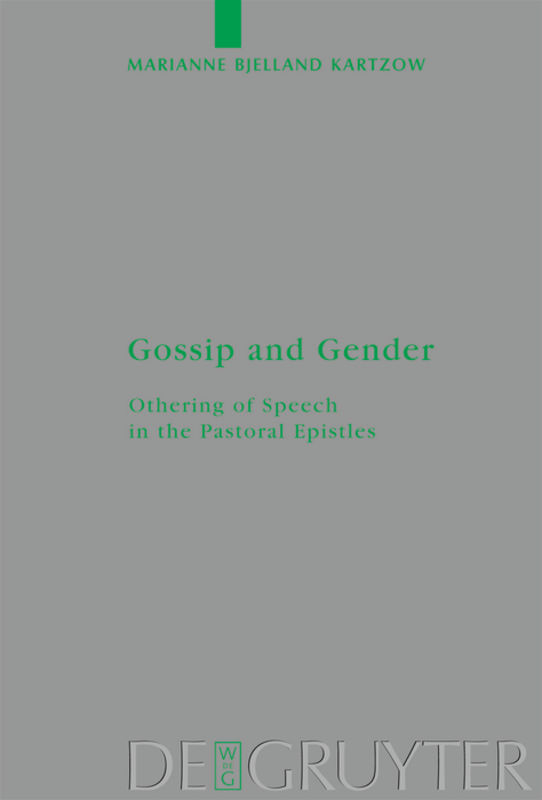
Gossip and Gender
This book suggests that gossip can be used as an interpretive key to understand more of early Christian identity and theology. Insights from the multi disciplinary field of gossip studies help to interpret what role gossip plays, especially in relation to how power and authority are distributed and promoted. A presentation of various texts in Greek, Hebrew and Latin shows that the relation between gossip and gender is complex: to gossip was typical for all women and risky for elite men who constantly had to defend their masculinity. Frequently the Pastoral Epistles connect gossip to false teaching, as an expression of deviance. On several occasions it is argued that various categories of women have to avoid gossip to be entrusted duties or responsibilities. \"Old wives' tales\" are associated with heresy, contrasted to godliness in which one had to train one self. Other passages clearly suggest that the false teaching resembles feminine gossip by use of metaphorical language: profane words will spread fast and uncontrolled like cancer; what the false teachers say is tickling in the ear, and their mouth must be stopped or silenced. The Pastoral Epistles employ terms drawn from the stereotype of gossip as rhetorical devices in order to undermine the masculinity and hence the authority, of the opponents.
eBook

Knowledge Goes Pop
A voice on late night radio tells you that a fast food joint injects its food with drugs that make men impotent. A colleague asks if you think the FBI was in on 9/11. An alien abductee on the Internet claims extra-terrestrials have planted a microchip in her left buttock. 'Julia Roberts in Porn Scandal' shouts the front page of a gossip mag. A spiritual healer claims he can cure chronic fatigue syndrome with the energizing power of crystals . . . What do you believe? Knowledge Goes Pop examines the popular knowledges that saturate our everyday experience. We make this information and then it shapes the way we see the world. How valid is it when compared to official knowledge and why does such (mis)information cause so much institutional anxiety? Knowledge Goes Pop examines the range of knowledge, from conspiracy theory to plain gossip, and its role and impact in our culture.
eBook
