
Catalogue Search | MBRL


Are you sure you want to remove the book from the shelf?

{{itemTitle}}
529
result(s) for
"Klimaänderung"
Sort by:


The Collapse of the Kyoto Protocol and the Struggle to Slow Global Warming
Even as the evidence of global warming mounts, the international response to this serious threat is coming unraveled. The United States has formally withdrawn from the 1997 Kyoto Protocol; other key nations are facing difficulty in meeting their Kyoto commitments; and developing countries face no limit on their emissions of the gases that cause global warming. In this clear and cogent book-reissued in paperback with an afterword that comments on recent events--David Victor explains why the Kyoto Protocol was never likely to become an effective legal instrument. He explores how its collapse offers opportunities to establish a more realistic alternative.
Global warming continues to dominate environmental news as legislatures worldwide grapple with the process of ratification of the December 1997 Kyoto Protocol. The collapse of the November 2000 conference at the Hague showed clearly how difficult it will be to bring the Kyoto treaty into force. Yet most politicians, policymakers, and analysts hailed it as a vital first step in slowing greenhouse warming. David Victor was not among them.
Kyoto's fatal flaw, Victor argues, is that it can work only if emissions trading works. The Protocol requires industrialized nations to reduce their emissions of greenhouse gases to specific targets. Crucially, the Protocol also provides for so-called \"emissions trading,\" whereby nations could offset the need for rapid cuts in their own emissions by buying emissions credits from other countries. But starting this trading system would require creating emission permits worth two trillion dollars--the largest single invention of assets by voluntary international treaty in world history. Even if it were politically possible to distribute such astronomical sums, the Protocol does not provide for adequate monitoring and enforcement of these new property rights. Nor does it offer an achievable plan for allocating new permits, which would be essential if the system were expanded to include developing countries.
The collapse of the Kyoto Protocol--which Victor views as inevitable--will provide the political space to rethink strategy. Better alternatives would focus on policies that control emissions, such as emission taxes. Though economically sensible, however, a pure tax approach is impossible to monitor in practice. Thus, the author proposes a hybrid in which governments set targets for both emission quantities and tax levels. This offers the important advantages of both emission trading and taxes without the debilitating drawbacks of each.
Individuals at all levels of environmental science, economics, public policy, and politics-from students to professionals--and anyone else hoping to participate in the debate over how to slow global warming will want to read this book.
eBook


Earthmasters : the dawn of the age of climate engineering
This book goes to the heart of the unfolding reality of the twenty-first century: international efforts to reduce greenhouse gas emissions have all failed, and before the end of the century Earth is projected to be warmer than it has been for 15 million years. The question \"can the crisis be avoided?\" has been superseded by a more frightening one, \"what can be done to prevent the devastation of the living world?\" And the disturbing answer, now under wide discussion both within and outside the scientific community, is to seize control of the very climate of the Earth itself. Clive Hamilton begins by exploring the range of technologies now being developed in the field of geoengineering--the intentional, enduring, large-scale manipulation of Earth's climate system. He lays out the arguments for and against climate engineering, and reveals the extent of vested interests linking researchers, venture capitalists, and corporations. He then examines what it means for human beings to be making plans to control the planet's atmosphere, probes the uneasiness we feel with the notion of exercising technological mastery over nature, and challenges the ways we think about ourselves and our place in the natural world.
eBook


Global crop yield response to extreme heat stress under multiple climate change futures
Extreme heat stress during the crop reproductive period can be critical for crop productivity. Projected changes in the frequency and severity of extreme climatic events are expected to negatively impact crop yields and global food production. This study applies the global crop model PEGASUS to quantify, for the first time at the global scale, impacts of extreme heat stress on maize, spring wheat and soybean yields resulting from 72 climate change scenarios for the 21st century. Our results project maize to face progressively worse impacts under a range of RCPs but spring wheat and soybean to improve globally through to the 2080s due to CO2 fertilization effects, even though parts of the tropic and sub-tropic regions could face substantial yield declines. We find extreme heat stress at anthesis (HSA) by the 2080s (relative to the 1980s) under RCP 8.5, taking into account CO2 fertilization effects, could double global losses of maize yield (ΔY = −12.8 ± 6.7% versus − 7.0 ± 5.3% without HSA), reduce projected gains in spring wheat yield by half (ΔY = 34.3 ± 13.5% versus 72.0 ± 10.9% without HSA) and in soybean yield by a quarter (ΔY = 15.3 ± 26.5% versus 20.4 ± 22.1% without HSA). The range reflects uncertainty due to differences between climate model scenarios; soybean exhibits both positive and negative impacts, maize is generally negative and spring wheat generally positive. Furthermore, when assuming CO2 fertilization effects to be negligible, we observe drastic climate mitigation policy as in RCP 2.6 could avoid more than 80% of the global average yield losses otherwise expected by the 2080s under RCP 8.5. We show large disparities in climate impacts across regions and find extreme heat stress adversely affects major producing regions and lower income countries.
Journal Article

Climate of Denial
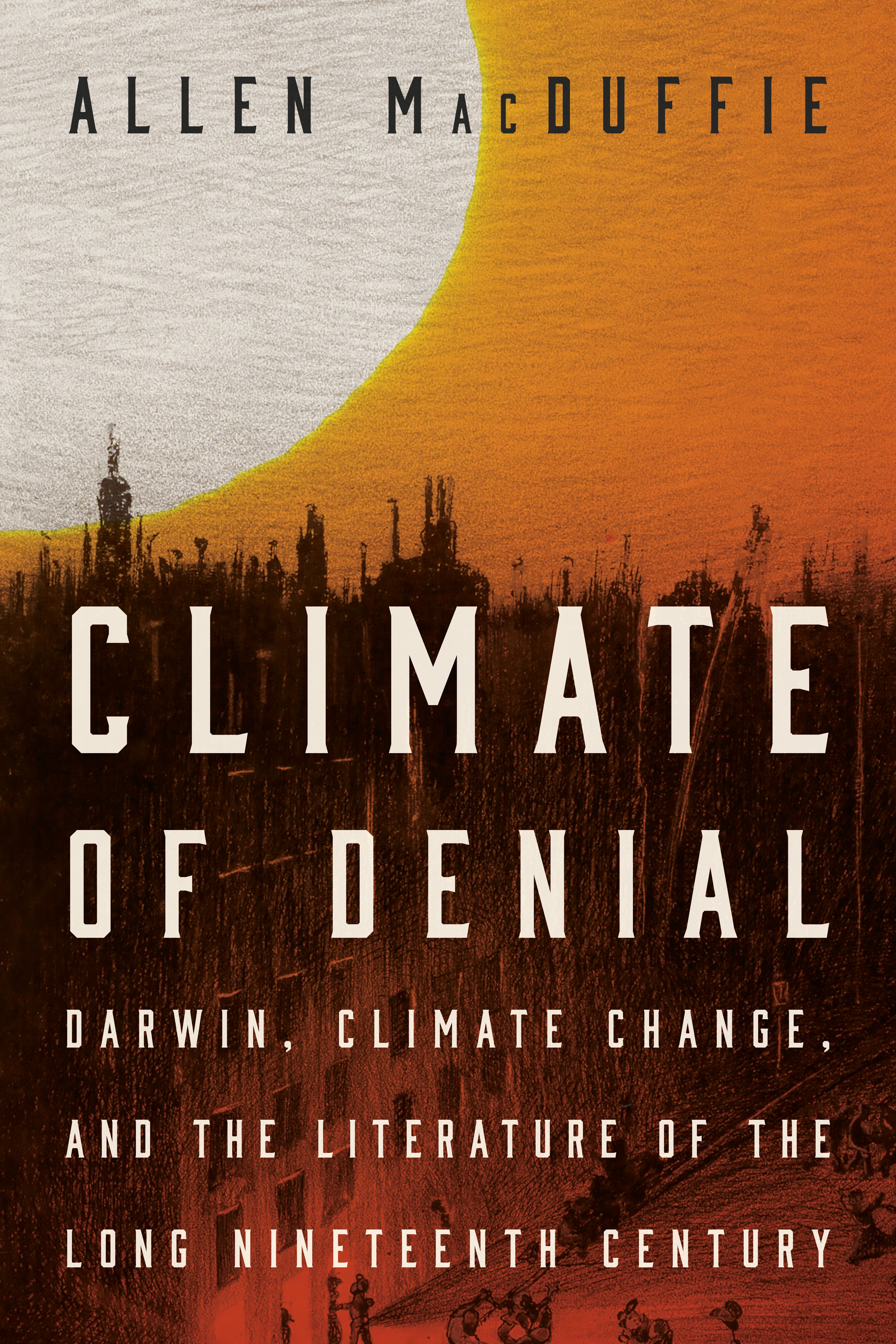
Many people today experience the climate crisis with a divided state of mind: aware of the extreme effects, but living everyday life as if the crisis is not actually happening. This book argues that this structure of feeling has roots that can be traced back to the nineteenth century, when Western culture encountered the profound shock of Charles Darwin's theory of evolution. Darwin's theory made it increasingly difficult for secular humanists to flatly deny that humans are animals, fully enmeshed in natural systems and processes. But like those of us confronting climate change today, many writers and scientists struggled to integrate its depersonalizing vision into their understanding of the place of humans in the natural order. The result was that the radical environmental implications of The Origin of Species were evaded as soon as they were articulated, abetted by a culture of denial structured by the illusions of capital and empire. In light of the climate emergency, Climate of Denial recontextualizes nineteenth-century texts to offer rich insight into the defensive strategies used—then and now—to avoid confronting the unsettling realities of our situation on this planet.
eBook

The politics of climate change
Since it first appeared, this book has achieved a classic status. Reprinted many times since its publication, it remains the only work that looks in detail at the political issues posed by global warming. This new edition has been thoroughly updated and provides a state-of-the-art discussion of the most formidable challenge humanity faces this century. If climate change goes unchecked, the consequences are likely to be catastrophic for human life on earth. Yet for most people and for many policy-makers too, it tends to be a back-of-the-mind issue. We recognize its importance and even its urgency, but for the most part it is swamped by more immediate concerns. Political action and intervention on local, national and international levels are going to have a decisive effect on whether or not we can limit global warming as well as how we adapt to that already occurring. However, at the moment, argues Giddens, we do not have a systematic politics of climate change. Politics-as-usual won't allow us to deal with the problems we face, while the recipes of the main challenger to orthodox politics, the green movement, are flawed at source. Giddens introduces a range of new concepts and proposals to fill in the gap, and examines in depth the connections between climate change and energy security--Back cover.
Book

vast machine
Global warming skeptics often fall back on the argument that the scientific case for global warming is all model predictions, nothing but simulation; they warn us that we need to wait for real data, \"sound science.\" In A Vast Machine Paul Edwards has news for these doubters: without models, there are no data. Today, no collection of signals or observations--even from satellites, which can \"see\" the whole planet with a single instrument--becomes global in time and space without passing through a series of data models. Everything we know about the world's climate we know through models. Edwards offers an engaging and innovative history of how scientists learned to understand the atmosphere--to measure it, trace its past, and model its future. Edwards argues that all our knowledge about climate change comes from three kinds of computer models: simulation models of weather and climate; reanalysis models, which recreate climate history from historical weather data; and data models, used to combine and adjust measurements from many different sources. Meteorology creates knowledge through an infrastructure (weather stations and other data platforms) that covers the whole world, making global data. This infrastructure generates information so vast in quantity and so diverse in quality and form that it can be understood only by computer analysis--making data global. Edwards describes the science behind the scientific consensus on climate change, arguing that over the years data and models have converged to create a stable, reliable, and trustworthy basis for the reality of global warming.
eBook