
Catalogue Search | MBRL


Are you sure you want to remove the book from the shelf?

{{itemTitle}}
29
result(s) for
"Knitting Fiction."
Sort by:

Crafty Llama
Llama knits while considering what special thing she wants to do, and soon all of her friends have joined her except Beaver, who only likes to make things that are useful.
Book

Wartime Knitting in Agatha Christie’s N or M?
Agatha Christie’s N or M? (1941) has received scarce critical attention despite the increasing academic discussion about the British Queens of Golden Age crime fiction. This, as Phyllis Lassner or Gill Plain argue, is a major lapse in the criticism of the genre, because the war novels by Golden Age female writers can demonstrate both the experimentation of the narrative form and the genre’s applicability to negotiate wartime concerns. N or M? focuses on the increasing paranoia about fifth columnists and the impact of WWII on everyday realities. To foreground the entanglement of the domestic and covert state operations through the counter-espionage mission of the Beresfords, Christie experiments with the fusion of spy fiction and the whodunit to subvert the traditional portrait of the spy by making Tuppence, a middle-aged housewife by now, but camouflaged as a knitting widow, the superior one. The novel also interrogates stereotypical assumptions about marginalized groups and negotiates new forms of patriotism by deconstructing propagandistic ideals of patriotic femininity. Therefore, this paper contends that Tuppence’s knitting provides insights into the competing discourses about women and their agency while also underscoring their contribution to the meaning making of the banal and the insignificant, eventually flaunted in the heroic power of the color magenta.
Journal Article

A knit before dying
Shop owner Josie Blair is finally settling into the pace of living in Dorset Falls, Connecticut. Between running Miss Marple Knits, jumpstarting a blog, and handcrafting items with the help of her knitting pals, Josie's too preoccupied to worry about her past in New York. And thanks to Lyndon and Harry, the owners of the brand-new antique shop next door, she has another project in her midst--repurposing a box of vintage crocheted doilies adorned with the most curious needlework. But before Josie can formally welcome her neighbors, she discovers Lyndon on the floor of his shop stabbed to death by a rusty old pair of sheep shears. Police have pinned Harry as the killer, but Josie isn't so sure. Now, she's lacing up for another homicide investigation--and no eyelet or stitch can go unexamined, lest she herself becomes ensnared in the criminal's deadly design.
Book
Spinning the Tale: Spinster Detectives and the Construction of Narrative in the Miss Silver Mysteries
The concept of spinster detective is one that has been relatively understudied, despite general contemporary interest in the detective form as an academic as well as a popular genre. The spinster detective sub-genre has remained on the sidelines, probably because of its utilization of an old woman as the detective. As an alternative to the professional detective, she represents a counter figure who sits comfortably in her chair knitting away as the events revolve around her. It is interesting to note that the word “spinster” itself comes from the act of spinning and spinster detectives from Miss Marple onwards have been frequently represented as old ladies who alternatively knit, crochet, weave, spin, or embroider. This correlation between being unmarried and “spinning” gains a poignant dimension when the actions of detecting and spinning are considered as central to these narratives. What the spinster detective does, in effect, is, she spins a tale; she constructs events in such a way as to explain who committed a crime and how, by forming a narrative out of the evidence. Her narrative is a counter narrative to the dominant presence and construction of the professional detective. This paper aims to reveal how the Miss Silver character in the Patricia Wentworth detective series gains narrative presence in the novels through the act of knitting, and how she gains a legitimate voice through this seemingly passive production.
Journal Article

Knit to kill
While on a weekend getaway to Osprey Island, hosted by Amy, Black Sheep member Lucy Binger's friend, a prominent member of the community is murdered, turning the idyllic setting into a crime scene. When the investigation focuses on Amy's husband, the knitters step in to untangle the clues.
Book

LAS HEBRAS DE PENÉLOPE EN LAS AMÉRICAS
Este artículo se centra en la figura de Penélope, en tanto tejedora ejemplar de la literatura occidental. Esta figura es erigida por la épica como ostentadora de feminidad, una feminidad reforzada en la tragedia griega. Nos interesa la modelación de Penélope destinada a tejer y ocupada en los quehaceres del tejido para advertir los desdoblamientos ficcionales que garantizan la reproducción de un imaginario de la feminidad, pero, sobre todo, para rastrear en la narrativa reciente de las Américas las alteraciones y recreaciones que nos permitan narrar de otra manera el vínculo entre cuerpos y escritura. Para tal efecto, dejamos planteado el desplazamiento de una concepción metafórica del texto por una concepción material del tejido.
This article focuses on Penelope, usually presented as an exemplary weaver of Western literature. This figure is erected by epic as a display of femininity, a femininity reinforced in Greek tragedy. We are interested in the modeling of Penelope destined to weave and engaged in weaving tasks to notice the fictional unfolding that guarantees the reproduction of an imaginary of femininity, but, above all, to recognize in the recent narrative of the Americas the alterations and re-creations that allow us to narrate the link between bodies and writing in another way. For this purpose, we propose the displacement of a metaphorical conception of the text by a material conception of knitting.
Journal Article

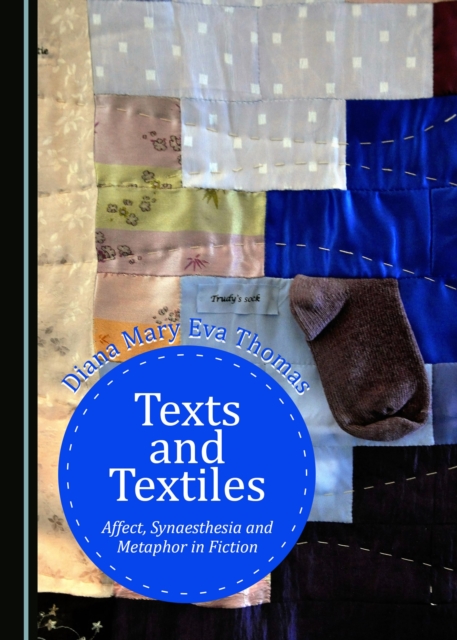
Texts and Textiles
This study shows how fiction that makes use of textiles as an essential element utilizes synaesthetic writing and synaesthetic metaphor to create an affective link to, and response in, the reader. These links and responses are examined using affect theory from Silvan Tomkins and Brian Massumi and work on synaesthesia by Richard Cytowic, Lawrence Marks, and V.S. Ramachandran, among others. Synaesthetic writing, including synaesthetic metaphors, has been explored in poetry since the 1920s and, more recently, in fiction, but these studies have been general in nature. By narrowing the field of investigation to those novels that specifically employ three types of hand-crafted textiles (quilt-making, knitting and embroidery), the book isolates how these textiles are used in fiction. The combination of synaesthesia, memory, metaphor and, particularly, synaesthetic metaphor in fiction with textiles in the text of the case studies selected, shows how these are used to create affect in readers, enhancing their engagement in the story. The work is framed within the context of the history of textile production and the use of textiles in fiction internationally, but concentrates on Australian authors who have used textiles in their writing. The decision to focus on Australian authors was taken in light of the quality and depth of the writing of textile fiction produced in Australia between 1980 and 2005 in the three categories of hand-crafted textiles - quilt-making, knitting and embroidery. The texts chosen for intensive study are: Kate Grenville's The Idea of Perfection (1999, quilting); Marele Day's Lambs of God (1997, knitting) and Anne Bartlett's Knitting (2005, knitting); Jessica Anderson's Tirra Lirra by the River (1978, embroidery) and Marion Halligan's Spider Cup (1990, embroidery).
eBook

Purls and poison
When a fellow Black Sheep Knitter is suspected of poisoning her coworker, the group puts down their needles and takes up their friend's defense...Suzanne Cavanaugh has just about had it with her office rival at Prestige Properties. It's bad enough that Liza Devereaux is constantly needling her at work, but when she shows up at one of Suzanne's open houses to poach potential buyers, it's the last straw. No one in the office fails to hear the two snarling at each other. When Liza is later found dead in her office cubicle--poisoned by a diet shake--Suzanne becomes the prime suspect. It's soon discovered, though, that Liza had double-crossed so many around town and stashed their dark secrets in her designer handbags that anyone could be the culprit. The Black Sheep Knitters have no doubt their friend has been framed--but they need to prove it. Stirred to action, they get together to catch a sneaky killer who's trying to pull the wool over everyone's eyes . . .
Book

Research into Reading Behavior
Some years ago, a colleague flying out of Minneapolis to an American Library Association convention did an informal assessment of the local librarians he saw waiting to board the plane. Most of our fiction is in bedrooms, our den has shelves full of non-fiction (heavy on botany and horticulture), and my sewing room is home to sewing, embroidery, knitting, and other handcraft books. The National Endowment for the Arts (NEA) shared data about how adults participated in the arts during COVID-19.3 In the section on reading behavior, the survey found that 53 percent of Americans read \"literature and/or books of some kind\" in 2022, down from 57 percent in 2017.
Trade Publication Article