
Catalogue Search | MBRL


Are you sure you want to remove the book from the shelf?

{{itemTitle}}
13,638
result(s) for
"Knowledge Production"
Sort by:


Econometric Modelling of the Regional Knowledge Production Function in Europe
By adopting a semiparametric approach, the ‘traditional’ regional knowledge production function is developed in three complementary directions. First, the model is augmented with region-specific time trends to account for endogeneity due to selection on unobservables. Second, the nonparametric part of the model relaxes the standard assumptions of linearity and additivity regarding the effect of R&D and human capital. Finally, the assumption of homogeneity in the effects of R&D and human capital is also relaxed by explicitly accounting for the differences between developed and lagging regions. The analysis of the genesis of innovation in the regions of the European Union unveils nonlinearities, threshold effects, complex interactions and shadow effects that cannot be uncovered by standard parametric formulations.
Journal Article

Dynamics of long-life assets : from technology adaptation to upgrading the business model
This book is published under a CC BY-NC 4.0 license. The editors present essential methods and tools to support a holistic approach to the challenge of system upgrades and innovation in the context of high-value products and services. The approach presented here is based on three main pillars: an adaptation mechanism based on a broad understanding of system dependencies; efficient use of system knowledge through involvement of actors throughout the process; and technological solutions to enable efficient actor communication and information handling. The book provides readers with a better understanding of the factors that influence decisions, and put forward solutions to facilitate the rapid adaptation to changes in the business environment and customer needs through intelligent upgrade interventions. Further, it examines a number of sample cases from various contexts including car manufacturing, utilities, shipping and the furniture industry. The book offers a valuable resource for both academics and practitioners interested in the upgrading of capital-intensive products and services. \"The work performed in the project \"Use-It-Wisely (UiW)\" significantly contributes towards a collaborative way of working. Moreover, it offers comprehensive system modelling to identify business opportunities and develop technical solutions within industrial value networks. The developed UiW-framework fills a void and offers a great opportunity. The naval construction sector of small passenger vessels, for instance, is one industry that can benefit.\" Nikitas Nikitakos, Professor at University of the Aegean, Department of Shipping, Trade, and Transport, Greece. \"Long-life assets are crucial for both the future competiveness and sustainability of society. Make wrong choices now and you are locked into a wrong system for a long time. Make the right choices now and society can prosper. This book gives important information about how manufacturers can make right choices.\" Arnold Tukker, Scientific director, Institute of Environmental Sciences (CML), Leiden University, and senior scientist, TNO.
Book


Toward successful joint knowledge production for climate change adaptation
In the domain of climate change adaptation, joint knowledge production (JKP) through intensive cooperation between scientists, policy-makers, and other actors is often proposed as a means to reconcile supply and demand for knowledge. Regional adaptation projects in the Netherlands form prominent examples of this. However, there is a lack of systematic empirical studies on how JKP can be done successfully. Here, we take the next step toward generating design principles for JKP. We do so by carrying out a comparative analysis of six Dutch adaptation projects using a previously developed assessment framework. Project documents were studied, and 30 semi-structured interviews were held with researchers, policy-makers, and financiers in the projects. Based on project comparisons, we derive and elaborate on two design principles for JKP. First, the most successful projects managed to create what we term a protected space for knowledge development while establishing connections with ongoing policy processes. Successful JKP seems to be more likely in cases in which actors make a conscious decision for the institutional location of the project on the research–policy nexus, whereby the coordinating entity has some characteristics of a boundary organization. Second, specific resources, including facilities, boundary objects, and specific competencies increase the chance for success.
Journal Article

African Studies, Forging Common Grounds: Languages, Scripts and Translation
In this presidential address I offer a critical examination of how Africa was misrepresented in the Global North’s imaginations and media reporting during the COVID-19 pandemic. Such biased imaginings of Africa as a site of inevitable catastrophe account for the racialized under-accounting of the history of African scientists’ pioneering success in biomedical research and with epidemics. The global archives of COVID-19 pandemics must acknowledge these scientists, as well as the humanistic contributions of African artists who collaborated with health experts and produced poetic/musical performances in local and world languages to tackle biomedical and social pandemics.
Journal Article


Learning from knowledge co-production research and practice in the twenty-first century: global lessons and what they mean for collaborative research in Nunatsiavut
An increasing need for novel approaches to knowledge co-production that effectively and equitably address sustainability challenges has arisen in the twenty-first century. Calls for more representative and contextual co-production strategies have come from Indigenous communities, scientific research forums, and global environmental governance networks. Despite calls to action, there are no systematic reviews that derive lessons from knowledge co-production scholarship to interpret their significance through the lens of a specific sociopolitical and cultural context. We conducted a systematic review of peer-reviewed and grey literature on knowledge co-production published from 2000 to 2020. Using a hybrid inductive and deductive thematic analysis, we identified two conceptual themes—guiding principles and approaches—to structure the synthesis and interpretation of 102 studies. We found that knowledge co-production studies often converged on four interrelated principles: recognition of contextual diversity bounding knowledge co-production, preemptive and intentional engagement with Indigenous knowledge holders, formation of shared understanding of the purpose of knowledge co-production, and empowerment of knowledge holders throughout the co-production cycle. These principles manifested in multiple approaches for interpreting, bridging, applying, and distributing power amongst diverse knowledge systems rooted in different epistemologies. We filter these findings through the social–ecological context that frames an ongoing knowledge co-production project with Inuit communities in Nunatsiavut, Canada: the Sustainable Nunatsiavut Futures Project. Our review suggests that emerging forms of knowledge co-production principles and approaches yield immense potential in diverse contexts. Yet in many regions, including Nunatsiavut, principles alone may not be enough to account for systemic and contextualized issues (e.g., colonisation and data sovereignty) that can present roadblocks to equitable sustainability science in the twenty-first century if left unaddressed.
Journal Article
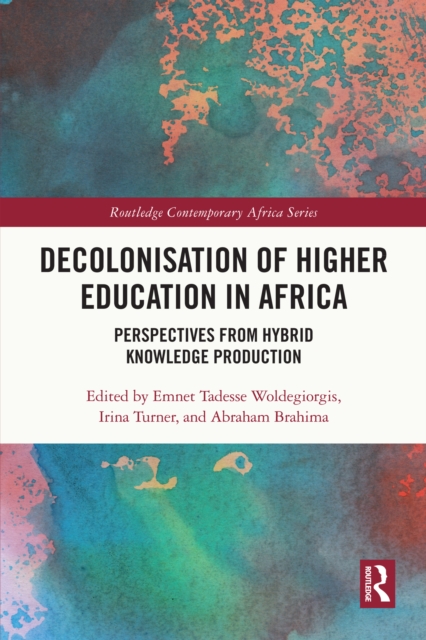
Decolonisation of Higher Education in Africa
This book discusses the status and importance of decolonisation and indigenous knowledge in academic research, teaching, and learning programmes and beyond.
Taking practical lessons from a range of institutions in Africa, the book argues that local and global sciences are culturally equal and capable of synergistic complementarity and then integrates the concept of hybrid science into discourses on decolonisation. The chapters argue for a cross-cultural dialogue between different epistemic traditions and the accommodation of ‘Indigenous’ knowledge systems in higher education. Bringing together critical scholars, teaching and administrating academics from different disciplines, the chapters provide alternative conceptual outlooks and practical case-based perspectives towards decolonised study environments.
This book will be of interest to researchers of decolonisation, postcolonial studies, higher education studies, political studies, African studies, and philosophy.
eBook