
Catalogue Search | MBRL


Are you sure you want to remove the book from the shelf?

{{itemTitle}}
2,580
result(s) for
"Knowledge-based systems"
Sort by:

Internet of Things with Raspberry Pi 3
Internet of Things (IoT) is currently a growing trend in the technology space, and Raspberry Pi is the perfect board to get started with building IoT projects. Applications of IoT are the basis of smart homes and when scaled up, we can drive smart cities and achieve manufacturing automation. This book covers many powerful features of.
eBook

Enterprise Internet of Things Handbook
Internet of Things is today and now. This \"hand\" book covers almost all the bare essential knowledge that is needed for an architect or a developer to build IoT solution. Right from understanding what IoT is and exploring various off of the shelf IoT platforms, this book has it all. This book also covers Machine Learning IoT at a basic level.
eBook

Integrating Remote Sensing and Knowledge-Based Systems for Structural Lineament Mapping in the Rif Belt
This study presents a novel methodology for mapping Fault- and Thrust-based Structural Lineaments (FT-SL) in the rugged and inaccessible Oued-Laou watershed of the Rif Belt, Morocco. Combining optical (Landsat-8 OLI, Sentinel-2 MSI) and radar (Sentinel-1 SAR) remote sensing data, the research employs manual, semi-automatic, and automatic extraction methods enhanced by spatial filtering (Sobel, Laplacian, Kuan). A Knowledge-Based System (KBS) integrated with Multi-Criteria Decision Analysis (MCDA) evaluates the effectiveness of these methods, focusing on lineament statistics, orientation, density distribution, and correlation with existing geological maps. The results highlight Sentinel-1 SAR’s superior performance in detecting subsurface structures, while manual extraction yields the highest accuracy. This study also demonstrates the potential for generalizing this approach to other Alpine orogenic regions, such as the Alps, due to shared geological characteristics. The findings provide a robust framework for structural lineament mapping in mountainous terrains, addressing challenges of accessibility and data scarcity.
Journal Article

BioTransformer: a comprehensive computational tool for small molecule metabolism prediction and metabolite identification
Background
A number of computational tools for metabolism prediction have been developed over the last 20 years to predict the structures of small molecules undergoing biological transformation or environmental degradation. These tools were largely developed to facilitate absorption, distribution, metabolism, excretion, and toxicity (ADMET) studies, although there is now a growing interest in using such tools to facilitate metabolomics and exposomics studies. However, their use and widespread adoption is still hampered by several factors, including their limited scope, breath of coverage, availability, and performance.
Results
To address these limitations, we have developed BioTransformer, a freely available software package for accurate, rapid, and comprehensive in silico metabolism prediction and compound identification. BioTransformer combines a machine learning approach with a knowledge-based approach to predict small molecule metabolism in human tissues (e.g. liver tissue), the human gut as well as the environment (soil and water microbiota), via its metabolism prediction tool. A comprehensive evaluation of BioTransformer showed that it was able to outperform two state-of-the-art commercially available tools (Meteor Nexus and ADMET Predictor), with precision and recall values up to 7 times better than those obtained for Meteor Nexus or ADMET Predictor on the same sets of pharmaceuticals, pesticides, phytochemicals or endobiotics under similar or identical constraints. Furthermore BioTransformer was able to reproduce 100% of the transformations and metabolites predicted by the EAWAG pathway prediction system. Using mass spectrometry data obtained from a rat experimental study with epicatechin supplementation, BioTransformer was also able to correctly identify 39 previously reported epicatechin metabolites via its metabolism identification tool, and suggest 28 potential metabolites, 17 of which matched nine monoisotopic masses for which no evidence of a previous report could be found.
Conclusion
BioTransformer can be used as an open access command-line tool, or a software library. It is freely available at
https://bitbucket.org/djoumbou/biotransformerjar/
. Moreover, it is also freely available as an open access RESTful application at
www.biotransformer.ca
, which allows users to manually or programmatically submit queries, and retrieve metabolism predictions or compound identification data.
Journal Article

An artificial intelligence approach to support knowledge management on the selection of creativity and innovation techniques
Purpose
Creativity is an important skill for design teams to reach new and useful solutions. Designers often use one or more of creativity and innovation techniques (CITs) to achieve the desired creative potential during new product development (NPD). The selection of adequate CITs requires considerable expertise, given the multiple application contexts and the extensive number of techniques available. The purpose of this study is to present a creativity support system able to manage this amount of information and provide valuable knowledge to improve NPD.
Design/methodology/approach
This study presents a knowledge-based system prototype using artificial intelligence (AI) to support knowledge management on the selection of CITs for design. CITs assertion is modelled through a double inference process using five categories, correlating over 500 different entry scenarios to 24 implemented CITs. The techniques are classified according to: design stage, innovation focus, team relationship, execution method and difficult of use. Prototype outputs explanations on the inference process and chosen techniques information.
Findings
To demonstrate the system scope, two opposite design cases are presented. The system was validated by experts in knowledge management and mechanical engineering design. The validation process demonstrates relevance of the approach and improvement directions for future developments.
Originality/value
Though literature contains toolkits and taxonomy for CITs, no work applies AI to identify design scenarios, select best CITs and instruct about their use. Validators reported to know less than half of the available techniques, showing a clear knowledge gap among design experts.
Journal Article

Evaluating the external validity of an artificial intelligence-based mobile support app for caregiving relatives by an online expert survey
Background
Mobile Care Backup is a support app for family caregivers that provides textual information on topics personalized to their specific care situation. Personalization is performed by an artificial intelligence-based expert system. Here, we present the evaluation of the expert system’s validity with project external nursing experts. Furthermore, we discuss the general limitations of an online survey as an evaluation methodology for expert systems.
Methods
This study was conducted as an online survey in German and English. A total of nine experts, all of whom were female and had extensive (outpatient) care experience, were included. The participants were presented with descriptions of multiple fictitious family caregivers and the system’s personalized list of topics. They were then asked to rate the appropriateness on a five-item Likert scale and suggest additional topics. The collected data was analyzed descriptively to investigate whether MoCaB‘s topic recommendation strategy aligns with project external experts. For deviating topic sequences, the consensus of the experts was verified by pairwise rank correlation using Spearman’s Rho. Additional suggested topics were checked to see if they were part of the system but not provided (false negatives).
Results
In the 495 submitted ratings, participants rated the suggested topics‘ appropriateness relatively high, with an average rating of 4.4 and a median of 5. This indicates that participants consider most of the recommended topics important for the fictitious family caregiver. The system‘s personalization performance was high (precision of 0.965 and recall of 0.986). Overall, the experts are unanimous. There is no unique alternative sequence regarding the rare cases of disagreement with the system in the ordering of topics.
Conclusions
The MoCaB system’s external validity is high, and isolated inconsistencies will be resolved in the project group. Using an online survey to evaluate the system’s validity with external experts is complex and time-consuming. Participants need a very high degree of competence, as they must infer from the title to the content. Nevertheless, it is an essential step in the evaluation process of expert systems and, if carried out correctly, can identify weak spots and further improve the expert system.
Journal Article

Predicting The Use of a Knowledge-Based System for Collaborative Surgical Team
Advancement of new technologies and the accessibility of the Internet make it feasible to provide collaborative teams for medical purposes. This research studies how technology impacts the health care system to tackle the problem of forming an efficient team for medical purposes at hospitals in the Northern region of Malaysia. In this paper, we explore the Knowledge-based Collaborative Surgical Team (K-CST) system further, which automatically assigns an efficient collaborative surgical team. By utilizing the evolution of technologies and the Internet, this study aims to incorporate a knowledge-based approach with a genetic algorithm to form an efficient medical team. A survey was conducted among 30 health practitioners in the Northern region of Malaysia to predict the acceptance to use of the proposed K-CST system in comparison with the existing system. Collected data were analysed using Statistical Package for Social Science (SPSS) by using Pearson Correlation to describe the strength of the relationship between K-CST system and the existing system. Results for K- CST system was significant and have a positive relationship, while the results for the existing system were slightly insignificant and had a negative relationship. This study recommends that there should be some improvement in the system with the purpose of promoting a better healthcare system. The results from the analysis showed the hat K-CST system is accepted in the Northern region of Malaysia and has a good potential to be implemented in hospitals in the country.
Journal Article

Chatbot-facilitated Nursing Education: Incorporating a Knowledge-Based Chatbot System into a Nursing Training Program
Conventional nursing courses have solely adopted lecture-based instruction for knowledge delivery, which tends to lack interaction, rehearsal, and personalized feedback. The development of chatbot technologies and their broad application have provided an opportunity to solve the abovementioned problems. Some knowledge-based chatbot systems have been developed; however, it is still a challenging issue for researchers to determine exactly how to effectively apply these chatbot technologies in nursing training courses. Intending to explore the application mode of chatbot technologies and their effectiveness in nursing education, this study integrated a knowledge-based chatbot system into the teaching activities of a physical examination course, using smartphones as the learning devices, and guiding students to practice their anatomy knowledge in addition to analyzing their learning efficacy and pleasure. A quasi-experiment was conducted by recruiting two classes of university students with nursing majors. One class was the experimental group learning with the knowledge-based chatbot system, while the other class was the control group learning with the traditional instruction. Based on the experimental results, the knowledge-based chatbot system effectively enhanced students' academic performance, critical thinking, and learning satisfaction. The results indicate that the application of chatbots has great potential in nursing education.
Journal Article

Agronomic Linked Data (AgroLD): A knowledge-based system to enable integrative biology in agronomy
Recent advances in high-throughput technologies have resulted in a tremendous increase in the amount of omics data produced in plant science. This increase, in conjunction with the heterogeneity and variability of the data, presents a major challenge to adopt an integrative research approach. We are facing an urgent need to effectively integrate and assimilate complementary datasets to understand the biological system as a whole. The Semantic Web offers technologies for the integration of heterogeneous data and their transformation into explicit knowledge thanks to ontologies. We have developed the Agronomic Linked Data (AgroLD- www.agrold.org), a knowledge-based system relying on Semantic Web technologies and exploiting standard domain ontologies, to integrate data about plant species of high interest for the plant science community e.g., rice, wheat, arabidopsis. We present some integration results of the project, which initially focused on genomics, proteomics and phenomics. AgroLD is now an RDF (Resource Description Format) knowledge base of 100M triples created by annotating and integrating more than 50 datasets coming from 10 data sources-such as Gramene.org and TropGeneDB-with 10 ontologies-such as the Gene Ontology and Plant Trait Ontology. Our evaluation results show users appreciate the multiple query modes which support different use cases. AgroLD's objective is to offer a domain specific knowledge platform to solve complex biological and agronomical questions related to the implication of genes/proteins in, for instances, plant disease resistance or high yield traits. We expect the resolution of these questions to facilitate the formulation of new scientific hypotheses to be validated with a knowledge-oriented approach.
Journal Article
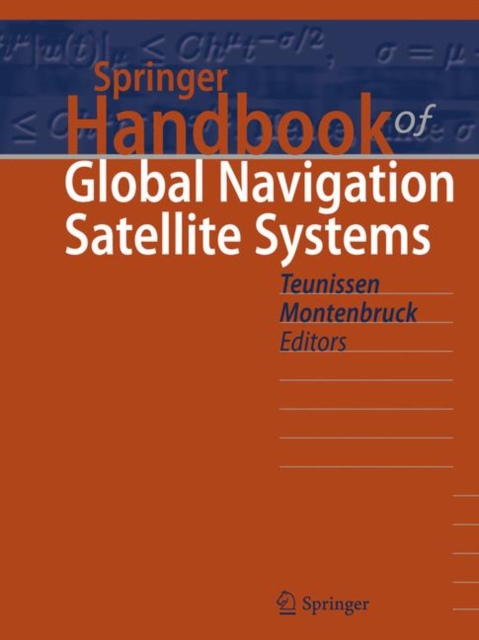
Springer handbook of global navigation satellite systems
This Handbook presents a complete and rigorous overview of the fundamentals, methods and applications of the multidisciplinary field of Global Navigation Satellite Systems (GNSS), providing an exhaustive, one-stop reference work and a state-of-the-art description of GNSS as a key technology for science and society at large.
eBook