
Catalogue Search | MBRL


Are you sure you want to remove the book from the shelf?

{{itemTitle}}
236
result(s) for
"Konversationsanalyse"
Sort by:

Conversational metrics, psychopathological dimensions and self-disturbances in patients with schizophrenia
Difficulties in interpersonal communication, including conversational skill impairments, are core features of schizophrenia. However, very few studies have performed conversation analyses in a clinical population of schizophrenia patients. Here we investigate the conversational patterns of dialogues in schizophrenia patients to assess possible associations with symptom dimensions, subjective self-disturbances and social functioning. Thirty-five schizophrenia patients were administered the Positive and Negative Syndrome Scale (PANSS), the Clinical Language Disorder Rating Scale (CLANG), the Scale for the Assessment of Thought, Language and Communication (TLC), the Examination of Anomalous Self-Experience Scale (EASE), and the Social and Occupational Functioning Assessment Scale (SOFAS). Moreover, participants underwent a recorded semi-structured interview, to extract conversational variables. Conversational data were associated with negative symptoms and social functioning, but not with positive or disorganization symptoms. A significant positive correlation was found between “pause duration” and the EASE item “Spatialization of thought”. The present study suggests an association between conversational patterns and negative symptom dimension of schizophrenia. Moreover, our findings evoke a relationship between the natural fluidity of conversation and of the natural unraveling of thoughts.
Journal Article

Action and agency in dialogue : passion, incarnation and ventriloquism
What happens when people communicate or dialogue with each other? This is the daunting question that this book proposes to address by starting from a controversial hypothesis: What if human interactants were not the only ones to be considered, paraphrasing Austin (1962), as \"doing things with words\"? That is, what if other \"things\" could also be granted the status of agents in a dialogical situation? Action and Agency in Dialogue: Passion, incarnation, and ventriloquism proposes to explore this unique hypothesis by mobilizing metaphorically the notion of ventriloquism. According to this ventriloqual perspective, interactions are never purely local, but dislocal, that is, they constantly mobilize figures (collectives, principles, values, emotions, etc.) that incarnate themselves in people's discussions. This highly original book, which develops the analytical, practical and ethical dimensions of such a theoretical positioning, may be of interest to communication scholars, linguists, sociologists, conversation analysts, management and organizational scholars, as well as philosophers interested in language, action and ethics.
eBook
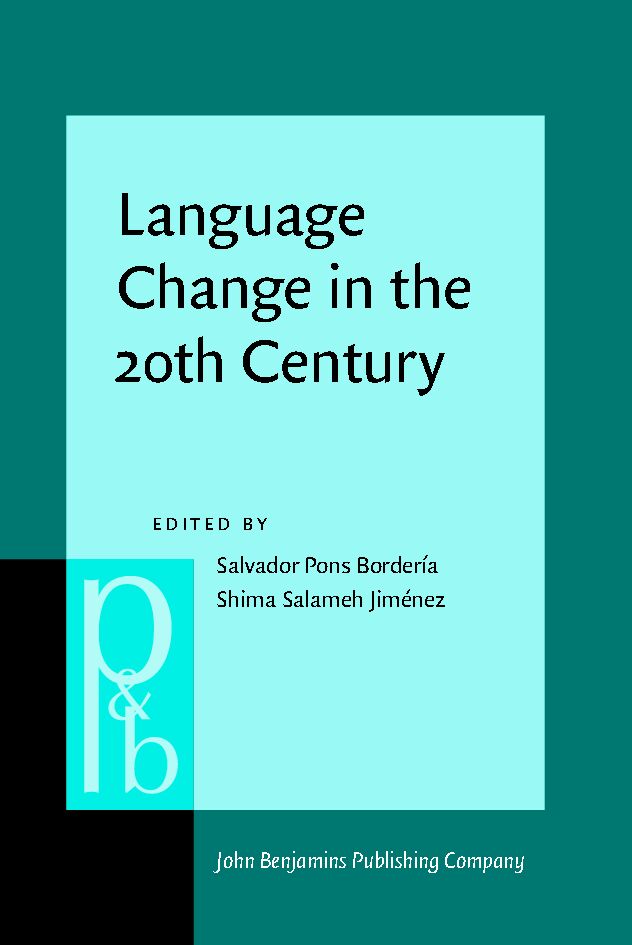
Language Change in the 20th Century
This book examines the distinctive features that set the study of the 20th century apart from preceding periods. With a primary focus on Romance languages, including Spanish, Italian, French, and Portuguese, the book advocates for the adoption of innovative methodologies to enhance the nuanced retrieval of research data.
eBook

Conversation Analysis
'Conversation analysis' is an approach to the study of social interaction that focuses on practices of speaking that recur across a range of contexts and settings. The early studies in this tradition were based on the analysis of English conversation. More recently, however, conversation analysts have begun to study talk in a broader range of communities around the world. Through detailed analyses of recorded conversations, this book examines differences and similarities across a wide range of languages including Finnish, Japanese, Tzeltal Mayan, Russian and Mandarin. Bringing together interrelated methodological and analytic contributions, it explores topics such as the role of gaze in question-and-answer sequences, the organization of repair, and the design of responses to assessments. The emerging comparative perspective demonstrates how the structure of talk is inflected by the local circumstances within which it operates.
eBook

Understanding pragmatic markers
The multifunctionality of pragmatic markers makes it difficult to describe their meaning and functional potential. By taking a broad perspective on markers, classifying them, describing their class-specific properties and analysing individual markers, Karin Aijmer assesses whether generalisations can be made about the prosody of the markers.
eBook

The Multimodal Performance of Conversational Humor
This volume is the first monograph exploring the functions of visual cues in humor, advocating for the development of a non-linguocentric theory of humor performance. It analyzes a corpus of dyadic, face-to-face interactions in Spanish and English to study the relationship between humor, smiling, and gaze, and shows how, by focusing on these elements, it is possible to shed light on the \"unsaid\" of conversations.In the book, the humorous framing of an utterance is shown to be negotiated and co-constructed dialogically and multimodally, through changes and patterns of smiling synchronicity, smiling intensity, and eye movements. The study also analyzes the multimodal features of failed humor and proposes a new categorization from a dialogic perspective.Because of its interdisciplinary approach, which includes facial expression analysis and eye tracking, this book is relevant to humor researchers as well as scholars in social and behavioral sciences interested in multimodality and embodied cognition.
eBook


Facebook and Conversation Analysis
Facebook and Conversation Analysis investigates the structure and organization of comments on a major social media platform, Facebook, using applied conversation analysis methods. Providing previously undocumented insights into the structure of comment threads, this book demonstrates that they have a meaningful organization, rather than casually following one another. Although normally used to explore the structure of spoken conversations, in recent years conversation analysis approaches have been successfully applied to examine online interactions on Twitter, discussion forums and email exchanges. By turning this approach towards Facebook comments, Matteo Farina provides clear and important insights into the organization of this type of social interaction. Supported by a large sample of data, with findings based on a corpus of 213 comment threads, with over 1,200 comments exchanged by 266 contributors, this book makes an important contribution to our understanding of the way people communicate on Facebook.
eBook

On Materiality: Home Spaces and Objects as Expanding Elements of Everyday Experiences
In diesem Artikel beschäftigen wir uns mit der Rolle von Materialität im Leben von acht italienischen Familien. Hierzu haben wir, mit einem Fokus auf Räume und Objekte, untersucht, wie sie materielle Rahmen und Grenzen für ihre individuellen und miteinander geteilten Alltagserfahrungen nutzen. Es kamen unterschiedliche Datensorten zum Einsatz, z.B. Audio- und Videoaufzeichnungen von Haustouren, visuelle ethnografische Notizen und Fotos, Beobachtung von Alltagsaktivitäten und das Mapping und Tracking spezifischer Handlungen in wiederkehrenden Intervallen. Zur Untersuchung des Materialitätsbezogenen Talk-in-Interaction der Familienmitglieder nutzten wir diskurs- und konversationsanalytische Verfahren. Unsere Ergebnisse zeigen, dass Räume und Objekte der Erweiterung der Alltagsaktivitäten der Teilnehmenden dienten: Sie wurden als flexibel in ihrer Nutzung, multifunktional und affektiv besetzt präsentiert. Vor diesem Hintergrund diskutieren wir mögliche methodologische Implikationen für die angemessene Erhebung familiärer Aktivitäten und Erfahrungen in der eigenen Wohnumgebung.
Journal Article

Discursive leadership : in conversation with leadership psychology
Discursive Leadership: In Conversation with Leadership Psychology presents a new, groundbreaking way for scholars and graduate students to examine and explore leadership. Differing from a psychological approach to leadership which tries to get inside the heads of leaders and employees, author Gail Fairhurst focuses on the social or communicative aspects between them. A discursive approach to leadership introduces a host of relatively new ideas and concepts and helps us understand leadership′s changing role in organizations.
eBook