
Catalogue Search | MBRL


Are you sure you want to remove the book from the shelf?

{{itemTitle}}
5,723
result(s) for
"Kriging"
Sort by:

Gradient-enhanced kriging for high-dimensional problems
Surrogate models provide an affordable alternative to the evaluation of expensive deterministic functions. However, the construction of accurate surrogate models with many independent variables is currently prohibitive because they require a large number of function evaluations for the desired accuracy. Gradient-enhanced kriging has the potential to reduce the number of evaluations when efficient gradient computation, such as an adjoint method, is available. However, current gradient-enhanced kriging methods do not scale well with the number of sampling points because of the rapid growth in the size of the correlation matrix, where new information is added for each sampling point in each direction of the design space. Furthermore, they do not scale well with the number of independent variables because of the increase in the number of hyperparameters that must be estimated. To address this issue, we develop a new gradient-enhanced surrogate model approach that drastically reduces the number of hyperparameters through the use of the partial least squares method to maintain accuracy. In addition, this method is able to control the size of the correlation matrix by adding only relevant points defined by the information provided by the partial least squares method. To validate our method, we compare the global accuracy of the proposed method with conventional kriging surrogate models on two analytic functions with up to 100 dimensions, as well as engineering problems of varied complexity with up to 15 dimensions. We show that the proposed method requires fewer sampling points than conventional methods to obtain the desired accuracy, or it provides more accuracy for a fixed budget of sampling points. In some cases, we get models that are over three times more accurate than previously developed surrogate models for the same computational time, and over 3200 times faster than standard gradient-enhanced kriging models for the same accuracy.
Journal Article

Nonlinear models based on enhanced Kriging interpolation for prediction of rock joint shear strength
One of the most basic topics in rock mechanic is the shear strength criteria for rock joints. Thus, it is of high importance to accurately predict the shear strength of rock joints. In this study, the abilities for accuracy and agreement of Kriging model-based nonlinear interpolation strategy are investigated in terms of predicting the shear strength of rock joints. Totally 84 datasets were used to construct the Kriging models; the datasets were divided into two main parts: training and testing. The prepared database was applied to the training phase in the Kriging model; this way, several nonlinear basic functions were introduced to enhance the predictions of the Kriging model. The examined functions in this paper were linear, 2-order, 3-order, exponential, logarithmic, logistic, hyperbolic tangent, and hyperbolic sine. The sigmoid forms of the basic functions, including logistic and hyperbolic tangent, provide the superior predictions compared to other mathematical functions, while the 2-order and 3-order forms provide the worst performances than the linear, exponential, and logarithmic functions. According to the obtained results, the logistic-based model with coefficient of determination (
R
2
) of 0.916 was found the optimal model that can be successfully applied to estimating the shear strength of rock joints.
Journal Article
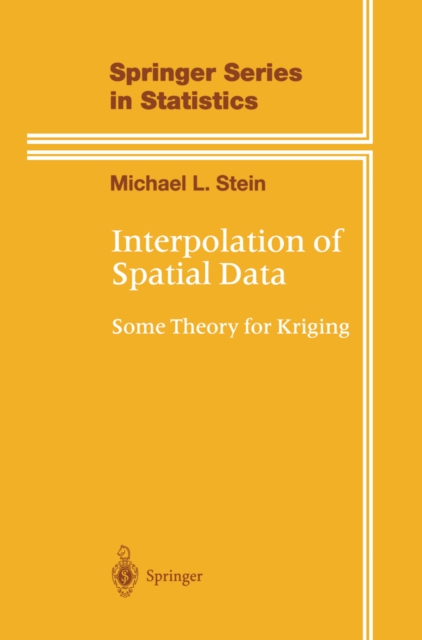
Interpolation of Spatial Data: Some Theory for Kriging
Prediction of a random field based on observations of the random field at some set of locations arises in mining, hydrology, atmospheric sciences, and geography. Kriging, a prediction scheme defined as any prediction scheme that minimizes mean squared prediction error among some class of predictors under a particular model for the field, is commonly used in all these areas of prediction. This book summarizes past work and describes new approaches to thinking about kriging.
eBook
A sequential constraints updating approach for Kriging surrogate model-assisted engineering optimization design problem
Kriging surrogate model has been widely used in engineering design optimization problems to replace computational cost simulations. To facilitate the usage of the Kriging surrogate model-assisted engineering optimization design, there are still challenging issues on the updating of Kriging surrogate model for the constraints, since there exists prediction error between the Kriging surrogate model and the real constraints. Ignoring the interpolation uncertainties from the Kriging surrogate model of constraints may lead to infeasible optimal solutions. In this paper, general sequential constraints updating approach based on the confidence intervals from the Kriging surrogate model (SCU-CI) are proposed. In the proposed SCU-CI approach, an objective switching and sequential updating strategy is introduced based on whether the feasibility status of the design alternatives would be changed because of the interpolation uncertainty from the Kriging surrogate model or not. To demonstrate the effectiveness of the proposed SCU-CI approach, nine numerical examples and two practical engineering cases are used. The comparisons between the proposed approach and five existing approaches considering the quality of the obtained optimum and computational efficiency are made. Results illustrate that the proposed SCU-CI approach can generally ensure the feasibility of the optimal solution under a reasonable computational cost.
Journal Article

US particulate matter air quality improves except in wildfire-prone areas
Using data from rural monitoring sites across the contiguous United States, we evaluated fine particulate matter (PM2.5) trends for 1988–2016. We calculate trends in the policy-relevant 98th quantile of PM2.5 using Quantile Regression. We use Kriging and Gaussian Geostatistical Simulations to interpolate trends between observed data points. Overall, we found positive trends in 98th quantile PM2.5 at sites within the Northwest United States (average 0.21 ± 0.12 μg·m−3·y−1; ±95% confidence interval). This was in contrast with sites throughout the rest of country, which showed a negative trend in 98th quantile PM2.5, likely due to reductions in anthropogenic emissions (average −0.66 ± 0.10 μg·m−3·y−1). The positive trend in 98th quantile PM2.5 is due to wildfire activity and was supported by positive trends in total carbon and no trend in sulfate across the Northwest. We also evaluated daily moderate resolution imaging spectroradiometer (MODIS) aerosol optical depth (AOD) for 2002–2017 throughout the United States to compare with ground-based trends. For both Interagency Monitoring of Protected Visual Environments (IMPROVE) PM2.5 and MODIS AOD datasets, we found positive 98th quantile trends in the Northwest (1.77 ± 0.68% and 2.12 ± 0.81% per year, respectively) through 2016. The trend in Northwest AOD is even greater if data for the high-fire year of 2017 are included. These results indicate a decrease in PM2.5 over most of the country but a positive trend in the 98th quantile PM2.5 across the Northwest due to wildfires.
Journal Article

Random Forest Spatial Interpolation
For many decades, kriging and deterministic interpolation techniques, such as inverse distance weighting and nearest neighbour interpolation, have been the most popular spatial interpolation techniques. Kriging with external drift and regression kriging have become basic techniques that benefit both from spatial autocorrelation and covariate information. More recently, machine learning techniques, such as random forest and gradient boosting, have become increasingly popular and are now often used for spatial interpolation. Some attempts have been made to explicitly take the spatial component into account in machine learning, but so far, none of these approaches have taken the natural route of incorporating the nearest observations and their distances to the prediction location as covariates. In this research, we explored the value of including observations at the nearest locations and their distances from the prediction location by introducing Random Forest Spatial Interpolation (RFSI). We compared RFSI with deterministic interpolation methods, ordinary kriging, regression kriging, Random Forest and Random Forest for spatial prediction (RFsp) in three case studies. The first case study made use of synthetic data, i.e., simulations from normally distributed stationary random fields with a known semivariogram, for which ordinary kriging is known to be optimal. The second and third case studies evaluated the performance of the various interpolation methods using daily precipitation data for the 2016–2018 period in Catalonia, Spain, and mean daily temperature for the year 2008 in Croatia. Results of the synthetic case study showed that RFSI outperformed most simple deterministic interpolation techniques and had similar performance as inverse distance weighting and RFsp. As expected, kriging was the most accurate technique in the synthetic case study. In the precipitation and temperature case studies, RFSI mostly outperformed regression kriging, inverse distance weighting, random forest, and RFsp. Moreover, RFSI was substantially faster than RFsp, particularly when the training dataset was large and high-resolution prediction maps were made.
Journal Article

A Multiresolution Gaussian Process Model for the Analysis of Large Spatial Datasets
We develop a multiresolution model to predict two-dimensional spatial fields based on irregularly spaced observations. The radial basis functions at each level of resolution are constructed using a Wendland compactly supported correlation function with the nodes arranged on a rectangular grid. The grid at each finer level increases by a factor of two and the basis functions are scaled to have a constant overlap. The coefficients associated with the basis functions at each level of resolution are distributed according to a Gaussian Markov random field (GMRF) and take advantage of the fact that the basis is organized as a lattice. Several numerical examples and analytical results establish that this scheme gives a good approximation to standard covariance functions such as the Matérn and also has flexibility to fit more complicated shapes. The other important feature of this model is that it can be applied to statistical inference for large spatial datasets because key matrices in the computations are sparse. The computational efficiency applies to both the evaluation of the likelihood and spatial predictions.
Journal Article

Application of lignin in controlled release: development of predictive model based on artificial neural network for API release
Predictive models for simulation of drug release from tablets containing lignin as excipient were developed in this work. Two predictive models including Artificial Neural Network (ANN) and hybrid ANN-Kriging were developed to simulate the tablet dissolution. Measured data was collected on the release rate of aspirin tablets prepared by dry granulation via roll compaction followed by milling and tableting. Two formulations were considered, one with lignin and one without. The main aim is to show the effect of lignin as a bio-based natural polymer in tablet manufacturing to control drug dissolution. For the ANN model development, process and formulation parameters including roll pressure and lignin content were considered as the input, while API dissolution was considered as response. The predictions were compared with measured data to calibrate and validate the model. To improve the predictability of the model, Kriging interpolation was used to enhance the number of training points for the ANN. The interpolated data was trained and validated. The final concentration and the dissolution rate were predicted by ANN as well as ANN-Kriging models, and the
R
2
of greater than 0.99 for most cases was obtained. The validated model was used to evaluate the effect of process parameters on the release rate and it was indicated that the tablets containing lignin have higher release rate compared to tablets without. Also, it was revealed that process parameters do not have significant effect on the tablet release rate, and the tablet release rate is mainly affected by the lignin content. The results indicated that ANN-based model is a powerful tool to predict the API release rate for tablets containing various formulations, and can be used as a predictive tool for design of controlled release systems.
Journal Article

A Multi-Resolution Approximation for Massive Spatial Datasets
Automated sensing instruments on satellites and aircraft have enabled the collection of massive amounts of high-resolution observations of spatial fields over large spatial regions. If these datasets can be efficiently exploited, they can provide new insights on a wide variety of issues. However, traditional spatial-statistical techniques such as kriging are not computationally feasible for big datasets. We propose a multi-resolution approximation (M-RA) of Gaussian processes observed at irregular locations in space. The M-RA process is specified as a linear combination of basis functions at multiple levels of spatial resolution, which can capture spatial structure from very fine to very large scales. The basis functions are automatically chosen to approximate a given covariance function, which can be nonstationary. All computations involving the M-RA, including parameter inference and prediction, are highly scalable for massive datasets. Crucially, the inference algorithms can also be parallelized to take full advantage of large distributed-memory computing environments. In comparisons using simulated data and a large satellite dataset, the M-RA outperforms a related state-of-the-art method. Supplementary materials for this article are available online.
Journal Article

Comparing ordinary kriging and inverse distance weighting for soil as pollution in Beijing
Spatial interpolation method is the basis of soil heavy metal pollution assessment and remediation. The existing evaluation index for interpolation accuracy did not combine with actual situation. The selection of interpolation methods needs to be based on specific research purposes and research object characteristics. In this paper, As pollution in soils of Beijing was taken as an example. The prediction accuracy of ordinary kriging (OK) and inverse distance weighted (IDW) were evaluated based on the cross validation results and spatial distribution characteristics of influencing factors. The results showed that, under the condition of specific spatial correlation, the cross validation results of OK and IDW for every soil point and the prediction accuracy of spatial distribution trend are similar. But the prediction accuracy of OK for the maximum and minimum is less than IDW, while the number of high pollution areas identified by OK are less than IDW. It is difficult to identify the high pollution areas fully by OK, which shows that the smoothing effect of OK is obvious. In addition, with increasing of the spatial correlation of As concentration, the cross validation error of OK and IDW decreases, and the high pollution area identified by OK is approaching the result of IDW, which can identify the high pollution areas more comprehensively. However, because the semivariogram constructed by OK interpolation method is more subjective and requires larger number of soil samples, IDW is more suitable for spatial prediction of heavy metal pollution in soils.
Journal Article