
Catalogue Search | MBRL


Are you sure you want to remove the book from the shelf?

{{itemTitle}}
217
result(s) for
"Kurt Tucholsky"
Sort by:
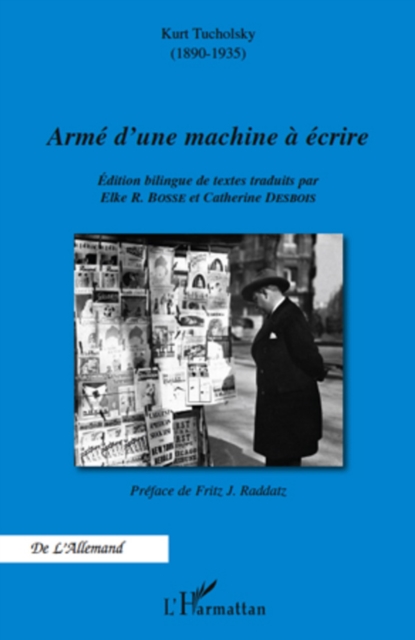
Armé d'une machine à écrire
Agréable surprise pour le lecteur moderne de découvrir ou redécouvrir Kurt Tucholsky, cet auteur berlinois des années 1920 tellement lié à son époque, à son pays et à sa langue, mais aussi tellement universel ! De la période d'efferverscence dont il brosse le portrait, il a les contrastes, tiraillé entre la créativité débridée des Années folles et le quotidien de la République de Weimar, fait de tensions tant politiques qu'économiques et sociales. Armé de sa machine à écrire, ce maître de la forme courte met en garde contre tout assoupissement intellectuel et moral ; il veut en même temps rire et faire rire, par une écriture créative, jeu de mots, jeu avec les mots.
eBook

\Potatoes\ and \Home\ Kurt Tucholsky
Tucholsky was perusing one of those patriotic books that subject the German army to close scrutiny, where he came across a historical anecdote that's worth a closer look. During the siege of Paris in 1870, the author recounts, the enemy outposts held up quite well. But the soldiers were not always shooting at one another. It happened, for example, that they helped each other out with potatoes. On one occasion a group of French soldiers approached, the Germans raised their weapons, someone called out in German: \"Don't shoot! We won't shoot either!\" and they began to communicate about exchanging drinks. Germany is a land divided, and one part of it is us. And against it all, it stands--unbowed, flagless, without barrel-organs, sentimentality or drawn swords--this quiet love of our home.
Journal Article

From Photomontage to “Functional Montage” Staging an Intermedial Assembly Line in Kurt Tucholsky’s and John Heartfield’s Deutschland, Deutschland über Alles
This essay demonstrates that Kurt Tucholsky’s and John Heartfield’s photobook Deutschland, Deutschland über Alles (DD), published in 1929, aimed to unveil the actual condition of the Weimar Republic by addressing and educating the working class. The worker-readers of DD are supposed to see themselves differently with the help of the photobook’s combinations of texts and images that imitate an assembly line – a view familiar to the worker. This essay shows that, what I call “functional montages” – an extension of the photomontage that combines industrial and cinematic montage – allow worker-readers to both recognize themselves in DD, while at the same time gaining the ability to take a critical stance on their position within the German public sphere. This shows not only how Tucholsky and Heartfield are educating workers by employing the technique of montage; DD also exemplifies how the idea of intermediality is not just a procedure of translating images from one medium to another. Instead, it is the images’ potential to create visual narratives that allows for a juxtaposition of photographs and texts in the target medium, following a combination of cinematic and industrial montage principles. This shows that intermediality is less a transfer of media elements than a transfer of their narrative potential.
Journal Article
Preface
In tagging the current issue with the theme of \"Literature and History\" the immediate and obvious connection is to the end of WWI in 1918, a mere century ago, a narrow and at the same time vast frame of reference. There follow a series of works that address war directly-Khvostov, Pushkin, and other Russian poets expressing their ecstasy over Moscow's survival; Ömer Seyfettin's poets seeking patriotic augury at Gallipoli; Kurt Tucholsky's fierce, brave resistance to nationalism. In that first year, 1968, the new journal opened its arms to the world by featuring (along with works from the Indo-European languages, Chinese, and Japanese) translations of Yoruba oral poetry into English, by Ulrich Beier.
Journal Article

Beyond the Border : The German-Jewish Legacy Abroad
The modern German-Jewish experience through the rise of Nazism in 1933 was characterized by an explosion of cultural and intellectual creativity. Yet well after that history has ended, the influence of Weimar German-Jewish intellectuals has become ever greater. Hannah Arendt, Gershom Scholem, Theodor Adorno, Walter Benjamin, Franz Rosenzweig, and Leo Strauss have become household names and possess a continuing resonance. \"Beyond the Border\" seeks to explain this phenomenon and analyze how the German-Jewish legacy has continuingly permeated wider modes of Western thought and sensibility, and why these Émigrés occupy an increasingly iconic place in contemporary society. Steven Aschheim traces the odyssey of a fascinating group of German-speaking Zionists--among them Martin Buber and Hans Kohn--who recognized the moral dilemmas of Jewish settlement in pre-Israel Palestine and sought a binationalist solution to the Arab-Israel conflict. He explores how German-Jewish Émigré historians like Fritz Stern and George Mosse created a new kind of cultural history written against the background of their exile from Nazi Germany and in implicit tension with postwar German social historians. And finally, he examines the reasons behind the remarkable contemporary canonization of these Weimar intellectuals--from Arendt to Strauss--within Western academic and cultural life. Beyond the Border is about more than the physical act of departure. It also points to the pioneering ways these Émigrés questioned normative cognitive boundaries and have continued to play a vital role in addressing the predicaments that engage and perplex us today.
eBook

Scaffolding a Presentation: Comments from Spanish and German
This paper considers implementation of a 'scaffolding' method as a means towards successful 'presentations' and acquisition of presentational language in the classroom and beyond. Setting-up a concrete, well articulated and culturally nuanced yet personalized scaffolding for acquiring upper-level language in working towards and performing presentations will be explored. Specific experiences from Second-Year language classes in both Spanish and then German are considered. Setting clear objectives in a personalized atmosphere and issues of development of transferable professional skills will be further contemplated. Index Terms--presentations, presentational language, transferable skills, scaffolding, German, Spanish
Journal Article

S. Y. Agnon's German Consecration and the “Miracle” of Hebrew Letters
This essay discusses the interplay of German and Hebrew in S. Y. Agnon's later fiction, particularly Ad henah (To This Day; 1952). In this work, Agnon, who had lived in Germany between 1912 and 1924, revisits the German home front during World War I. He uses this setting to reflect upon the modern status of Hebrew—the sacred language of creation—in a world ravaged by war, including the more contemporary 1948 battles. For this meditation on language, creation, and destruction, he draws on the golem tale, which had become a mainstay of German-language literature in the nineteenth and early twentieth centuries. As his “golem,” Agnon casts a brain-injured German soldier who has forgotten his name, family, and home. Agnon's rich rewriting of the golem story, a narrative of animation through language, establishes an unholy alliance between Hebrew and German and invites a reconsideration of Gustav Meyrink's occult bestseller, Der Golem, first published in 1915. Through translations of his stories into German in the 1910s, Agnon found himself hailed as the “authentic” chronicler of East European Jewish life, particularly as contrasted with the “inauthentic” Meyrink. Pushing back against this dichotomy and the past cult surrounding his works in German Jewish circles, Agnon's mid-twentieth-century writing reveals the ongoing presence, and even preservation, of German language and culture within modern Hebrew.
Journal Article

Weimar thought
During its short lifespan, the Weimar Republic (1918-33) witnessed an unprecedented flowering of achievements in many areas, including psychology, political theory, physics, philosophy, literary and cultural criticism, and the arts. Leading intellectuals, scholars, and critics--such as Hannah Arendt, Walter Benjamin, Ernst Bloch, Bertolt Brecht, and Martin Heidegger--emerged during this time to become the foremost thinkers of the twentieth century. Even today, the Weimar era remains a vital resource for new intellectual movements. In this incomparable collection,Weimar Thoughtpresents both the specialist and the general reader a comprehensive guide and unified portrait of the most important innovators, themes, and trends of this fascinating period.
The book is divided into four thematic sections: law, politics, and society; philosophy, theology, and science; aesthetics, literature, and film; and general cultural and social themes of the Weimar period. The volume brings together established and emerging scholars from a remarkable array of fields, and each individual essay serves as an overview for a particular discipline while offering distinctive critical engagement with relevant problems and debates.
Whether used as an introductory companion or advanced scholarly resource,Weimar Thoughtprovides insight into the rich developments behind the intellectual foundations of modernity.
eBook

Beyond Repetition: Karl Kraus's \Absolute Satire\
This article reassesses the theoretical import of the Viennese satirist Karl Kraus, arguing that his satire challenges conventional understandings of the genre. Most notably in The Last Days of Mankind (Die letzten Tage der Menschheit), Kraus's satire delegitimizes any given historical or political position, addressing, rather, what he calls \"posterity\" as the only viable alternative. This moment lies beyond the repetitive structures inherent to modernity, specifically as they were articulated in the First World War. Kraus's \"absolute satire\" (Hermann Broch) thus contains a temporal dimension insofar as its intended audience is one that does not yet exist.
Journal Article