
Catalogue Search | MBRL


Are you sure you want to remove the book from the shelf?

{{itemTitle}}
3,284
result(s) for
"Kusama, Yayoi"
Sort by:


The Beauty of Fireflies: Transience, Myth, Bioluminescence, and Wonder
The beauty of fireflies captivated the imagination of Victorian poets, naturalists, short-story writers, and travel writers alike. Like their earthbound relatives, glow-worms, these unremarkable brown insects in daytime became otherworldly sparks of light by night. This article explores their evocative potential — not least for John Ruskin — to capture the magic of an Italian summer’s evening. It shows how their metaphorical potential was readily exploited: fireflies were seen across cultures as synonymous with the soul; glow-worms as humble creatures whose special qualities would nonetheless shine out. Both fireflies and glow-worms were imaginatively linked to the fairy world, as we see in paintings as well as in writing. I move from these imaginative representations to consider how bioluminescence was understood by Victorians, and how the language of their investigations borrowed from a register of fantasy. Even when the phenomenon of firefly illumination was better understood, the sense of wonder that these creatures can create persisted. Yet today, the numbers of these insects are currently diminishing, due to habitat loss and light pollution. Although their magical beauty can be alluded to, and recreated artificially — as in Yayoi Kusama’s Infinity Rooms, experiencing these light shows functions as an analogy, not a substitution. Fireflies and glow-worms are a reminder of wonder’s powerful motivating force when it comes to taking action against environmental precarity: to experience them is to be affected emotionally by them, and they represent the extraordinary beauty, yet fragility, that we encounter in the natural world. They contain a paradox that was well recognized in the nineteenth century: that the small, dull-coloured, and apparently insignificant can contain the sublime.
Journal Article

Yayoi Kusama : from here to infinity
Provides an introduction to the Japanese artist who is known for her use of dots.
Book

With Endless Articulations
The evolution of information infrastructures has shaped nature conservation related to wild species, landscapes and collections of biological diversity, efforts that are germane to nation-building and many other political projects. Extensive practices of quantification are now embedded in environmental monitoring, biodiversity protection and the banking of plant genetic resources. This suggests a kaleidoscope of human intentions and institutional mandates that are embodied within fluidly changing information systems. These technologies have come to condense cultural assumptions, values, and orientations to the Anthropocene. The conservation of biodiversity must continually generate not only spectacles of nature, but also spectacles of expert knowledge and management. Information itself is the new frontier of green capitalism, affirming a paradigm of perpetual growth.
Journal Article

Yayoi Kusama : 1945 -- now
A major career survey of Yayoi Kusama, one of the most widely admired and popular artists of our time, published in collaboration with M+, Hong Kong, to accompany M+'s first Special Exhibition, Yayoi Kusama: 1945 to Now, from 12 November 2022 to 14 May 2023.
Book

La pantalla infinita. El escaparatismo como trampantojo urbano a través de las propuestas artísticas de Yayoi Kusama para Louis Vuitton
Los escaparates en el ámbito urbano generan escenas múltiples que confluyen en el entorno en una suma de diversos significados. Este estudio parte del análisis de las colaboraciones entre Louis Vuitton y Yayoi Kusama durante los años 2012 y 2022, desde la concepción de estos exhibidores comerciales como una pantalla infinita que alberga creaciones que en ocasiones trasgreden los propios límites físicos y conceptuales de estos espacios. Tras un análisis de las propuestas de la artista japonesa en el ámbito del escaparatismo, el artículo se centra en una serie de colaboraciones donde se valoran sus significados en relación con el paisaje de la urbe y el propio transeúnte, atendiendo al contexto propio de la Maison. Observaremos aspectos que transforman el significado del mensaje de estas escenografías comerciales, como el papel de los reflejos o la transgresión de los límites espaciales, conceptos característicos de la obra de Kusama, para aproximarnos a la idea de escaparate expandido, como una suma de escenas que conforman una pantalla infinita.
Journal Article

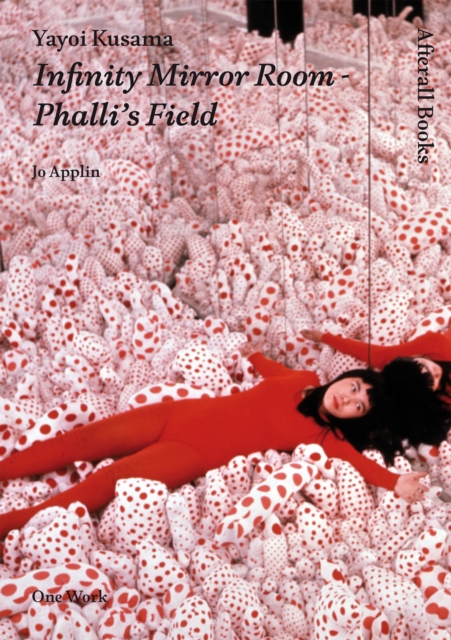
Yayoi Kusama : infinity mirror room - phalli's field
Almost a half-century after Yayoi Kusama debuted her landmark installation Infinity Mirror Room--Phalli's Field (1965) in New York, the work remains challenging and unclassifiable. Shifting between the Pop-like and the Surreal, the Minimal and the metaphorical, the figurative and the abstract, the psychotic and the erotic, with references to \"free love\" and psychedelia, it seemed to embody all that the 1960s was about, while at the same time denying the prevailing aesthetics of its time. The installation itself was a room lined with mirrored panels and carpeted with several hundred brightly polka-dotted soft fabric protrusions into which the visitor was completely absorbed. Kusama simply called it \"a sublime, miraculous field of phalluses.\" A precursor of performance-based feminist art practice, media pranksterism, and \"Occupy\" movements, Kusama (born in 1929) was once as well known as her admirers--Andy Warhol, Donald Judd, and Joseph Cornell. In this first monograph on an epoch-defining work, Jo Applin looks at the installation in detail and places it in the context of subsequent art practice and theory as well as Kusama's own (as she called it) \"obsessional art.\" Applin also discusses Kusama's relationship to her contemporaries, particularly those working with environments, abstract-erotic sculpture, and mirrors, and those grappling with such issues as abstraction, eroticism, sexuality, and softness. The work of Lee Lozano, Claes Oldenburg, Louise Bourgeois, and Eva Hesse is seen anew when considered in relation to Yayoi Kusama's.
eBook

A mathematical formulation and computational exploration of Yayoi Kusama’s tentacle artworks
Yayoi Kusama, renowned for her three-dimensional modern artworks, is particularly famous for her tentacle-themed pieces. Each of these works features a room with multiple surfaces, resembling tentacles, where each of these surfaces may be viewed as an incomplete monotonically decreasing sequence (where it has been cut before the convergence). While Kusama’s approach is purely artistic, it raises an intriguing mathematical question: Given a surface defined by a monotonically decreasing sequence of
j
(sufficiently dense) layers, can we predict the surface continuation (by layers) for
, and is a convergence being obtained? We aim to provide a mathematical perspective on abstract art and enable its analysis from a computational perspective. To achieve our purpose, we first made a 3
D
computer model of each of the tentacles which was created by the designer in the team (for a given 2
D
image). Second, the computational team received this modeling, sampled it; and formulated a prediction algorithm for a given tentacle. Third and last, each of the tentacle predictions has been sent back to the designer, which smoothly reconstructs each tentacle by the algorithm continuation, locates each continuation in a similar way to the original room in the 2
D
image and wraps it with the respective texture. In this fashion, the viewer can compare the original artistic artwork of the tentacle room to the mathematical analysis predicted room.
Journal Article