
Catalogue Search | MBRL


Are you sure you want to remove the book from the shelf?

{{itemTitle}}
56
result(s) for
"LAW / Constitutional. bisacsh"
Sort by:

The Hidden History of the Supreme Court and the Betrayal of America
The New York Times–bestselling author \"delivers a full-throated indictment of the U.S. Supreme Court in this punchy polemic\" ( Publishers Weekly).
In this book, Thom Hartmann, the most popular progressive radio host in America, explains how the Supreme Court has spilled beyond its Constitutional powers—and how we the people should take that power back.
Taking his typically in-depth, historically informed view, Thom Hartmann asks, What if the Supreme Court didn't have the power to strike down laws? According to the Constitution, it doesn't. From the founding of the republic until 1803, the Supreme Court was the final court of appeals, as it was always meant to be. So where did the concept of judicial review start? As so much of modern American history, it began with the battle between the Federalists and Anti-Federalists, and with Marbury v. Madison.
Hartmann argues it is not the role of the Supreme Court to decide what the law is but rather the duty of the people themselves. He lays out the history of the Supreme Court of the United States, from Alexander Hamilton's defense to modern-day debates, with key examples of cases where the Supreme Court overstepped its constitutional powers. The ultimate remedy to the Supreme Court's abuse of power is with the people--the ultimate arbiter of the law—using the ballot box. America does not belong to the kings and queens; it belongs to the people.
\"A meticulously documented strategy for trimming the power of nine ideologically motivated political activists unaccountable to the will of the people. . . . important and timely.\"—David Korten, author of When Corporations Rule the World
eBook

The Hidden History of Guns and the Second Amendment
The New York Times -bestselling author explores the real history of guns in America and how to limit both their lethal impact and the gun lobby's power.Taking his typically in-depth, historically informed view, Thom Hartmann, the most popular progressive radio host in America, examines the brutal role guns have played in American history, from.
eBook
The Politics of Principle
Under its first chief justice, Arthur Chaskalson, the South African Constitutional Court built an unrivalled reputation in the comparative constitutional law community for technically accomplished and morally enlightened decision-making. At the same time, the Court proved remarkably effective in asserting its institutional role in post-apartheid politics. While each of these accomplishments is noteworthy in its own right, the Court's simultaneous success in legal and political terms demands separate investigation. Drawing on and synthesising various insights from judicial politics and legal theory, this study offers an interdisciplinary explanation for the Chaskalson Court's achievement. Rather than a purely political strategy of the kind modelled by rational choice theorists, the study argues that the Court's achievement is attributable to a series of adjudicative strategies in different areas of law. In combination, these strategies allowed the Court to satisfy institutional norms of public reason-giving while at the same time avoiding political attack.
eBook
American epic: reading the US Constitution
The Constitution is about to turn 225 years old, and throughout its long history, attempts to discern its meaning have dominated American politics. Indeed, arguments over its meaning are more animated today than ever given the popularity of the Tea Party, whose adherents demand strict adherence to what they regard as its true, original meaning. It is therefore not surprising that deep interest among the lay public in the Constitution's text is often associated with a very specific fundamentalist approach to interpretation. In American Epic, the eminent legal scholar Garrett Epps also reads the constitution closely, but with a very different aim. He shares his own interpretations of the text of the U.S. Constitution-as law, as poetry, as narrative, and as What the Framers Intended-both as a guide and an inspiration for others as they explore the document for themselves and find their own approaches. He shows that it is possible to pay close attention to each word and sentence in the Constitution without interpreting it narrowly; to engage with the text not searching for one meaning, but many. A fluid and engaging writer, Epps' learned and surprising reading of the Constitution will make readers look at the document in an entirely new way.
eBook

Fear and the First Amendment : controversial cases of the Roberts Court
A highly original account of the role that fear plays in key First Amendment cases ruled on by the Roberts Supreme Court In Fear and the First Amendment , Kevin A.Johnson and Craig R.Smith offer a deeply considered examination of the ways fear figures in First Amendment questions ruled on by the contemporary Supreme Court.
eBook
The Constitution : an introduction
From war powers to health care, freedom of speech to gun ownership, religious liberty to abortion, practically every aspect of American life is shaped by the Constitution. This vital document, along with its history of political and judicial interpretation, governs our individual lives and the life of our nation. Yet most of us know surprisingly little about the Constitution itself, and are woefully unprepared to think for ourselves about recent developments in its long and storied history. The Constitution: An Introduction is the definitive modern primer on the US Constitution. Michael Stokes Paulsen, one of the nation's most provocative and accomplished scholars of the Constitution, and his son Luke Paulsen, a gifted young writer and lay scholar, have combined to write a lively introduction to the supreme law of the United States, covering the Constitution's history and meaning in clear, accessible terms. Beginning with the Constitution's birth in 1787, Paulsen and Paulsen offer a grand tour of its provisions, principles, and interpretation, introducing readers to the characters and controversies that have shaped the Constitution in the 200-plus years since its creation. Along the way, the authors provide correctives to the shallow myths and partial truths that pervade so much popular treatment of the Constitution, from school textbooks to media accounts of today's controversies, and offer powerful insights into the Constitution's true meaning. A lucid and engaging guide, The Constitution: An Introduction provides readers with the tools to think critically and independently about constitutional issuesa skill that is ever more essential to the continued flourishing of American democracy.
eBook
The Collision of Political and Legal Time
How does the U.S. Supreme Court shape constitutional and political development? In The Collision of Political and Legal Time, Kimberley Fletcher answers this question by analyzing the key role the Court has played in interpreting presidential decision-making in the area of foreign affairs since 1936. She reconsiders the Curtiss-WrightCourt, which instituted a new constitutional order that established plenary powers independent of congressional delegation. Fletcher also reexamines Japanese internment and detainee cases, demonstrating the entrenchment of the new constitutional order and how presidential ascendency becomes institutionalized. Other cases, such as Youngstown, illustrate how the Court, during a time of war, will check Executive power and authority.
The Collision of Political and Legal Time examines these cases and controversies in foreign policymaking through the twentieth and into the twenty-first centuries to show that the Court is not passive or constrained; it does not merely follow politics or the majority coalition. Through her nuanced analysis, Fletcher makes a larger argument about the role of the U.S. Supreme Court as an agent of change, which ultimately transforms power, shapes politics, and redirects history.
eBook
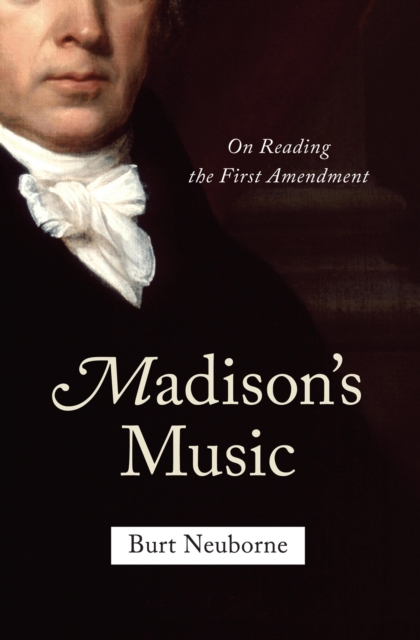
Madison's music : on reading the First Amendment
Are you sitting down? It turns out that everything you learned about the First Amendment is wrong. For too long, we've been treating small, isolated snippets of the text as infallible gospel without looking at the masterpiece of the whole. Legal luminary Burt Neuborne argues that the structure of the First Amendment as well as of the entire Bill of Rights was more intentional than most people realize, beginning with the internal freedom of conscience and working outward to freedom of expression and finally freedom of public association. This design, Neuborne argues, was not to protect discrete individual rights--such as the rights of corporations to spend unlimited amounts of money to influence elections--but to guarantee that the process of democracy continues without disenfranchisement, oppression, or injustice. Neuborne, who was the legal director of the ACLU and has argued numerous cases before the Supreme Court, invites us to hear the \"music\" within the form and content of Madison's carefully formulated text. When we hear Madison's music, a democratic ideal flowers in front of us, and we can see that the First Amendment gives us the tools to fight for campaign finance reform, the right to vote, equal rights in the military, the right to be full citizens, and the right to prevent corporations from riding roughshod over the weakest among us. Neuborne gives us an eloquent lesson in democracy that informs and inspires.
eBook
Ideas with Consequences
The Federalist Society, which has been in existence for three decades, is one of the most successful intellectual movements in modern American political history. It began as a relatively small organization of conservative lawyers dedicated to eroding the national government's power in virtually every arena except defense and enhancing the power of states vis-a-vis the federal government. It now has 40,000 members, including four Supreme Court Justices, dozens of federal judges, and every Republican attorney general since the 1980s. Indeed, when Republican presidents have nominated judges, Federalist Society membership has served as the seal of approval. The Federalist Society's influence on American politics is well-known. But how, exactly, does it exert that influence? In Ideas with Consequences, Amanda Hollis-Brusky brilliantly traces how the Federalist Society does this. Drawing on a database of over 2,000 original and primary documents, including personal interviews with Federalist Society members, archival data, and a complete database of transcripts from Federalist Society National Conferences, Hollis-Brusky constructs the most complete and social scientific narrative of Federalist Society influence to date. In doing so, she shows how the Federalist Society serves as the hub of a complex circulatory system and how the ideas it generates have become the lifeblood of the conservative movement. In the areas of gun rights, campaign finance, federalism, and state sovereignty, Hollis-Brusky demonstrates how the Federalist Society's investment in ideas, professional education, and networking has resulted in some of the most revolutionary Supreme Court decisions of the past three decades. Hollis-Brusky also illustrates the ways in which the Federalist Society network worked to help bring these constitutional revolutions about in the first place-by identifying, credentialing, and getting the right kinds of judges and Justices on the bench, and by reducing the stigma associated with once-radical constitutional theories. Not only a rich story of the conservative legal movement, Ideas with Consequences also develops a powerful social scientific framework for analyzing the ways in which interest groups and networks influence legal and judicial policy in America.
eBook
