
Catalogue Search | MBRL


Are you sure you want to remove the book from the shelf?

{{itemTitle}}
661,010
result(s) for
"LAW / Courts."
Sort by:

Islamic Divorce in the Twenty-First Century
Islamic Divorce in the 21st Century shows the wide range
of Muslim experiences in marital disputes and in seeking Islamic
divorces. For Muslims, having the ability to divorce in accordance
with Islamic law is of paramount importance. However, Muslim
experiences of divorce practice differ tremendously. The chapters
in this volume discuss Islamic divorce from West Africa to
Southeast Asia, and each story explores aspects of the everyday
realities of disputing and divorcing Muslim couples face in the
twenty-first century. The book's cross-cultural and comparative
look at Islamic divorce indicates that Muslim divorces are impacted
by global religious discourses on Islamic authority, authenticity,
and gender; by global patterns of and approaches to secularity; and
by global economic inequalities and attendant patterns of
urbanization and migration. Studying divorce as a mode of Islamic
law in practice shows us that the Islamic legal tradition is
flexible, malleable, and context-dependent.
eBook

Madam Chief Justice
In Madam Chief Justice, editors W. Lewis Burke Jr. and Joan P. Assey chronicle the remarkable career of Jean Hoefer Toal, South Carolina's first female Supreme Court Chief Justice. As a lawyer, legislator, and judge, Toal is one of the most accomplished womenin South Carolina history. In this volume, contributors, including two United States Supreme Court Justices, federal and state judges state leaders, historians, legal scholars, leading attorneys, family, and friends, provide analysis, perspective, and biographical information about the life and career of this dynamic leader and her role in shaping South Carolina. Growing up in Columbia during the 1950s and 60s, Jean Hoefer was a youthful witness to the civil rights movement in the state and nation. Observing the state's premier civil rights lawyer Matthew J. Perry Jr. in court encouraged her to attend law school, where she met her husband, Bill Toal. When she was admitted to the South Carolina Bar in 1968, fewer than one hundred women had been admitted in the state's history. From then forward she was both a leader and a role model. As a lawyer she excelled in trial and appellate work and won major victories on behalf of Native Americans and women. In 1975, Toal was elected to the South Carolina House of Representatives and despite her age and gender quickly became one of the most respected members of that body. During her fourteen years as a House member, Toal promoted major legislation on many issuesincluding constitutional law, criminal law, utilities regulation, local government, state appropriations, workers compensation, and freedom of information. In 1988, Toal was sworn in as the first female justice on the Supreme Court of South Carolina, where she made her mark through her preparation and insight. She was elected Chief Justice in 2000, becoming the first woman ever to hold the highest position in the state's judiciary. As Chief Justice, Toal not only modernized her court, but also the state's judicial system. As Toal's two daughters write in their chapter, the traits their mother brings to her professional life--exuberance, determination, and loyalty--are the same traits she demonstrates in her personal and family life. As a child, Toal loved roller skating in the lobby of the post office,a historic building that now serves as the Supreme Court of South Carolina. From a child in Columbia to Madam Chief Justice, her story comes full circle in this compelling account of her life and influence. Madam Chief Justice features a foreword by Sandra Day O'Connor, retired associate justice of the United State Supreme Court, and an introduction by Ruth Bader Ginsburg, an associate justice of the United States Supreme Court.
eBook

Echo of Its Time
Throughout its existence the Federal District Court of Nebraska has echoed the dynamics of its time, reflecting the concerns, interests, and passions of the people who have made this state their home.Echo of Its Timeexplores the court's development, from its inception in 1867 through 1933, tracing the careers of its first four judges: Elmer Dundy, William Munger, Thomas Munger (no relation), and Joseph Woodrough, whose rulings addressed an array of issues and controversies echoing macro-level developments within the state, nation, and world.Echo of Its Timeboth informs and entertains while using the court's operations as a unique and accessible prism through which to explore broader themes in the history of the state and the nation. The book explores the inner workings of the court through Thomas Munger's personal correspondence, as well as the court's origins and growing influence under the direction of its legendary first judge, Elmer Dundy. Dundy handled many notable and controversial matters and made significant decisions in the field of Native American law, includingStanding Bear v. CrookandElk v. Wilkins. From the turn of the century through 1933 the court's docket reflected the dramatic and rapid changes in state, regional, and national dynamics, including labor disputes and violence, political corruption and Progressive Era reform efforts, conflicts between cattle ranchers and homesteaders, wartime sedition and \"slacker\" prosecutions, criminal enterprises, and the endless battles between government agents and bootleggers during Prohibition.
eBook
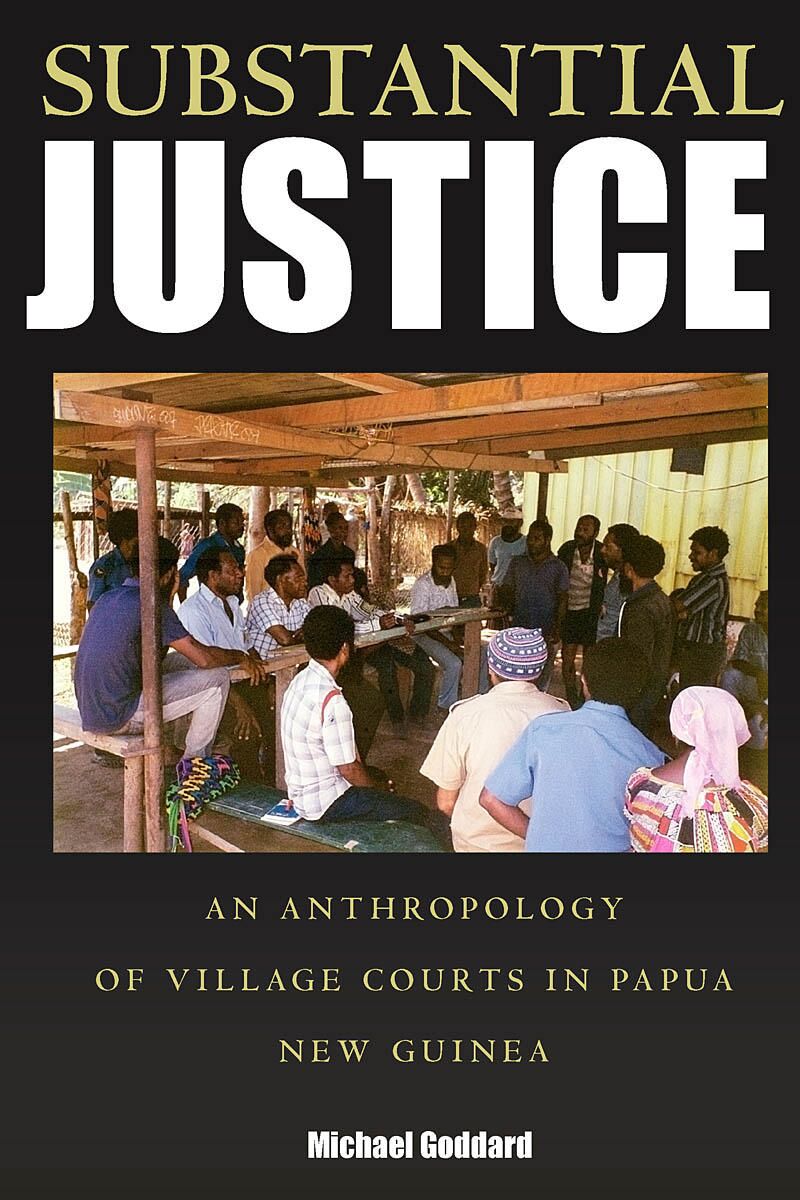
Substantial justice
Papua New Guinea's village court system was introduced in 1974, partly in an effort to overcome the legal, geographical, and social distance between village societies and the country's formal courts. There are now more than 1100 village courts all over PNG, hearing thousands of cases each week. This anthropological study is grounded in ethnographic research on three different village courts and the communities they serve. It also explores the colonial historical background to the establishment of the village court system, and the local and global processes influencing the efforts of village courts to deal with everyday disputes among grassroots Melanesians.
eBook

The judge in a democracy
Whether examining election outcomes, the legal status of terrorism suspects, or if (or how) people can be sentenced to death, a judge in a modern democracy assumes a role that raises some of the most contentious political issues of our day. But do judges even have a role beyond deciding the disputes before them under law? What are the criteria for judging the justices who write opinions for the United States Supreme Court or constitutional courts in other democracies? These are the questions that one of the world's foremost judges and legal theorists, Aharon Barak, poses in this book.
In fluent prose, Barak sets forth a powerful vision of the role of the judge. He argues that this role comprises two central elements beyond dispute resolution: bridging the gap between the law and society, and protecting the constitution and democracy. The former involves balancing the need to adapt the law to social change against the need for stability; the latter, judges' ultimate accountability, not to public opinion or to politicians, but to the \"internal morality\" of democracy.
Barak's vigorous support of \"purposive interpretation\" (interpreting legal texts--for example, statutes and constitutions--in light of their purpose) contrasts sharply with the influential \"originalism\" advocated by U.S. Supreme Court Justice Antonin Scalia.
As he explores these questions, Barak also traces how supreme courts in major democracies have evolved since World War II, and he guides us through many of his own decisions to show how he has tried to put these principles into action, even under the burden of judging on terrorism.
eBook

Citizens, Courts, and Confirmations
In recent years the American public has witnessed several hard-fought battles over nominees to the U.S. Supreme Court. In these heated confirmation fights, candidates' legal and political philosophies have been subject to intense scrutiny and debate.Citizens, Courts, and Confirmationsexamines one such fight--over the nomination of Samuel Alito--to discover how and why people formed opinions about the nominee, and to determine how the confirmation process shaped perceptions of the Supreme Court's legitimacy.
Drawing on a nationally representative survey, James Gibson and Gregory Caldeira use the Alito confirmation fight as a window into public attitudes about the nation's highest court. They find that Americans know far more about the Supreme Court than many realize, that the Court enjoys a great deal of legitimacy among the American people, that attitudes toward the Court as an institution generally do not suffer from partisan or ideological polarization, and that public knowledge enhances the legitimacy accorded the Court. Yet the authors demonstrate that partisan and ideological infighting that treats the Court as just another political institution undermines the considerable public support the institution currently enjoys, and that politicized confirmation battles pose a grave threat to the basic legitimacy of the Supreme Court.
eBook

Prairie Justice
Winner, ISHS Superior Achievement Award for a Scholarly Publication, 2016 A concise legal history of Illinois through the end of the nineteenth century, Prairie Justice covers the region's progression from French to British to early American legal systems, which culminated in a unique body of Illinois law that has influenced other jurisdictions.
eBook

Courtroom Talk and Neocolonial Control
The book uses critical sociolinguistic analysis to examine the social consequences of courtroom talk. The focus of the study is the cross-examination of three Australian Aboriginal boys who were prosecution witnesses in the case of six police officers charged with their abduction. The analysis reveals how the language mechanisms allowed by courtroom rules of evidence serve to legitimize neocolonial control over Indigenous people. In the propositions and assertions made in cross-examination, and their adoption by judicial decision-makers, the three boys were constructed not as victims of police abuse, but rather in terms of difference, deviance and delinquency. This identity work addresses fundamental issues concerning what it means to be an Aboriginal young person, as well as constraints about how to perform or live this identity, and the rights to which Aboriginal people can lay claim, while legitimizing police control over their freedom of movement. Understanding this courtroom talk requires analysis of the sociopolitical and historical actions and structures within which the courtroom hearing was embedded. Through this analysis, the interrelatedness of structure, agency, constraint and change, which is central to critical sociolinguistics, becomes apparent. In its investigation of language ideologies that underpin courtroom talk, as well as the details of how language is used, and the social consequences of this talk, the book highlights the need for far-reaching changes to courtroom rules of evidence.
eBook
The Supreme Court : an essential history
The most respected one volume history of the US Supreme Court, expanded to include the Roberts Court through 2017.
eBook
The History of the New York Court of Appeals, 1932 - 2003
From 1932 to 2003, the New York Court of Appeals-the highest court in the state- decided crucial cases pertaining to the social and legal issues of the day. The judges' rulings affected laws regarding motion picture censorship; obscenity, indecency, and immorality; religion; capital punishment; torts; the right to control personal medical care; and abortion. This comprehensive history completes a two volume series that began with The History of the New York Court of Appeals, 1847-1932. Each case is richly recounted and analyzed, detailing the decisions and dissenting opinions. Short biographies are provided for the judges who served during this period, and changes in the selection of judges, as well as the court's jurisdiction, are thoroughly explained. Particular to this volume, the authors provide the legal, social, and political contexts for these cases, showing how the law has evolved over time. They examine the court's view concerning its constitutional power to respond to an economic emergency during the Great Depression; they outline cases in which the judges ruled on the government's role in legislating morals and morality; and they focus on the evolution of the court's opinions regarding statutory interpretation, judicial federalism, censorship, constitutional reform, criminal law and capital punishment, rules of evidence, education, family law, and antitrust and labor law.
eBook