
Catalogue Search | MBRL


Are you sure you want to remove the book from the shelf?

{{itemTitle}}
59,862
result(s) for
"LAW / Emigration "
Sort by:

The Price of Rights
Many low-income countries and development organizations are calling for greater liberalization of labor immigration policies in high-income countries. At the same time, human rights organizations and migrant rights advocates demand more equal rights for migrant workers. The Price of Rights shows why you cannot always have both. Examining labor immigration policies in over forty countries, as well as policy drivers in major migrant-receiving and migrant-sending states, Martin Ruhs finds that there are trade-offs in the policies of high-income countries between openness to admitting migrant workers and some of the rights granted to migrants after admission. Insisting on greater equality of rights for migrant workers can come at the price of more restrictive admission policies, especially for lower-skilled workers. Ruhs advocates the liberalization of international labor migration through temporary migration programs that protect a universal set of core rights and account for the interests of nation-states by restricting a few specific rights that create net costs for receiving countries. The Price of Rights analyzes how high-income countries restrict the rights of migrant workers as part of their labor immigration policies and discusses the implications for global debates about regulating labor migration and protecting migrants. It comprehensively looks at the tensions between human rights and citizenship rights, the agency and interests of migrants and states, and the determinants and ethics of labor immigration policy.
eBook

Migration Law and the Externalization of Border Controls
Over the last few decades, both the European Union and European States have been implementing various strategies to externalize border controls with the declared intent of saving human lives and countering smuggling but with the actual end result of shifting borders, circumventing international obligations and ultimately preventing access to Europe. What has been principally deplored is the fact that externalizing border controls risks creating 'legal black holes'. Furthermore, what is particularly worrying in the current European debate is the intensification of this practice by multiple arrangements with unsafe third countries, exposing migrants and asylum seekers to serious human rights violations.
This book explores whether European States can succeed in shifting their responsibility onto Third States in cases of human rights violations. Focusing, in particular, on the 2017 Italy-Libya Memorandum of Understanding, the book investigates the possible basis for triggering the responsibility of outsourcing States. The second part of the book examines how the Italy-Libya MoU is only a small part of a broader scenario, exploring EU policies of externalization. A brief overview of the recent decisions of the EU Court vis-à-vis two aspects of externalization (the EU-Turkey statement and the issue of humanitarian visas) will pave the way for the conclusions since, in the author's view, the current attitude of the Luxembourg Court confirms the importance of focusing on the responsibility of European States and the urgent need to investigate the possibility of bringing a claim against the outsourcing States before the Court of Strasbourg.
Offering a new perspective on an extremely topical subject, this book will appeal to students, scholars and practitioners with an interest in European Law, International Law, Migration and Human Rights.
eBook

Controlling Immigration Through Criminal Law
This book provides a systematic and comprehensive overview of the increased role of criminal law in managing migration, from a European, domestic and comparative law perspective. The contributors critically engage with the current trends leading to the criminalisation of irregular migrants, asylum seekers and those who engage in ‘humanitarian smuggling’, and the national and common policies calling for a broader use of criminal law measures. The chapters explore the measures used to protect borders, their impact in terms of effectiveness and their ability to strike a fair balance between security and the protection of human rights. The contributors to the book cover a range of disciplines within law, human rights and criminology resulting in a broad understanding of the issues at play. Volume 12 in the series Hart Studies in European Criminal Law
eBook
Special Issue: Who Belongs? Immigration, Citizenship, and the Constitution of Legality
The 60th volume of Studies in Law, Politics, and Society edited by Austin Sarat, is an essential text for legal scholars with a unique focus on the disciplines of sociology, politics and the humanities. This special issue interrogates how law defines identity. It addresses the key themes of immigration and citizenship, and examines the criteria that produces the label of \"American\". Articles discuss birthright citizenship and immigrant membership in the US, early immigration histories, sovereignty, and citizenship policies with current examples from Europe. Are all those born or naturalized in the US \"American\" and all those born or naturalized elsewhere not? How does law identify and decide who belongs? How does dealing with \"outsiders\" challenge the law? This volume answers these questions and explores how citizens are not born through accidents of geography but are made through law.
eBook
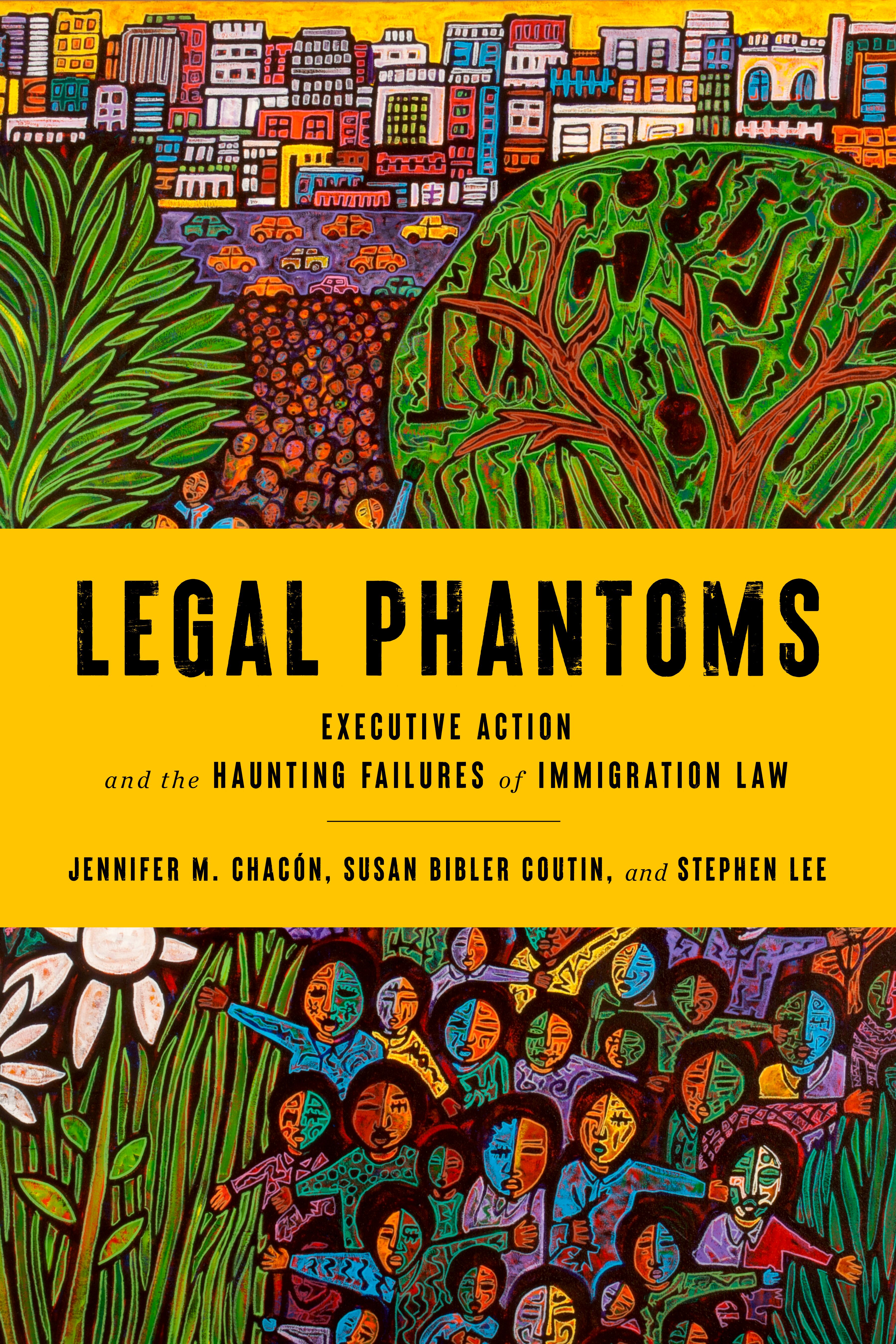
Legal Phantoms
The 2012 Deferred Action for Childhood Arrivals (DACA) program was supposed to be a stepping stone, a policy innovation announced by the White House designed to put pressure on Congress for a broader, lasting set of legislative changes. Those changes never materialized, and the people who hoped to benefit from them have been forced to navigate a tense and contradictory policy landscape ever since, haunted by these unfulfilled promises. Legal Phantoms tells their story. After Congress failed to pass a comprehensive immigration bill in 2013, President Obama pivoted in 2014 to supplementing DACA with a deferred action program (known as DAPA) for the parents of citizens and lawful permanent residents and a DACA expansion (DACA+) in 2014. But challenges from Republican-led states prevented even these programs from going into effect. Interviews with would-be applicants, immigrant-rights advocates, and government officials reveal how such failed immigration-reform efforts continue to affect not only those who had hoped to benefit, but their families, communities, and the country in which they have made an uneasy home. Out of the ashes of these lost dreams, though, people find their own paths forward through uncharted legal territory with creativity and resistance.
eBook

Run for the Border
Mexico and the United States exist in a symbiotic relationship: Mexico frequently provides the United States with cheap labor, illegal goods, and, for criminal offenders, a refuge from the law. In turn, the U.S. offers Mexican laborers the American dream: the possibility of a better livelihood through hard work. To supply each other's demands, Americans and Mexicans have to cross their shared border from both sides. Despite this relationship, U.S. immigration reform debates tend to be security-focused and center on the idea of menacing Mexicans heading north to steal abundant American resources. Further, Congress tends to approach reform unilaterally, without engaging with Mexico or other feeder countries, and, disturbingly, without acknowledging problematic southern crossings that Americans routinely make into Mexico. In Run for the Border, Steven W. Bender offers a framework for a more comprehensive border policy through a historical analysis of border crossings, both Mexico to U.S. and U.S. to Mexico. In contrast to recent reform proposals, this book urges reform as the product of negotiation and implementation by cross-border accord; reform that honors the shared economic and cultural legacy of the U.S. and Mexico. Covering everything from the history of Anglo crossings into Mexico to escape law authorities, to vice tourism and retirement in Mexico, to today's focus on Mexican border-crossing immigrants and drug traffickers, Bender takes lessons from the past 150 years to argue for more explicit and compassionate cross-border cooperation. Steeped in several disciplines, Run for the Border is a blend of historical, cultural, and legal perspectives, as well as those from literature and cinema, that reflect Bender's cultural background and legal expertise.
eBook

The battle to stay in America : immigration's hidden front line
2020 Foreword INDIE awards winner The Battle to Stay in America is the story of a community coming to grips with the federal government's crackdown on immigrants, and learning how to defend itself. Informative and personal, this is a story about mothers and fathers, lawyers and activists, local police and federal agencies, and a struggle for the identity of a nation. This is the quintessential story of the war on immigrants, as fought and felt on the front lines in the heart of America.
eBook

Nations of Emigrants
The violence and economic devastation of the 1980-1992 civil war in El Salvador drove as many as one million Salvadorans to enter the United States, frequently without authorization. InNations of Emigrants, the legal anthropologist Susan Bibler Coutin analyzes the case of emigration from El Salvador to the United States to consider how current forms of migration challenge conventional understandings of borders, citizenship, and migration itself. Interviews with policymakers and activists in El Salvador and the United States are juxtaposed with Salvadoran emigrants' accounts of their journeys to the United States, their lives in this country, and, in some cases, their removal to El Salvador. These interviews and accounts illustrate the dilemmas that migration creates for nation-states as well as the difficulties for individuals who must live simultaneously within and outside the legal systems of two countries.
During the 1980s, U.S. officials generally regarded these migrants as economic immigrants who deserved to be deported, rather than as political refugees who merited asylum. By the 1990s, these Salvadorans were made eligible for legal permanent residency, at least in part due to the lives that they had created in the United States. Remarkably, this redefinition occurred during a period when more restrictive immigration policies were being adopted by the U.S. government. At the same time, Salvadorans in the United States, who send relatives more than $3 billion in remittances annually, have become a focus of policymaking in El Salvador and are considered key to its future.
eBook

American Gulag
Before September 11, 2001, few Americans had heard of immigration detention, but in fact a secret and repressive prison system run by the U.S. Immigration and Naturalization Service has existed in this country for more than two decades. InAmerican Gulag,prisoners, jailers, and whistle-blowing federal officials come forward to describe the frightening reality inside these INS facilities. Journalist Mark Dow's on-the-ground reporting brings to light documented cases of illegal beatings and psychological torment, prolonged detention, racism, and inhumane conditions. Intelligent, impassioned, and unlike anything that has been written on the topic, this gripping work of investigative journalism should be read by all Americans. It is a book that will change the way we see our country.American Gulagtakes us inside prisons such as the Krome North Service Processing Center in Miami, the Corrections Corporation of America's Houston Processing Center, and county jails around the country that profit from contracts to hold INS prisoners. It contains disturbing in-depth profiles of detainees, including Emmy Kutesa, a defector from the Ugandan army who was tortured and then escaped to the United States, where he was imprisoned in Queens, and then undertook a hunger strike in protest. To provide a framework for understanding stories like these, Dow gives a brief history of immigration laws and practices in the United States-including the repercussions of September 11 and present-day policies. His book reveals that current immigration detentions are best understood not as a well-intentioned response to terrorism but rather as part of the larger context of INS secrecy and excessive authority.American Gulagexposes the full story of a cruel prison system that is operating today with an astonishing lack of accountability.
eBook

Precarity and Belonging
Precarity and Belonging examines how the movement of people and their incorporation, marginalization, and exclusion, under epochal conditions of labor and social precarity affecting both citizens and noncitizens, have challenged older notions of citizenship and alienage. This collection brings mobility, precarity, and citizenship together in order to explore the points of contact and friction, and, thus, the spaces for a possible politics of commonality between citizens and noncitizens.The editors ask: What does modern citizenship mean in a world of citizens, denizens, and noncitizens, such as undocumented migrants, guest workers, permanent residents, refugees, detainees, and stateless people? How is the concept of citizenship, based on assumptions of deservingness, legality, and productivity, challenged when people of various and competing statuses and differential citizenship practices interact with each other, revealing their co-constitutive connections? How is citizenship valued or revalued when labor and social precarity impact those who seemingly have formal rights and those who seemingly or effectively do not? This book interrogates such binaries as citizen/noncitizen, insider/outsider, entitled/unentitled, \"legal\"/\"illegal,\" and deserving/undeserving in order to explore the fluidity--that is, the dynamism and malleability--of the spectra of belonging.
eBook