
Catalogue Search | MBRL


Are you sure you want to remove the book from the shelf?

{{itemTitle}}
7
result(s) for
"LAW / Intellectual Property / General. bisacsh"
Sort by:

Taking Liberties
Since 9/11, the U.S. government has acted in a variety of ways--some obvious, some nearly invisible--to increase its surveillance and detention power over American citizens and residents. While most of us have made our peace with the various new restrictions on our civil liberties after 9/11, we have done it without really understanding what those restrictions are or the extent of their reach. Moreover, we tend to think that if the national security state overreaches, we shouldn't worry--the courts will come to the rescue and rein it in. In Taking Liberties, Susan Herman explains how this came to be. Beginning in late 2001, the Bush Administration undertook a series of measures, some of which were understandable and valid given the context, to expand federal surveillance authority. Yet as she shows through a series of gripping episodes involving ordinary Americans, they overreached to the point eroding basic constitutional liberties. Herman spells out in vivid detail why all Americans should be worried about the governmental dragnet that has slowly and at times imperceptibly expanded its coverage over the American public. The erosion of civil liberties doesn't just impact immigrants, Americans of Middle Eastern descent, or Guantanamo detainees, but any American who appears to be engaging in provocative political activity. Taking Liberties is a wake-up call for all Americans, who remain largely unaware of the post-9/11 surveillance regime's insidious and continuing growth.
eBook
Intellectual Property
A new edition of the trusted book on intellectual property
Intellectual Property simplifies the process of attaching a dollar amount to intellectual property and intangible assets, be it for licensing, mergers and acquisitions, loan collateral, investment purposes, and determining infringement damages.
Written by Russell L. Parr, an expert in the valuation/intellectual property field, this book comprehensively addresses IP Valuation, the Exploitation Strategies of Licensing and Joint Ventures, and determination of Infringement Damages. The author explains commonly used strategies for determining the value of intellectual property, as well as methods used to set royalty rates based on investment rates of returns.
This book examines the business economics of strategies involving intellectual property licensing and joint ventures, provides analytical models that can be used to determine reasonable royalty rates for licensing and for determining fair equity splits in joint venture arrangements.
Key concepts in this book are brought to life by presenting real-world examples of exploitation strategies being used by major corporations.
* Provides practical tools for and examines the business economics for determining the value intellectual property in licensing and joint venture decisions
* Presents analytical models for determining reasonable royalty rates for licensing and for determining fair equity splits in joint venture arrangements
* Provides a detailed discussion about determining intellectual property infringement damages focusing on lost profits and reasonable royalties.
eBook

The Law and Economics of Intellectual Property in the Digital Age
This book explores the economic analysis of intellectual property law, with a special emphasis on the Law and Economics of informational goods in light of the past decade’s technological revolution. In recent years there has been massive growth in the Law and Economics literature focusing on intellectual property, on both normative and positive levels of analysis. The economic approach to intellectual property is often described as a monolithic, coherent approach that may differ only as it is applied to a particular case. Yet the growing literature of Law and Economics in intellectual property does not speak in one voice. The economic discourse used in legal scholarship and in policy-making encompasses several strands, each reflecting a fundamentally different approach to the economics of informational works, and each grounded in a different ideology or methodological paradigm.
This book delineates the various economic approaches taken and analyzes their tenets. It maps the fundamental concepts and the theoretical foundation of current economic analysis of intellectual property law, in order to fully understand the ramifications of using economic analysis of law in policy making. In so doing, one begins to appreciate the limitations of the current frameworks in confronting the challenges of the information revolution. The book addresses the fundamental adjustments in the methodology and underlying assumptions that must be employed in order for the economic approach to remain a useful analytical framework for addressing IPR in the information age.
Professor Eli M Salzberger was the Dean of the Faculty of Law at the University of Haifa and the President of the European Association of Law and Economics. His research and teaching areas are legal theory, economic analysis of law, legal ethics, and the Israeli Supreme Court.
Niva Elkin-Koren is the Dean of the University of Haifa Faculty of Law and the founding director of the Haifa Center for Law & Technology. Her research focuses on the legal institutions that facilitate private and public control over the production and dissemination of information. Their first co-authored book Law, Economic and Cyberspace was published by Edward Elgar in 2004.
Part 1: Intellectual Property, Law and Economics Introduction 1. Introduction to Law and Economics 2. The Rise of Intellectual Property Part 2: Normative Analysis 3. The Incentives Paradigm 4. The Proprietary Model of Intellectual Property Part 3: Central Intervention and Private Ordering 5. Intellectual Property and the Rise of Private Ordering 6. Intellectual Property in the Digital Era: Economic Analysis and Governance by Technology Part 4: Positive Analysis 7. A positive Analysis of Intellectual Property Law
eBook
A Guide for Implementing a Patent Strategy
This book provides a strategic framework for cost efficient engineering of market moving patent portfolios by organizing patent engineering efforts around the problems that innovators solve for their customers and not the technologies developed to solve these problems.
Patents are a vital asset in the modern business world. They allow patent holders to introduce new products in to a market while deterring other market players from simply copying innovative features without making comparable investments in research and development. In years past, a few patents may have provided adequate protection. That is no longer the case. In today's world, it is critical that innovative companies protect the features of their products that give them a competitive advantage with a family or portfolio of patents that are strategically generated to protect the market position of the patent holder. A patent portfolio that deters competitors from introducing competitive products in a timely manner can be worth billions of dollars. Anything less than this is an expensive and possibly fatal distraction. This book provides a strategic framework for cost efficient engineering of patent portfolios that protect your investments in research and development and that extend the market advantages that these investments provide.
The book illustrates the use of the problem centric framework to enable the efficient creation of individual patents and patent portfolios that have significant value in and by themselves and allow a company to control its product market. It also introduces the concept of a patent engineer whose role it is to organize input from legal, business and technical communities and organize portfolios and patents using the problem centric framework.
eBook

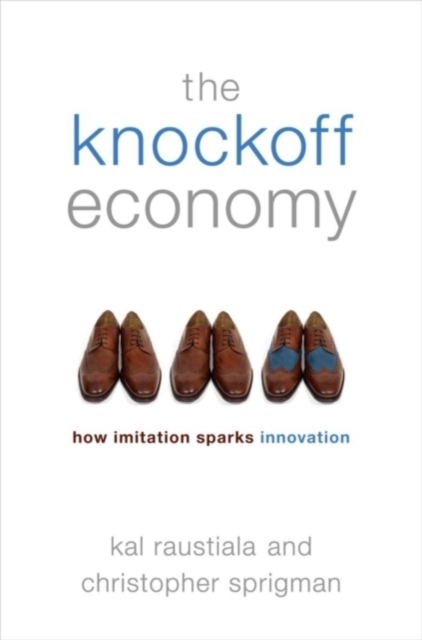
The Knockoff Economy
From the shopping mall to the corner bistro, knockoffs are everywhere in today's marketplace. Conventional wisdom holds that copying kills creativity, and that laws that protect against copies are essential to innovation—and economic success. But are copyrights and patents always necessary? This book argues that creativity can not only survive in the face of copying, but can thrive. The book approaches the question of incentives and innovation in a wholly new way—by exploring creative fields where copying is generally legal, such as fashion, food, and even professional football. By uncovering these important but rarely studied industries, the text reveals a nuanced and fascinating relationship between imitation and innovation. In some creative fields, copying is kept in check through informal industry norms enforced by private sanctions. In others, the freedom to copy actually promotes creativity. High fashion gave rise to the very term “knockoff,” yet the freedom to imitate great designs only makes the fashion cycle run faster—and forces the fashion industry to be even more creative. The book carries the analysis from food to font design to football plays to finance, examining how and why each of these vibrant industries remains innovative even when imitation is common. There is an important thread that ties all these instances together—successful creative industries can evolve to the point where they become inoculated against—and even profit from—a world of free and easy copying. And there are important lessons here for copyright-focused industries, like music and film, that have struggled as digital technologies have made copying increasingly widespread and difficult to stop.
eBook
