
Catalogue Search | MBRL


Are you sure you want to remove the book from the shelf?

{{itemTitle}}
479
result(s) for
"LGBTQ representation"
Sort by:

Gay TV and Straight America
After decades of silence on the subject of homosexuality, television in the 1990s saw a striking increase in programming that incorporated and, in many cases, centered on gay material. In shows including Friends, Seinfeld, Party of Five, Homicide, Suddenly Susan, The Commish, Ellen, Will & Grace, and others, gay characters were introduced, references to homosexuality became commonplace, and issues of gay and lesbian relationships were explored, often in explicit detail.
In Gay TV and Straight America, Ron Becker draws on a wide range of political and cultural indicators to explain this sudden upsurge of gay material on prime-time network television. Bringing together analysis of relevant Supreme Court rulings, media coverage of gay rights battles, debates about multiculturalism, concerns over political correctness, and much more, Becker's assessment helps us understand how and why televised gayness was constructed by a specific culture of tastemakers during the decade.
On one hand the evidence points to network business strategies that embraced gay material as a valuable tool for targeting a quality audience of well-educated, upscale adults looking for something \"edgy\" to watch. But, Becker also argues that the increase of gay material in the public eye creates growing mainstream anxiety in reaction to the seemingly civil public conversation about equal rights.
In today's cultural climate where controversies rage over issues of gay marriage yet millions of viewers tune in weekly to programs like Queer Eye for the Straight Guy, this book offers valuable insight to the complex condition of America's sexual politics.
eBook
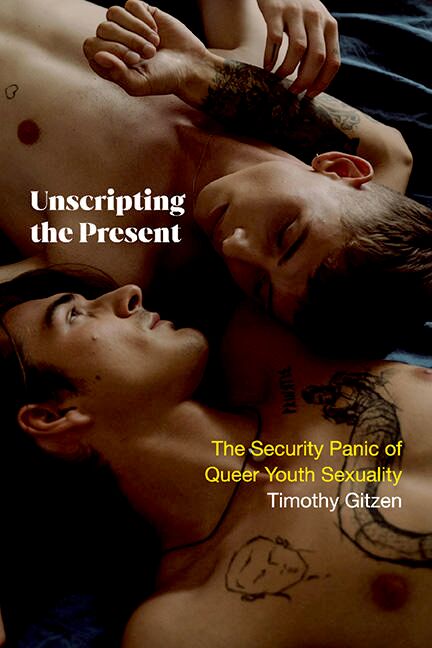
Unscripting the Present
Interrogates contemporary sex panics in the United
States, looking especially at popular culture texts to
conceptualize queer youth survival strategies.
Sex panics saturate contemporary discourse and politics in
the United States. While such panics have a long history, they
are now infused with rhetoric, logics, and methods of security
that turn queer sexuality into an existential crisis. Queer
youth bear the brunt of this crisis, with their presumed
innocence always in danger of being lost.
Unscripting the Present interweaves analysis of laws
and lawsuits, news media, sociological studies, and popular
culture both to understand contemporary sex panics and to
highlight how queer youth find ways to survive in the here and
now. Developing a novel technique of \"unscripting,\" Timothy
Gitzen focuses our attention on those impromptu moments when
things go awry in representations of queer youth-moments that
disrupt securitization's social \"scripts.\" Foregoing well-worn
promises of things getting better, texts such as Netflix's
Sex Education , the film
Love, Simon , and the multimodal show Skam upend the
anxious hyperfocus on what's to come in favor of a hopeful
present.
eBook

Women Together/Women Apart
What does it mean to look like a lesbian? Though it remains impossible to conjure a definitive image that captures the breadth of this highly nuanced term, today at least we are able to consider an array of visual representations that have been put into circulation by lesbians themselves over the last six or seven decades. In the early twentieth century, though, no notion of lesbianism as a coherent social or cultural identity yet existed. In Women Together/Women Apart, Tirza True Latimer explores the revolutionary period between World War I and World War II when lesbian artists working in Paris began to shape the first visual models that gave lesbians a collective sense of identity and allowed them to recognize each other. Flocking to Paris from around the world, artists and performers such as Romaine Brooks, Claude Cahun, Marcel Moore, and Suzy Solidor used portraiture to theorize and visualize a \"new breed\" of feminine subject. The book focuses on problems of feminine and lesbian self-representation at a time and place where the rights of women to political, professional, economic, domestic, and sexual autonomy had yet to be acknowledged by the law. Under such circumstances, same-sex solidarity and relative independence from men held important political implications.Combining gender theory with visual, cultural, and historical analysis, Latimer draws a vivid picture of the impact of sexual politics on the cultural life of Paris during this key period. The book also illuminates the far-reaching consequences of lesbian portraiture on contemporary constructions of lesbian identity.
eBook

Nomadism and Stasis in Transparent
Joey Soloway (previously known as Jill) approaches the Jewish story as one of perpetual wandering—between identities, between bodies, between realms of belonging. While Transparent is as arguably concerned with relationality and interdependence as untethered individualism, in the series’ tense opposition between wandering and stasis, Soloway privileges the expansive, open-ended identity of wandering over the narrowly proscribed monolithic identity that accompanies rest or arrival. Looking back on how the series has evolved, its emphasis on loss, confusion, and unsettled indeterminacy occurs most emphatically in Rabbi Raquel’s evocative words launching the third season as she struggles with a sermon about Passover. At one time or another the series revisits or otherwise evokes the ruptures of Genesis, the sense of felix culpa that accompanies all human exiles; from the Garden, Abraham’s Lech Lacha (“Get you gone from your country and from your birthplace and from your father’s house”), the expulsion of Ishmael into the desert, the narrative of Ruth the Moabite, each offering richly circuitous terrains, repetitions of wandering, wryly underscored in the uncertainties and scrambled destinies of the Pfefferman tribe.
Journal Article

El Síndrome de la Lesbiana Muerta : mecanismos de autorregulación del «fandom» LGBTI en las polémicas fan-productor de la serie «The 100»
Este artículo explora los mecanismos de autorregulación de las fans en situaciones de conflicto con productores, alentadas por el tratamiento injusto que reciben los personajes LGBTI en ficciones televisivas y que se engloba en el llamado Dead Lesbian Syndrome («Síndrome de la Lesbiana Muerta»), cliché narrativo que implica un final trágico para los personajes femeninos LGBTI. A partir de una metodología basada en los estudios de recepción y el análisis del discurso, se analiza la campaña de boicot organizada por las fans lesbianas y bisexuales de la serie juvenil de ciencia-ficción The 100 (The CW, 2014-) tras la muerte en la tercera temporada de un carismático personaje lésbico: la Comandante Lexa (Alycia Debnam-Carey). Los resultados muestran que las fans utilizan el miedo a las represalias de la industria, el pensamiento estratégico y la representación positiva para los personajes LGBTI) como estrategias argumentativas destinadas a contener la acción de los fans tóxicos que acosan a los productores en las redes sociales, y a proteger la misión social del fan activismo. Aquest article explora els mecanismes d’autoregulació de les fans en situacions de conflicte amb productors, encoratjades pel tractament injust que reben els personatges LGBTI en ficcions televisives i que s’engloba en l’anomenat Dead Lesbian Syndrome (Síndrome de la Lesbiana Morta), clixé narratiu que implica un final tràgic per als personatges femenins LGBTI. A partir d’una metodologia basada en els estudis de recepció i l’anàlisi del discurs, s’analitza la campanya de boicot organitzada per les fans lesbianes i bisexuals de la sèrie juvenil de ciència-ficció The 100 (The CW, 2014-) després de la mort en la tercera temporada d’un carismàtic personatge lèsbic: la Comandant Lexa (Alycia Debnam-Carey). Els resultats mostren que les fans utilitzen la por a les represàlies de la indústria, el pensament estratègic i la representació positiva per als personatges LGBTI com a estratègies argumentatives destinades a contenir l’acció dels fans tòxics que assetgen els productors en les xarxes socials, i a protegir la missió social del fan activisme. This article explores the mechanisms of fans self-regulation in conflict situations with the showrunners. Conflict situations are encouraged by the unfair treatment that LGBTQ characters receive in TV series, including the so-called Dead Lesbian Syndrome: a narrative cliché that implies a tragic ending for the LGBTQ female characters. In our study, which is methodologically based on reception studies and discourse analysis, we analyse the boycott campaign organized by lesbian and bisexual fans of The 100 (The CW, 2014-) after the death, in the third season, of a charismatic lesbian character: Commander Lexa (Alycia Debnam-Carey). The results show that fans use the fear of industry reprisals, strategic thinking and the positive portrayal of LGBTQ characters as argumentative strategies designed to contain the action of toxic fans that harass showrunners in social networks, and to protect the social labor of fan activism.
Journal Article

LGBTQ+ Representation in Video Games through the Eyes of the Queer Community
In this growing field of human interaction and activity, the video game industry plays a major role on levels both obvious and subtle. The estimated profits of the gaming industry as a whole exceed 180 billion dollars for 2021,2) with 11,916 new titles released3· and a peak of over twenty-seven million concurrent active users on Steam4· alone.5· Several major esports events took place in 2021, such as the League of Legends World Championship, The International: DOTA2 Championships, and Counter-Strike: Global Offensive Major Championships streamed across several platforms and attracted millions of viewers. The gaming industry, however, is not only a place of positive interaction and blooming creativity, which is best demonstrated by the ongoing sexual harassment and gender discrimination investigation in Activision Blizzard company.6· As the gaming community does not exist in a vacuum, it is influenced by the politics of major world powers, such as Chinese censorship of gaming platforms7) or the efforts of the European Union to regulate gambling features in games.8) All of these topics and many more are valid options for academic research, which is currently mostly situated in the field of recently4 established game studies. Existing research suggests significant ambivalence of representation and its reception by queer gamers.18) This is reinforced further by the themes of exclusion present in the process of game-making itself.191 However, due to part of the focus lying on the game studios and creators themselves, we also base our research on the perspective of queer game makers and the recent advances in this field.20) Furthermore, queer game studies are based on the theories present in the general field of queer studies.
Journal Article

Sexual Politics, Orientalism and Multicultural Citizenship in the Netherlands
Sexuality features prominently in European debates on multiculturalism and in Orientalist discourses on Islam. This article argues that representations of gay emancipation are mobilized to shape narratives in which Muslims are framed as non-modern subjects, a development that can best be understood in relation to the 'culturalization of citizenship' and the rise of Islamophobia in Europe. We focus on the Netherlands where the entanglement of gay rights discourses with anti-Muslim politics and representations is especially salient The thorough-going secularization of Dutch society, transformations in the realms of sex and morality since the 'long 1960s' and the 'normalization' of gay identities since the 1980s have made sexuality a malleable discourse in the framing of 'modernity' against 'tradition'. This development is highly problematic, but also offers possibilities for new alliances and solidarities in lesbian, gay, bisexual, transgendered and questioning (LGBTQ) politics and sexual and cultural citizenship.
Journal Article

Policy Ideology in European Mass Publics, 1981–2016
Using new scaling methods and a comprehensive public opinion dataset, we develop the first survey-based time-series–cross-sectional measures of policy ideology in European mass publics. Our dataset covers 27 countries and 36 years and contains nearly 2.7 million survey responses to 109 unique issue questions. Estimating an ordinal group-level IRT model in each of four issue domains, we obtain biennial estimates of the absolute economic conservatism, relative economic conservatism, social conservatism, and immigration conservatism of men and women in three age categories in each country. Aggregating the group-level estimates yields estimates of the average conservatism in national publics in each biennium between 1981–82 and 2015–16. The four measures exhibit contrasting cross-sectional cleavages and distinct temporal dynamics, illustrating the multidimensionality of mass ideology in Europe. Subjecting our measures to a series of validation tests, we show that the constructs they measure are distinct and substantively important and that they perform as well as or better than one-dimensional proxies for mass conservatism (left–right self-placement and median voter scores). We foresee many uses for these scores by scholars of public opinion, electoral behavior, representation, and policy feedback.
Journal Article

The Power of Equality? Polarization and Collective Mis-representation on Gay Rights in Congress, 1989-2019
The U.S. Supreme Court's recent application of employment protections to gays and lesbians in Bostock v. Clayton County highlights the striking absence of policy produced by the U.S. Congress despite two decades of increased public support for gay rights. With the notable exceptions of allowing gays and lesbians to serve in the military, and passing hate crimes legislation, every other federal policy advancing gay rights over the last three decades has been the product of a Supreme Court ruling or Executive Order. To better understand the reasons for this inaction, we examine the changing preferences of members of Congress on LGBTQ (lesbian, gay, bisexual, transgender, and queer) issues. Examining scores from the Human Rights Campaign from 1989 to 2019, we find a striking polarization by the parties on LGBTQ issues, as Democrats have become much more supportive and Republicans even more opposed to gay rights. This change has been driven not by gerrymandering, mass opinion polarization, or elite backlash, but among Republicans by a mix of both conversion and replacement, and among Democrats primarily of replacement of more moderate members. The result is a striking lack of collective representation that leaves members of the LGBTQ community at risk to the whims of presidents and jurists.
Journal Article
Bias in Perceptions of Public Opinion among Political Elites
The conservative asymmetry of elite polarization represents a significant puzzle. We argue that politicians can maintain systematic misperceptions of constituency opinion that may contribute to breakdowns in dyadic representation. We demonstrate this argument with original surveys of 3,765 politicians’ perceptions of constituency opinion on nine issues. In 2012 and 2014, state legislative politicians from both parties dramatically overestimated their constituents’ support for conservative policies on these issues, a pattern consistent across methods, districts, and states. Republicans drive much of this overestimation. Exploiting responses from politicians in the same district, we confirm these partisan differences within individual districts. Further evidence suggests that this overestimation may arise due to biases in who contacts politicians, as in recent years Republican citizens have been especially likely to contact legislators, especially fellow Republicans. Our findings suggest that a novel force can operate in elections and in legislatures: Politicians can systematically misperceive what their constituents want.
Journal Article