
Catalogue Search | MBRL


Are you sure you want to remove the book from the shelf?

{{itemTitle}}
1,052
result(s) for
"LITERARY CRITICISM / European / French"
Sort by:

From Francophonie to World Literature in French
In 2007 the French newspaperLe Mondepublished a manifesto titled \"Toward a 'World Literature' in French,\" signed by forty-four writers, many from France's former colonies. Proclaiming that the francophone label encompassed people who had little in common besides the fact that they all spoke French, the manifesto's proponents, the so-called francophone writers themselves, sought to energize a battle cry against the discriminatory effects and prescriptive claims offrancophonie.
In one of the first books to study the movement away from the term \"francophone\" to \"world literature in French,\" Thérèse Migraine-George engages a literary analysis of contemporary works in exploring the tensions and theoretical debates surrounding world literature in French. She focuses on works by a diverse group of contemporary French-speaking writers who straddle continents-Nina Bouraoui, Hélène Cixous, Maryse Condé, Marie NDiaye, Tierno Monénembo, and Lyonel Trouillot. What these writers have in common beyond their use of French is their resistance to the centralizing power of a language, their rejection of exclusive definitions, and their claim for creative autonomy.
eBook

Multilingualism and Mother Tongue in Medieval French, Occitan, and Catalan Narratives
The Occitan literary tradition of the later Middle Ages is a
marginal and hybrid phenomenon, caught between the preeminence of
French courtly romance and the emergence of Catalan literary prose.
In this book, Catherine Léglu brings together, for the first time
in English, prose and verse texts that are composed in Occitan,
French, and Catalan-sometimes in a mixture of two of these
languages. This book challenges the centrality of \"canonical\" texts
and draws attention to the marginal, the complex, and the hybrid.
It explores the varied ways in which literary works in the
vernacular composed between the twelfth and fifteenth centuries
narrate multilingualism and its apparent opponent, the mother
tongue. Léglu argues that the mother tongue remains a fantasy,
condemned to alienation from linguistic practices that were, by
definition, multilingual. As most of the texts studied in this book
are works of courtly literature, these linguistic encounters are
often narrated indirectly, through literary motifs of love, rape,
incest, disguise, and travel.
eBook
Aphorism in the Francophone Novel of the Twentieth Century
Aphorism in the Francophone Novel of the Twentieth Century includes critical readings of Terre des hommes by Antoine de Saint-Exupéry, Alexandre Chenevert by Gabrielle Roy, Gouverneurs de la rosée by Jacques Roumain, Pluie et vent sur Télumée miracle by Simone Schwarz-Bart, La route des Flandres by Claude Simon, Présence de la mort by C.F. Ramuz, and Neige noire by Hubert Aquin. Bell addresses the problems inherent in the term aphorism, the narrative and discourse function of aphorism within the genre of the novel, the interrelation between the structure of aphorism and the epistemological and hermeneutical functions this sub-genre may perform as a component part of the narrative fabric, the \"national\" character of aphoristics, and the problems that arise from \"anthologizing\" a novel's aphorisms. The importance of aphoristic formulation in the French literary tradition and its undeniable presence in the modern novel make this a particularly significant and fruitful study.
eBook
From Babel to Pentecost
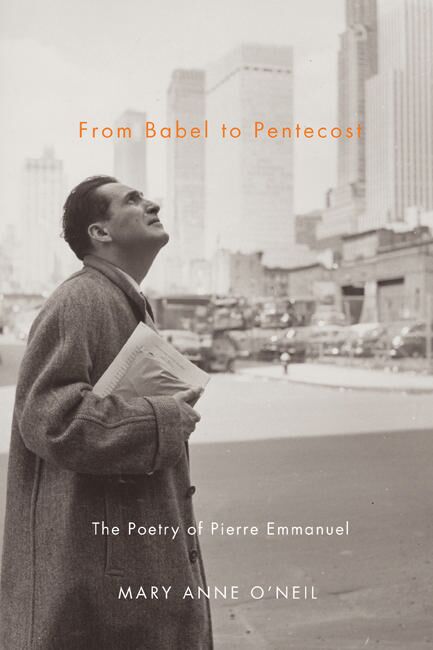
The most prolific and versatile French poet of the mid-twentieth century, Pierre Emmanuel's oeuvre spans five decades and an astonishing array of forms, from epics and love sonnets to patriotic works and prayers. The first full-length study of his works in English, From Babel to Pentecost brings Emmanuel's works to a new generation and a new readership.Mary Anne O'Neil's meticulous study of Emmanuel's complete works traces the poet's development as a thinker and artist while surveying both French and English scholarship on Emmanuel from the 1940s to the present. Employing close readings of poems as well as intertextual and psychoanalytic approaches, O'Neil draws connections between Emmanuel's influences, vocabulary, imagery, and meters, while translations allow English-language readers to engage directly with the texts. O'Neil's insightful commentary sheds light on the poet's relationship to movements in European poetry, to poets of Classical Greece, the Latin Middle Ages, and the Renaissance, and to sacred Hebrew, Hindu, and Buddhist verse.Keenly attuned to the changing world around him, Pierre Emmanuel exemplifies a poet's power to clarify the human condition, to move, and to teach. From Babel to Pentecost enables readers to rediscover the enduring richness and relevance of his work.
eBook

Critical Terrains
Examining and historicizing the concept of \"otherness\" in both literature and criticism, Lisa Lowe explores representations of non-European cultures in British and French writings from the eighteenth through the twentieth centuries.
eBook
Rendering French Realism
Realist novels are usually seen as verisimilar representations of the world, and even when that verisimilitude is critically examined (as it has been by Marxist and feminist critics), the criticism has referred to extra-literary matters, such as bourgeois ideology or defects in the portrayal of women. This book takes as its thesis that the point defining realism is the point at which the processes of representation break down, a sort of black hole of textuality, a rent in the tissue. The author argues that our notions of continuity, of readability, of representability, or our ideas about unity and ideological shift—or even our notions of what is hidden, occulted, or absent—all come from the nineteenth-century realist model itself. Instead of assuming representability, the author argues that we should look at places where the texts do not continue the representationalist model, where there is a sudden falling off, an abyss. Instead of seeing that point as a shortcoming, the author argues that it is equal to the mimetic successes of representation. After an initial chapter dealing with the limits and ruptures of textuality, the book considers the work of Stendhal, from its early state as a precursor to the later realism to La Chartreuse de Parme, which shows how the act of communication for Stendhal is always made of silences, gaps, and interruptions. The author then reads several works of Balzac, showing how he, while setting up the praxes of continuity on which his oeuvre depends, ruptures the works at various strategic points. In a chapter entitled \"Romantic Interruptions,\" works of Nerval and the younger Dumas, seemingly unrelated to the realist project, are shown to be marked by the ideological, representational, and semiotic assumptions that produced Balzac. The book concludes with Flaubert, looking both at how Flaubert incessantly makes things \"unfit\" and how critics, even the most perspicacious postmodern ones, often try to smooth over the permanent crisis of rupture that is the sign of Flaubert's writing. Lawrence R. Schehr is Professor of French at the University of South Alabama. He is the author, most recently, of The Shock of Men: Homosexual Hermeneutics in French Writing and Alcibiades at the Door: Gay Discourses in French Literature (both Stanford, 1995).
eBook

Genius Envy
In Genius Envy Adrianna M. Paliyenko uncovers a forgotten past: the multiplicity and diversity of nineteenth-century French women’s poetic voices. Conservative critics of the time attributed genius to masculinity and dismissed the work of female authors as “feminine literature.\" Despite the efforts of leading thinkers, critics, and historians to erase women from the pages of literary history, Paliyenko shows how female poets invigorated the debate about the origins of genius and garnered recognition in their time for their creativity and bold aesthetic ideas. This fresh account of French women poets’ contributions to literature probes the history of their critical reception and considers the texts of celebrated writers such as Desbordes-Valmore, Ségalas, Blanchecotte, Siefert, and Ackermann. The results show that these women explicitly challenged the notion of genius as gendered, advocating for their rightful place in the canon.
eBook

French literature on screen
This collection presents new essays in the complex field of French
literary adaptation. Using a variety of textual and interpretive
approaches, it sheds light on issues of gender, sexuality, class,
politics and social conventions while acknowledging a range of
contexts, from the commercial to the archival and the aesthetic.
The chapters, written by eminent international scholars, run
chronologically from The Count of Monte Cristo through
Proust and Bonjour, Tristesse to Philippe Djian's
Oh… (adapted for the screen as Elle ).
Collectively, they fill a need for contemporary discussions on the
significance of France's literary representations in the history of
global cinema.
eBook
Queer and Feminist Relationships in Contemporary Fiction
Relationships play a crucial role in feminist and queer fictions of the 21st century, whether we think of the connection among the artists and between them and their audience or the interaction of the characters or different modes of writing. The contributors to this volume analyze and map these friendly, amorous, sexual, political and artistic contacts within and around contemporary fictions of Romance cultures. They show how these works question, challenge and rethink circulating concepts of relationships and implement them aesthetically. This volume integrates contributions from feminist, queer and decolonial studies just as sociology of art.
eBook

Emporialism
This book examines what Amr Kamal calls the phenomenon of
emporialism , or the convergence between the spaces and
imaginaries of empires and emporia in the context of a modern
Mediterranean divided among the British, French, and Ottoman
empires. By \"emporia,\" Kamal refers to the commercial network of
nineteenth-century department stores, which gained prominence after
the Suez Canal project. Taking as a focal point French and Egyptian
department stores, the author examines emporialism as a set of
phenomenological experiences, discursive and social praxes, and
mechanisms of control and resistance, born from the intersection of
modernity, colonialism, and mass consumption. Drawing on archival
evidence, Kamal reads iconographic and literary representations of
emporia in English, French, Arabic, and Hebrew, from the nineteenth
century to the present, addressing works by Émile Zola, Huda
Shaarawi, Jacqueline Kahanoff, and others. Emporialism, Kamal
argues, served to rewrite the history of the Mediterranean, to
reinvent national belonging, and to interrogate issues of modernity
and social justice.
eBook