
Catalogue Search | MBRL


Are you sure you want to remove the book from the shelf?

{{itemTitle}}
27
result(s) for
"LITERARY CRITICISM / Modern / 20th Century bisacsh"
Sort by:

Sensational Joyce
Exploring how Ulysses imitates the human mind at work, connecting close readings to psychological theories of Joyces time In this book, John Gordon uses historically oriented close readings to demonstrate that Ulysses is a book that mimics the workings of the human mind. Gordon highlights James Joyces exceptional ability to capture and represent lived experiences, showing how Joyces writings display the ways specific minds interact with their environments. Ulysses is portrayed here as having its own evolving consciousness. Sensational Joyce is the first book on Joyces psychology to engage deeply with theorists beyond Freud, Jung, or Lacan. Gordon explains how Joyce used other psychological theories, like William Jamess ideas on stimulus and response, Gestalt psychology, John Watsons behaviorism, and trauma research. The book also includes discussions of phenomena considered experimental at the time, such as telepathy, telekinesis, precognition, and spiritualism. Gordon examines the characters of sensitive intellectual Stephen Dedalus and advertising professional Leopold Bloom, following the books centers of consciousness into the visionary, hallucinatory, and prophetic final chapters. Gordon highlights how Joyces unique writing style transforms sensations and stimuli into thoughts and responses. As Ulysses progresses, the sensationalmeaning sensory databecomes sensationalistic. In tracing the contemporary theories of psychology evidenced in the novel, Sensational Joyce presents many new and original interpretations that can be applied to other works by Joyce, especially Finnegans Wake.
eBook


Joyce without Borders
This book addresses James Joyce's borderlessness and the ways
his work crosses or unsettles boundaries of all kinds. The essays
in this volume position borderlessness as a major key to
understanding Joycean poiesis, opening new doors and new
engagements with his work.
Contributors begin by exploring the circulation of Joyce's
writing in Latin America via a transcontinental network of writers
and translators, including José Lezama Lima, José Salas Subirat,
Leopoldo Marechal, Edmundo Desnoës, Guillermo Cabrera Infante, and
Augusto Monterroso. Essays then consider Joyce through the lens of
the sciences, presenting theoretical interventions on posthumanist
parasitology in Ulysses ; on Giordano Bruno's coincidence
of opposites in Finnegans Wake ; and on algorithmic agency
in the Wake . Cutting-edge cognitive narratology is applied
to the \"Penelope\" episode.
Next, the volume features innovative essays on Joyce in relation
to early animated film and comics, engaging with animated film in
the \"Circe\" episode, Joyce's points of contact with George
Herriman's cartoon strip Krazy Kat , and structural
affinities between open-world gaming and Finnegans Wake .
The final essays focus on abiding human concerns, offering new
research on Joyce's creative use of \"spicy books\"; a Lacanian
consideration of \"The Dead\" alongside Katherine Mansfield's \"The
Stranger\" and Haruki Murakami's \"Kino\"; and a meditation on Joyce's
uncertainties about the boundary between life and death.
For Joyce, borders are problems-but ones that provided precious
fodder for his art. And as this volume demonstrates, they encourage
brilliant reflections on his work, from new scholars to leading
luminaries in the field.
A volume in the Florida James Joyce Series, edited by Sebastian D.
G. Knowles
eBook

Beating the Bounds
Exploring the role of boundaries and limits in the
writing of James Joyce
Beating the Bounds examines the role of boundaries and
limits in James Joyce's later works, primarily Finnegans
Wake but also Ulysses and other texts. Building on
the ideas of philosophers Friedrich Nietzsche, Giordano Bruno, and
scholar Fritz Senn, Roy Benjamin explains and reconciles Joyce's
contrary tendencies to establish and transgress limits.
Benjamin begins by contrasting Joyce's exploration of the
artificial impositions of ritual and political power with the
writer's attention to natural boundaries of rivers and mountains.
The next section considers sexual, spiritual, and interpersonal
boundaries in the Wake . Benjamin then discusses how Joyce
simultaneously affirms and undermines the limits of philosophy,
geometry, and aesthetics. The final section covers Joyce's
representation of the boundaries imposed in cosmogonic myths, the
collision between the bounded medieval world and the boundless
world of modern science, and the drive to escape from the
boundaries of place.
In this detailed and original analysis, Benjamin demonstrates
that in Joyce's writing, the tendency to disintegrate into chaos is
countered by an urge to impose order. Benjamin's close readings put
an abundance of subjects in conversation through the concept of
limits, showing the Wake 's relevance to many different
fields of thought.
A volume in the Florida James Joyce Series, edited by Sebastian
D. G. Knowles
eBook


An Irish-Jewish Politician, Joyce's Dublin, and Ulysses
A forgotten historical figure and his influence on the
writing of James Joyce
In this book, Neil Davison argues that Albert Altman (1853 ‒
1903), a Dublin-based businessman and Irish nationalist, influenced
James Joyce's creation of the character of Leopold Bloom, as well
as Ulysses 's broader themes surrounding race, nationalism,
and empire. Using extensive archival research, Davison reveals
parallels between the lives of Altman and Bloom, including how the
experience of double marginalization-which Altman felt as both a
Jew in Ireland and an Irishman in the British Empire-is a major
idea explored in Joyce's work.
Altman, a successful salt and coal merchant, was involved in
municipal politics over issues of Home Rule and labor, and
frequently appeared in the press over the two decades of Joyce's
youth. His prominence, Davison shows, made him a familiar name in
the Home Rule circles with which Joyce and his father most
identified. The book concludes by tracing the influence of Altman's
career on the Dubliners story \"Ivy Day in the Committee
Room,\" as well as throughout the whole of Ulysses . Through
Altman's biography, Davison recovers a forgotten life story that
illuminates Irish and Jewish identity and culture in Joyce's
Dublin.
A volume in the Florida James Joyce Series, edited by Sebastian
D. G. Knowles
eBook
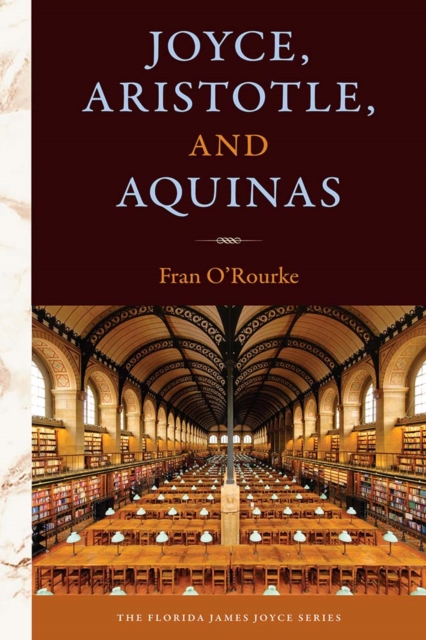
Joyce, Aristotle, and Aquinas
A rich examination of the influence of Aristotle and
Thomas Aquinas on James Joyce
In this book, Fran O'Rourke examines the influence of Aristotle
and Thomas Aquinas on James Joyce, arguing that both thinkers
fundamentally shaped the philosophical outlook which pervades the
author's oeuvre. O'Rourke demonstrates that Joyce was a
philosophical writer who engaged creatively with questions of
diversity and unity, identity, permanence and change, and the
reliability of knowledge.
Beginning with an introduction to each thinker, the book traces
Joyce's discovery of their works and his concrete engagement with
their thought. Aristotle and Aquinas equipped Joyce with
fundamental principles regarding reality, knowledge, and the soul,
which allowed him to shape his literary characters. Joyce
appropriated Thomistic concepts to elaborate an original and
personal aesthetic theory.
O'Rourke provides an annotated commentary on quotations from
Aristotle that Joyce entered into his famous Early Commonplace Book
and outlines their crucial significance for his writings. He also
provides an authoritative evaluation of Joyce's application of
Aquinas's aesthetic principles.
The first book to comprehensively illuminate the profound impact
of both the ancient and medieval thinker on the modernist writer,
Joyce, Aristotle, and Aquinas offers readers a rich
understanding of the intellectual background and philosophical
underpinnings of Joyce's work.
A volume in the Florida James Joyce Series, edited by Sebastian
D. G. Knowles
eBook

Modernism in Scandinavia
Scandinavia is a region associated with modernity: modern design, modern living and a modern welfare state. This new history of modernism in Scandinavia offers a picture of the complex reality that lies behind the label: a modernism made up of many different figures, impulses and visions. It places the individuals who have achieved international fame, such as Edvard Munch and Alvar Aalto in a wider context, and through a series of case studies, provides a rich analysis of the art, architecture and design history of the Nordic region, and of modernism as a concept and mode of practice. Scandinavian Modern addresses the decades between 1890 and 1970 and presents an intertwined history of modernism across the region. Charlotte Ashby gives a rationale for her focus on those countries which share an interrelated history and colonial past, but also stresses influences from outside the region, such as the English Arts and Crafts movement and the impact of emergent American modernism. Her richly illustrated account guides the reader through key historical periods and cultural movements, with case studies illuminating key art works, buildings, designed products and exhibitions.
eBook

Colonial Girlhood in Literature, Culture and History, 1840-1950
Colonial Girlhood in Literature, Culture and History, 1840-1950 explores a range of real and fictional colonial girlhood experiences from Jamaica, Mauritius, South Africa, India, New Zealand, Australia, England, Ireland, and Canada to reflect on the transitional state of girlhood between childhood and adulthood.
eBook

The Postcolonial Unconscious
The Postcolonial Unconscious is a major attempt to reconstruct the whole field of postcolonial studies. In this magisterial and, at times, polemical study, Neil Lazarus argues that the key critical concepts that form the very foundation of the field need to be re-assessed and questioned. Drawing on a vast range of literary sources, Lazarus investigates works and authors from Latin America and the Caribbean, Africa and the Arab world, South, Southeast and East Asia, to reconsider them from a postcolonial perspective. Alongside this, he offers bold new readings of some of the most influential figures in the field: Fredric Jameson, Edward Said and Frantz Fanon. A tour de force of postcolonial studies, this book will set the agenda for the future, probing how the field has come to develop in the directions it has and why and how it can grow further.
eBook