
Catalogue Search | MBRL


Are you sure you want to remove the book from the shelf?

{{itemTitle}}
983
result(s) for
"Labor contract Great Britain"
Sort by:
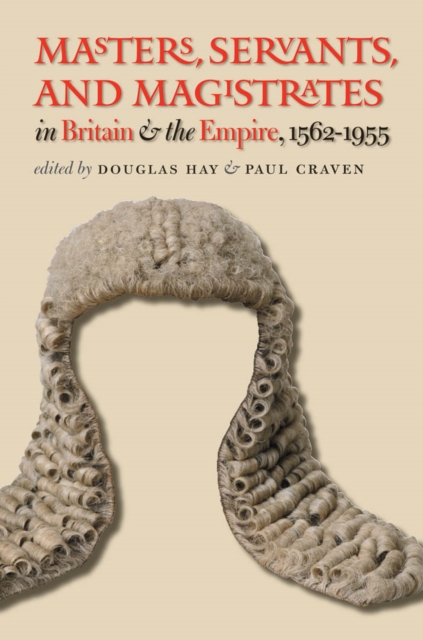
Masters, servants, and magistrates in Britain and the Empire, 1562-1955
Master and servant acts, the cornerstone of English employment law for more than four hundred years, gave largely unsupervised, inferior magistrates wide discretion over employment relations, including the power to whip, fine, and imprison men, women, and children for breach of private contracts with their employers. The English model was adopted, modified, and reinvented in more than a thousand colonial statutes and ordinances regulating the recruitment, retention, and discipline of workers in shops, mines, and factories; on farms, in forests, and on plantations; and at sea. This collection presents the first integrated comparative account of employment law, its enforcement, and its importance throughout the British Empire.
Sweeping in its geographic and temporal scope, this volume tests the relationship between enacted law and enforced law in varied settings, with different social and racial structures, different economies, and different constitutional relationships to Britain. Investigations of the enforcement of master and servant law in England, the British Caribbean, India, Africa, Hong Kong, Canada, Australia, and colonial America shed new light on the nature of law and legal institutions, the role of inferior courts in compelling performance, and the definition of \"free labor\" within a multiracial empire.
Contributors:
David M. Anderson, St. Antony's College, Oxford
Michael Anderson, London School of Economics
Jerry Bannister, Dalhousie University, Nova Scotia
M. K. Banton, National Archives of the United Kingdom, London
Martin Chanock, La Trobe University, Australia
Paul Craven, York University
Juanita De Barros, McMaster University
Christopher Frank, University of Manitoba
Douglas Hay, York University
Prabhu P. Mohapatra, Delhi University, India
Christopher Munn, University of Hong Kong
Michael Quinlan, University of New South Wales
Richard Rathbone, University of Wales, Aberystwyth
Christopher Tomlins, American Bar Foundation, Chicago
Mary Turner, London University
eBook


Bloch and Brearley: Employment Covenants and Confidential Information
Written under the general editorship of two specialist employment law practitioners, with contributions from their respective Chambers and Law Firm, Employment Covenants and Confidential Information: Law, Practice and Technique, Fourth Edition provides a comprehensive yet highly practical analysis of the law and practice in this area of employment disputes, setting out appropriate strategies from both the employer’s and employee’s perspective. The book focuses on how to prevent competitive activity by an employee or former employee and what to do when it happens. Clear guidance is given on drafting to minimise the risk of competitive activity, what activities an employee or ex-employee may and may not undertake and the remedies available where competitive activity occurs. This expanded edition includes up-to-date coverage of:
Case law relevant to the drafting and interpretation of employment covenantsCurrent trends regarding enforcement of employment covenants and duties of confidentialityDevelopments in the law on fiduciary duties and the interrelationship with duties of fidelityFresh perspectives on garden leave, springboard injunctions and team movesRemedies available against the (ex-)employee and third party competitorsDisputes with a foreign law element: conflict of laws, exclusive jurisdiction clauses, choice of law and anti-suit injunctions Employment Covenants and Confidential Information, Fourth Edition is essential reading for all employment law practitioners, HR professionals and company directors responsible for drafting and enforcing employment contracts. Through the use of checklists, flowcharts, precedents and case studies it translates theory into practice.
eBook

Masters and servants : the Hudson's Bay Company and its North American workforce, 1668-1786
\"With Masters and Servants, Scott P. Stephen has revealed startling truths about the men of the Hudson's Bay Company. Rather than dedicating themselves body and soul to the Company's interests, these workers hired out like domestic servants, joining a 'household' with its attendant norms of duty and loyalty. Through painstaking documentary research, Stephen shines welcome light on the lives of these largely overlooked historical actors. The household system produced a remarkably stable political-economic entity, connecting early Canadian resource extraction to larger trends in British imperialism and its emerging social relations. An essential book for labour historians, Masters and Servants will appeal to scholars of early modern Britain, the North American fur trade, Western social history, or business history, and anyone intrigued by the reach of the HBC.\"-- Provided by publisher.
Book

Managing Sport and Leisure Facilities
Concise and thoroughly detailed Managing Sport and Leisure Facilities is a clean operating guide to leisure management by contract, providing expert advice for both contractor and client. The author includes extracts from the relevant legislation and tender documents, and shows you how to submit a winning tender. He provides guidance on how to carry out customer surveys and also covers special items such as operating leisure facilities in hotels and sub-contracting catering services.
eBook

Chinese labour in South Africa, 1902-10 : race, violence, and global spectacle
\"At the beginning of the twentieth century, 'white' colonies around the world had restricted Asian migration, associated with immorality, disease, and a threat to 'white' labour. The 'Yellow Peril' was in full swing. And yet, in 1904, the British government imported over 64,000 Chinese indentured labourers to work on gold mines in Southern Africa. This book explores the decision to import Chinese labour so soon after the empire had fought to secure Southern Africa for the British Empire and despite the already tense racial situation in the region. This enables a clearer understanding of racial and political developments in Southern Africa during the reconstruction period and the formation of South Africa the nation. It places these localised issues within a wider historiography, such as research into colonial violence, moral panics and Black Perils, networks of labourism and whiteness, and economic imperialism. Through this book one can trace the complicated negotiations between national and imperial identities, between independence and patriotism, and giving a clearer sense of how trans-colonial relationships evolved\"-- Provided by publisher.
Book

Competitive Tendering - Management and Reality
This is a book written by those at the sharp end of leisure service contract management. The lessons that can be learned from it are of value to everyone involved in, or studying, all forms of contract management. Readers will be able to benefit from examples of best, and worst, practice. The book will be especially valuable for clients, contractors, and students, directors and consultants.
eBook

Trade unions and the state
The collapse of Britain's powerful labor movement in the last quarter century has been one of the most significant and astonishing stories in recent political history. How were the governments of Margaret Thatcher and her successors able to tame the unions? In analyzing how an entirely new industrial relations system was constructed after 1979, Howell offers a revisionist history of British trade unionism in the twentieth century. Most scholars regard Britain's industrial relations institutions as the product of a largely laissez faire system of labor relations, punctuated by occasional government interference. Howell, on the other hand, argues that the British state was the prime architect of three distinct systems of industrial relations established in the course of the twentieth century. The book contends that governments used a combination of administrative and judicial action, legislation, and a narrative of crisis to construct new forms of labor relations. Understanding the demise of the unions requires a reinterpretation of how these earlier systems were constructed, and the role of the British government in that process. Meticulously researched, Trade Unions and the State not only sheds new light on one of Thatcher's most significant achievements but also tells us a great deal about the role of the state in industrial relations.
eBook

The Anti-Slavery Project
It is commonly assumed that slavery came to an end in the nineteenth century. While slavery in the Americas officially ended in 1888, millions of slaves remained in bondage across Africa, Asia, and the Middle East well into the first half of the twentieth century. Wherever laws against slavery were introduced, governments found ways of continuing similar forms of coercion and exploitation, such as forced, bonded, and indentured labor. Every country in the world has now abolished slavery, yet millions of people continue to find themselves subject to contemporary forms of slavery, such as human trafficking, wartime enslavement, and the worst forms of child labor.The Anti-Slavery Project: From the Slave Trade to Human Traffickingoffers an innovative study in the attempt to understand and eradicate these ongoing human rights abuses. InThe Anti-Slavery Project, historian and human rights expert Joel Quirk examines the evolution of political opposition to slavery from the mid-eighteenth century to the present day. Beginning with the abolitionist movement in the British Empire, Quirk analyzes the philosophical, economic, and cultural shifts that eventually resulted in the legal abolition of slavery. By viewing the legal abolition of slavery as a cautious first step-rather than the end of the story-he demonstrates that modern anti-slavery activism can be best understood as the latest phase in an evolving response to the historical shortcomings of earlier forms of political activism. By exposing the historical and cultural roots of contemporary slavery,The Anti-Slavery Projectpresents an original diagnosis of the underlying causes driving one of the most pressing human rights problems in the world today. It offers valuable insights for historians, political scientists, policy makers, and activists seeking to combat slavery in all its forms.
eBook