
Catalogue Search | MBRL


Are you sure you want to remove the book from the shelf?

{{itemTitle}}
834
result(s) for
"Labor unions -- Spain"
Sort by:

The Politics of Social Inclusion and Labor Representation
InThe Politics of Social Inclusion and Labor Representation, Heather Connolly, Stefania Marino, and Miguel Martínez Lucio compare trade union responses to immigration and the related political and labour market developments in the Netherlands, Spain, and the United Kingdom. The labor movement is facing significant challenges as a result of such changes in the modern context. As such, the authors closely examine the idea of social inclusion and how trade unions are coping with and adapting to the need to support immigrant workers and develop various types of engagement and solidarity strategies in the European context.
Traversing the dramatically shifting immigration patterns since the 1970s, during which emerged a major crisis of capitalism, the labor market, and society, and the contingent rise of anti-immigration sentiment and new forms of xenophobia, the authors assess and map how trade unions have to varying degrees understood and framed these issues and immigrant labor. They show how institutional traditions, and the ways that trade unions historically react to social inclusion and equality, have played a part in shaping the nature of current initiatives.The Politics of Social Inclusion and Labor Representationconcludes that we need to appreciate the complexity of trade-union traditions, established paths to renewal, and competing trajectories of solidarity. While trade union organizations remain wedded to specific trajectories, trade union renewal remains an innovative, if at times, problematic and complex set of choices and aspirations.
eBook
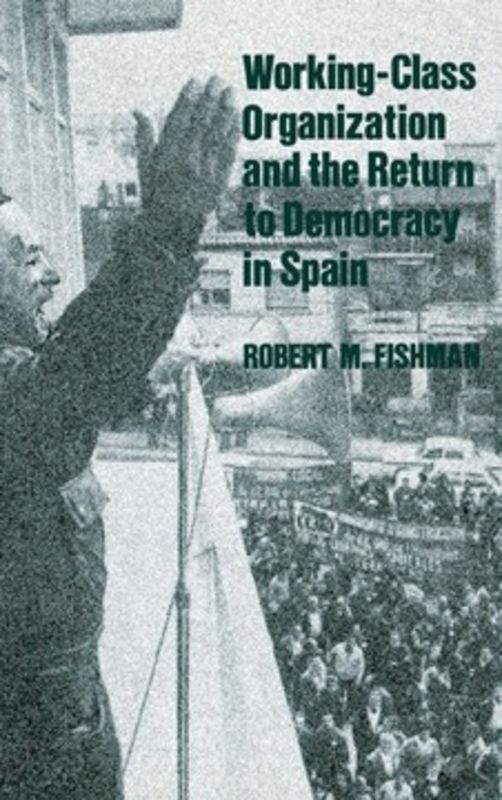
Working-Class Organization and the Return to Democracy in Spain
Following the death of Francisco Franco in 1975, the long repressed Spanish labor movement faced two challenges: to contribute to the transformation of the national political system, and to use newly achieved freedoms to build its own organizational presence. Focusing on areas of potential conflict between these two broad objectives, Robert Fishman here traces the development of the complex political role and organizational development of the Spanish workers' movement in the transition from dictatorship to democracy.
Drawing on rich empirical data including interviews with 324 plant-level labor leaders, Fishman examines the interplay between various unions' efforts to organize labor and to deal with national politics. He shows how the workers' movement, long an advocate of a ruptura or clear break with the Francoist past, came to support a process of negotiated reform and mobilizational restraint. Labor leaders' belief in the legitimacy of the democratic state, Fishman demonstrates, can serve as a key predictor of their willingness to support negotiated wage restraint.
In emphasizing the crucial role of plant-level labor leaders in national political processes, Fishman offers an innovative methodological approach to the analysis of the collective efforts of labor. Political scientists, sociologists, historians of labor movements, and observers of contemporary Western Europe and Latin America will read it with interest.
eBook

Lessons learned from cross-sectoral collaboration to protect migrant farmworkers during COVID-19 in Spain
In Spain, the agricultural sector relies heavily on migrant workers, especially during seasonal seasons. However, these workers face significant challenges related to precarious working conditions and structural vulnerability, which have become more acute since the outbreak of the COVID-19 pandemic. This descriptive qualitative study was based on 87 personal interviews with health and social professionals from sectors such as NGOs, social services, trade unions, local institutions, and health services to promote compliance with these measures in four Spanish regions. It explored the difficulties faced by migrant agricultural workers in complying with prevention measures during the COVID-19 pandemic, the measures taken by organizations and public institutions and the health consequences of the pandemic on this group. After a reflexive thematic analysis, the results show how to mitigate the pandemic’s impact, both local authorities and NGOs implemented extraordinary measures to care for migrant farm workers. Responses to the pandemic included temporary housing, mass testing, and stricter labor regulations. Working conditions, constant mobility, precarious housing, and language barriers contributed to the difficulty of implementing preventive measures. Covid-19 intensified inequalities and highlighted the lack of preparedness of institutions to deal with this group. The conclusions suggest that intercultural competence in health professional training and the creation of inclusive approaches to health and social care are critical to addressing health disparities and ensuring the well-being of all migrant farm workers, regardless of their migration status or mobility.
Journal Article

Understanding the Gains from Wage Flexibility: The Exchange Rate Connection
We study the gains from increased wage flexibility using a small open economy model with staggered price and wage setting. Two results stand out: (i) the effectiveness of labor cost reductions as a means to stimulate employment is much smaller in a currency union, and (ii) an increase in wage flexibility often reduces welfare, more likely so in an economy that is part of a currency union or with an exchange-rate-focused monetary policy. Our findings call into question the common view that wage flexibility is particularly desirable in a currency union.
Journal Article

Employment Vulnerability and Union Dissolution: Evidence on Intentions and Behaviors in Times of COVID-19 in Five European Countries
Couples’ stability at younger ages is often a precondition for family formation and childbearing. While there is evidence that the COVID-19 crisis has impacted union formation in high-income countries, micro-level studies on union dissolution are almost absent. Our data stems from the Youth Report project of Toniolo Institute, collected in April/May and October/November 2021, on quota samples of young individuals (aged 18 to 34) in Italy, France, Germany, Spain, and the UK. Our explorative research, undertaken with logistic regression models, provides evidence on how employment vulnerability (e.g., holding a temporary occupation) was associated with different likelihoods of breaking up (or intending to) before the COVID-19 pandemic. We find that employment vulnerability spilled into separation plans during the economic recession and in European regions (NUTS-1 or NUTS-2 level) reporting poorly performing labor markets, in terms of young women’s employment and young adults’ unemployment. Additionally, among men with less vulnerable employment conditions, couple stability is less negatively affected by the recession. Finally, we find that men report a higher likelihood of revising their pre-pandemic intention to break up for non-economic reasons, which is interpretable—at least in some cases—as evidence of a “cocoon effect”.
Journal Article

Labour market adjustments and migration in Europe and the United States
We compare the labour market response to region-specific shocks in Europe and the United States and to national shocks in Europe and investigate changes over time. We employ a multilevel factor model to decompose regional labour market variables and then estimate the dynamic response of the employment level, the employment rate and the participation rate using the region-specific variables and the country factors. We find that both in Europe and in the United States labour mobility accounts for about 50% of the long-run adjustment to region-specific labour demand shocks and only a little more in the United States than in Europe, where adjustment takes twice as long. In Europe, labour mobility is a less important adjustment mechanism in response to country-specific labour demand shocks that cause stronger and more persistent reactions of the employment and the participation rate. However, we detect a convergence of the adjustment processes in Europe and the United States, reflecting both a fall in interstate migration in the United States and a rise in the role of migration in Europe. Finally, we show that part of the difference between Europe and the United States in previous studies may be due to the use of different data sources.
Journal Article

Syndicalism and the Transition to Communism
During the first two decades of the twentieth century, amidst an extraordinary international upsurge in strike action, the ideas of revolutionary syndicalism developed into a major influence within the world wide trade union movement. Through a comparative study of revolutionary syndicalism in six key countries France, Spain Italy, America, Britain and Ireland this book provides a broad international analysis of one of the most dynamic and radical labour movements of the twentieth century. The volume also provides the first ever systematic examination of the relationship between syndicalism and communism.
eBook

False self-employment and bogus internships in Spain
This paper focuses on the state of precarious work in Spain: Are all those who work as self-employed persons and interns truly operating under those descriptions, or are many of them employees so precariously engaged that they have no labour contracts? If so, how has this come to pass? Why is it increasingly happening? This paper raises some answers based on the Marxist approach. We link employment instability to increased exploitation of the Spanish labour force. This trend is a reaction by capital to low rates of profit and the implementation of particular governmental economic policies implemented to meet the demands of the European Union. Due to the precariousness of work, prospects for achieving a stable and autonomous life for a large cohort of Spain’s working youth are seriously threatened.
Journal Article
