
Catalogue Search | MBRL


Are you sure you want to remove the book from the shelf?

{{itemTitle}}
30
result(s) for
"Labor unions and education United States History 20th century."
Sort by:

Rehearsing revolutions : the labor drama experiment and radical activism in the early twentieth century
\"Between the world wars, several labor colleges sprouted up across the U.S. These schools, funded by unions, sought to provide members with adult education while also indoctrinating them into the cause. As Mary McAvoy reveals, a big part of that learning experience centered on the schools' drama programs. For the first time, Rehearsing Revolutions shows how these left-leaning drama programs prepared American workers for the 'on-the-ground' activism emerging across the country. In fact, McAvoy argues, these amateur stages served as 'training grounds' for radical social activism in early twentieth-century America\"-- Provided by publisher.
Book

Rehearsing revolutions : the labor drama experiment and radical activism in the early twentieth century
Choice Outstanding Academic Title, 2019 George Freedley Memorial Award Finalist, 2020 Between the world wars, several labor colleges sprouted up across the U.S. These schools, funded by unions, sought to provide members with adult education while also indoctrinating them into the cause. As Mary McAvoy reveals, a big part of that learning experience centered on the schools' drama programs. For the first time, Rehearsing Revolutions shows how these left-leaning drama programs prepared American workers for the \"on-the-ground\" activism emerging across the country. In fact, McAvoy argues, these amateur stages served as training grounds for radical social activism in early twentieth-century America. Using a wealth of previously unpublished material such as director's reports, course materials, playscripts, and reviews, McAvoy traces the programs' evolution from experimental teaching tool to radically politicized training that inspired overt—even militant—labor activism by the late 1930s. All the while, she keeps an eye on larger trends in public life, connecting interwar labor drama to post-war arts-based activism in response to McCarthyism, the Cold War, and the Civil Rights movement. Ultimately, McAvoy asks: What did labor drama do for the workers' colleges and why did they pursue it? She finds her answer through several different case studies in places like the Portland Labor College and the Highlander Folk School in Tennessee.
eBook

Teacher strike! : public education and the making of a new American political order
\"A wave of teacher strikes in the 1960s and 1970s roiled urban communities. Jon Shelton illuminates how this tumultuous era helped shatter the liberal-labor coalition and opened the door to the neoliberal challenge at the heart of urban education today. Drawing on a wealth of research ranging from school board meetings to TV news reports, Shelton puts readers in the middle of fraught, intense strikes in Newark, St. Louis, and three other cities where these debates and shifting attitudes played out. He also demonstrates how the labor actions contributed to the growing public perception of unions as irrelevant or even detrimental to American prosperity. Foes of the labor movement, meanwhile, tapped into cultural and economic fears to undermine not just teacher unionism but the whole of liberalism\"-- Provided by publisher.
Book

Producing Good Citizens
Recent global security threats, economic instability, and political uncertainty have placed great scrutiny on the requirements for U.S. citizenship. The stipulation of literacy has long been one of these criteria. In Producing Good Citizens, Amy J. Wan examines the historic roots of this phenomenon, looking specifically to the period just before World War I, up until the Great Depression. During this time, the United States witnessed a similar anxiety over the influx of immigrants, economic uncertainty, and global political tensions. Early on, educators bore the brunt of literacy training, while also being charged with producing the right kind of citizens by imparting civic responsibility and a moral code for the workplace and society. Literacy quickly became the credential to gain legal, economic, and cultural status. In her study, Wan defines three distinct pedagogical spaces for literacy training during the 1910s and 1920s: Americanization and citizenship programs sponsored by the federal government, union-sponsored programs, and first year university writing programs. Wan also demonstrates how each literacy program had its own motivation: the federal government desired productive citizens, unions needed educated members to fight for labor reform, and university educators looked to aid social mobility. Citing numerous literacy theorists, Wan analyzes the correlation of reading and writing skills to larger currents within American society. She shows how early literacy training coincided with the demand for laborers during the rise of mass manufacturing, while also providing an avenue to economic opportunity for immigrants. This fostered a rhetorical link between citizenship, productivity, and patriotism. Wan supplements her analysis with an examination of citizen training books, labor newspapers, factory manuals, policy documents, public deliberations on citizenship and literacy, and other materials from the period to reveal the goal and rationale behind each program. Wan relates the enduring bond of literacy and citizenship to current times, by demonstrating the use of literacy to mitigate economic inequality, and its lasting value to a productivity-based society. Today, as in the past, educators continue to serve as an integral part of the literacy training and citizen-making process.
eBook

Reds at the blackboard
The New York City Teachers Union shares a deep history with the American left, having participated in some of its most explosive battles. Established in 1916, the union maintained an early, unofficial partnership with the American Communist Party, winning key union positions and advocating a number of Party goals. Clarence Taylor recounts this pivotal relationship and the backlash it created, as the union threw its support behind controversial policies and rights movements. Taylor's research reaffirms the party's close ties with the union-yet it also makes clear that the organization was anything but a puppet of Communist power.
Reds at the Blackboardshowcases the rise of a unique type of unionism that would later dominate the organizational efforts behind civil rights, academic freedom, and the empowerment of blacks and Latinos. Through its affiliation with the Communist Party, the union pioneered what would later become social movement unionism, solidifying ties with labor groups, black and Latino parents, and civil rights organizations to acquire greater school and community resources. It also militantly fought to improve working conditions for teachers while championing broader social concerns. For the first time, Taylor reveals the union's early growth and the somewhat illegal attempts by the Board of Education to eradicate the group. He describes how the infamous Red Squad and other undercover agents worked with the board to bring down the union and how the union and its opponents wrestled with charges of anti-Semitism.
eBook

House Staff Unionization — A Historical Tool Revisited
As more and more U.S. residents unionize, examination of the history of house staff organizing highlights the enduring rationales for unionization, as well as the precipitating and resulting tensions.
Journal Article
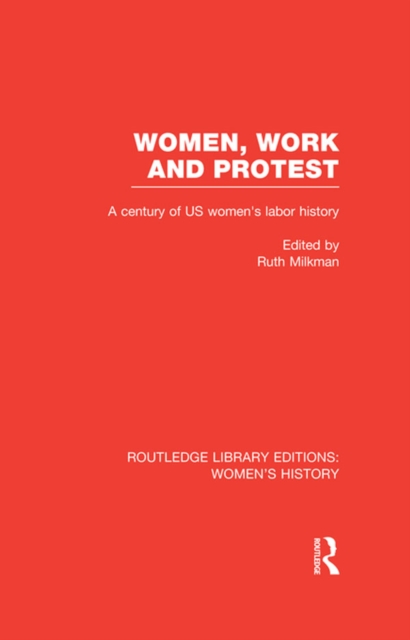
Women, Work and Protest
As paid work becomes increasingly central in women's lives, the history of their labor struggles assumes more and more importance. This volume represents the best of the new feminist scholarship in twentieth-century U.S. women's labor history. Fourteen original essays illuminate the complex relationship between gender, consciousness and working-class activism, and deepen historical understanding of the contradictory legacy of trade unionism for women workers. The contributors take up a wide range of specific subjects, and write from diverse theoretical perspectives. Some of the essays are case studies of women's participation in individual unions, organizing efforts, or strikes; others examine broader themes in women's labor history, focusing on a specific time period; and still others explore the situation of particular categories of women workers over a longer time span.
This collection extends the scope of current research and interpretation in women's labor history, both conceptually and in terms of periodization - emphasis is placed on the post-World War I period where the literature is sparse. This book will be valuable for scholars, students and general readers alike.
eBook

Not Alone
Between 1970 and 1985, lesbian, gay, and bisexual (LGB) educators publicly left their classroom closets, formed communities, and began advocating for a place of openness and safety for LGB people in America's schools.
eBook


Teachers United
This book tells the story of the rise of New York State United Teachers (NYSUT), New York State's largest union. Using first-hand accounts by rank-and-file teachers as well as leaders, Dennis Gaffney documents how teachers, once underpaid and hopelessly divided, finally organized, lifting themselves from the underclass to the middle class to become a formidable grassroots political force able to defeat and elect U.S. senators. He describes how New York's teachers sparked the modern-day teachers' movement, and what key lessons other labor unions can learn from NYSUT's unity and success. Teachers United also shows how NYSUT has been a leader of educational reform, winning more money for education, creating smaller classes, raising academic standards, and training better teachers.
eBook