
Catalogue Search | MBRL


Are you sure you want to remove the book from the shelf?

{{itemTitle}}
9
result(s) for
"Land tenure Southern States History 19th century."
Sort by:

Masterless men : poor whites and slavery in the antebellum South
\"Analyzing land policy, labor, and legal history, Keri Leigh Merritt reveals what happens to excess workers when a capitalist system is predicated on slave labor. With the rising global demand for cotton--and thus, slaves--in the 1840s and 1850s, the need for white laborers in the American South was drastically reduced, creating a large underclass who were unemployed or underemployed. These poor whites could not compete--for jobs or living wages--with profitable slave labor. Though impoverished whites were never subjected to the daily violence and degrading humiliations of racial slavery, they did suffer tangible socio-economic consequences as a result of living in a slave society. Merritt examines how these 'masterless' men and women threatened the existing Southern hierarchy and ultimately helped push Southern slaveholders toward secession and civil war\"-- Provided by publisher.
Book
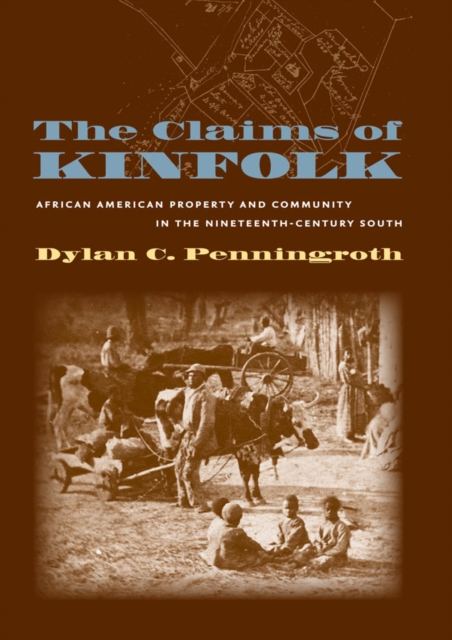
The claims of kinfolk : African American property and community in the nineteenth-century South
In The Claims of Kinfolk , Dylan Penningroth uncovers an extensive informal economy of property ownership among slaves and sheds new light on African American family and community life from the heyday of plantation slavery to the \"\"freedom generation\"\" of the 1870s. By focusing on relationships among blacks, as well as on the more familiar struggles between the races, Penningroth exposes a dynamic process of community and family definition. He also includes a comparative analysis of slavery and slave property ownership along the Gold Coast in West Africa, revealing significant differences between the African and American contexts. Property ownership was widespread among slaves across the antebellum South, as slaves seized the small opportunities for ownership permitted by their masters. While there was no legal framework to protect or even recognize slaves' property rights, an informal system of acknowledgment recognized by both blacks and whites enabled slaves to mark the boundaries of possession. In turn, property ownership--and the negotiations it entailed--influenced and shaped kinship and community ties. Enriching common notions of slave life, Penningroth reveals how property ownership engendered conflict as well as solidarity within black families and communities. Moreover, he demonstrates that property had less to do with individual legal rights than with constantly negotiated, extralegal social ties. |Penningroth uncovers an extensive informal economy of property ownership among slaves during the antebellum and post emancipation periods, connecting slaves' economic activity with their social relationships and family and community life. Includes a comparative analysis of slavery and slave property ownership along the Gold Coast in West Africa.
eBook


Common land, wine and the French Revolution
Recent revisionist history has questioned the degree of social and economic change attributable to the French Revolution. Some historians have also claimed that the Revolution was primarily an urban affair with little relevance to the rural masses. This book tests these ideas by examining the Revolutionary, Napoleonic and Restoration attempts to transform the tenure of communal land in one region of southern France; the department of the Gard. By analysing the results of the legislative attempts to privatize common land, this study highlights how the Revolution's agrarian policy profoundly affected French rural society and the economy. Not only did some members of the rural community, mainly small-holding peasants, increase their land holdings, but certain sectors of agriculture were also transformed; these findings shed light on the growth in viticulture in the south of France before the monocultural revolution of the 1850s. The privatization of common land, alongside the abolition of feudalism and the transformation of judicial institutions, were key aspects of the Revolution in the countryside. This detailed study demonstrates that the legislative process was not a top-down procedure, but an interaction between a state and its citizens. It is an important contribution to the new social history of the French Revolution and will appeal to economic and social historians, as well as historical geographers.
eBook

Settler colonialism and land rights in South Africa : possession and dispossession on the Orange River
This local history of Griqua Philippolis (1824-1862) and Afrikaner Orania (1990-2013) gets at the crux of the ever-pertinent land question in South Africa. Identifying the many layers of dispossession definitive of the South African past, the book presents a provocative new argument about land rights and the residues of settler colonialism.
eBook

The Plantation
A rare classic in American social science, Edgar Thompson's 1932 University of Chicago dissertation, \"The Plantation,\" broke new analytic ground in the study of the southern plantation system. Thompson refuted long-espoused climatic theories of the origins of plantation societies and offered instead a richly nuanced understanding of the links between plantation culture, the global history of capitalism, and the political and economic contexts of hierarchical social classification. This first complete publication of Thompson's study makes available to modern readers one of the earliest attempts to reinterpret the history of the American South as an integral part of global processes. In this Southern Classics edition, editors Sidney W. Minz and George Baca provide a thorough introduction explicating Thompson's guiding principles and grounding his germinal work in its historical context. Thompson viewed the plantation as a political institution in which the quasi-industrial production of agricultural staples abroad through race-making labor systems solidified and advanced European state power. His interpretation marks a turning point in the scientific study of an ancient agricultural institution, in which the plantation is seen as a pioneering instrument for the expansion of the global economy. Further, his awareness of the far-reaching history of economic globalization and of the conception of race as socially constructed predicts viewpoints that have since become standard. As such, this overlooked gem in American intellectual history is still deeply relevant for ongoing research and debate in social, economic, and political history.
eBook

Indigenous communities and settler colonialism : land holding, loss and survival in an interconnected world
The new world created through Anglophone emigration in the 19th century has been much studied. But there have been few accounts of what this meant for the Indigenous populations. This book shows that Indigenous communities tenaciously held land in the midst of dispossession, whilst becoming interconnected through their struggles to do so.
eBook

Commercializing chemical warfare: citrus, cyanide, and an endless war
Astonishing changes have occurred to agricultural production systems since WWII. As such, many people tend to date the origins of industrial chemical agricultural to the early 1940s. The origins of industrial chemical agriculture, however, both on and off the field, have a much longer history. Indeed, industrial agriculture’s much discussed chemical dependency—in particular its need for toxic chemicals—and the development of the industries that feed this fix, have a long and diverse past that extend well back into the nineteenth century. In this paper, through the narrative of a late nineteenth century creation story, I go in search of a crucial linchpin in that longer history. I argue that industrial pest control has been imbued with the practices, discourse, materials, and ethics of modern chemical warfare since its inception. Faced with pest-induced collapse, Los Angeles citrus growers and scientists of the USDA and UC Agricultural Extension chemically fixed the citrus pest problem by developing and utilizing the cyanide gas chamber. Cyanide fumigation quickly became the toxic cornerstone of the citrus industry, enabling its intensification and expansion as the pest infection became systemic. By the turn the century, furnished with an economic poison made cheap and weapons-grade due to changes in the world gold mining industry, growers transformed cyanide fumigation into a necessary agricultural input. In chemically overriding an agro-ecological contradiction of capitalist agriculture, growers, scientists, and government officials amalgamated industrially organized agriculture to accelerating and endless chemical warfare. These suddenly necessary agricultural practices signaled a state change in world-ecology and agroindustrial organization, thus, the discovery of effective industrial control for citrus pests was not only a pivotal moment in the history of Southern California but it was also an event that has had world-historical implications.
Journal Article

White farms, black labor: the state and agrarian change in Southern Africa, 1910-1950
Two collections of essays by historians and historical geographers enrich this argument by focusing on struggles that took place in less visible sectors of the economy, nooks and crannies where African workers tended to be even more exploited and vulnerable than in the mines. Liquor and Labor, first, contains fifteen chapters covering much of the region, from the Zambian Copperbelt to the vineyards of the Cape to South Africa's giant urban centres. They range in time from 1658, when the Dutch governor at Cape Town recommended a daily glass of brandy to \"animate\" slaves toward Christianity, up to the 1980s, when giant corporations wiped out small-scale brewers with their mass-produced cartons of sorghum beer. The principal focus lies in the period from the turn of the 19th century to the early 1960s, when struggles to capture a cheap African labour force were most intense. The authors analyze both the changing ways that capital sought to use alcohol to capture and control its work force, and the protean ways that Africans resisted those controls. The role of liquor in southern African society, and in particular its ability to crystallize early resistance to the state by African women, has been the theme of several important studies. The essays here build on these works and comparative studies from elsewhere -- the introduction by Ambler and Jeeves has 180 footnotes. They also show how the startling diversity of policies toward alcohol can be linked to struggles between different groups of capitalists. Given the particular nature of coal mining in Natal, for example, mine owners tended to favour a system where their workers were \"stabilized\" by running up debts for drinking in company-owned canteens (Ruth Edgecombe). In Johannesburg, however, where mine owners found 15-20 per cent of their workers incapacitated by alcohol each day, there were early attempts to impose total prohibition (Julie Baker). At the Cape, poorer farmers clung to the ancient \"tot system\" (two quarts of reject wine per day in lieu of cash) long after more capitalized farmers sought to modernize (Pamela Scully). African drinking traditions also evolved over time reflecting class and generational conflict over who controlled mine workers' incomes (Patrick McAllister). One consistent theme of the various chapters is that pre-industrial forms of agricultural practice may have been exploitative and violent but they did give Africans room to negotiate for tolerable working conditions. These practices began to be replaced by more modern relations of production in the post-World War I era. Labour tenancy was phased out and migrant labour compounds modelled on the mines were phased in. Fully proletarianized farm workers were then exposed to ever harsher working and living conditions. At the heart of South Africa's most productive maize-growing area in the 1940s, to illustrate, Martin Murray cites a labour inspector who found that 75 per cent of all workers bore scars from beatings at work. Charles Mather shows how \"progressive\" farmers reduced costs by paying wages but deducting spurious fines. Hostels in Natal are directly implicated in the malaria epidemics of the late 1920s (Alan Jeeves). In 1928-29, for example, an estimated 3,000 African workers died of malaria on the sugar plantations (William Beinart).
Book Review