
Catalogue Search | MBRL


Are you sure you want to remove the book from the shelf?

{{itemTitle}}
1,250
result(s) for
"Land use, Rural Case studies."
Sort by:

Farmland preservation : land for future generations
\"As land is lost to urban sprawl and other non-farm activity, our ability to produce food is diminished and options for future food production are limited. Farmland preservation speaks to the need to preserve the agricultural land base for future generations. The need for protection is driven by uncertainty caused by climate change, population growth, food security, energy availability, and other local and global factors. This uncertainty means that there is an ever-growing responsibility to ensure that the actions of today do not compromise the needs of future generations. This second edition of \"Farmland Preservation\" provides a range of views and case studies from across Canada, the United States, and beyond. Its fourteen essays are intended to help the reader understand the importance of the issue and the potential for applying new approaches to agricultural protection, policy tools, and initiatives.\"-- Provided by publisher.
Book
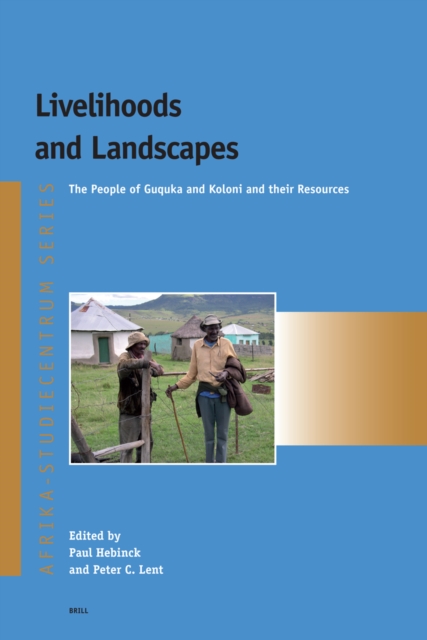
Livelihoods and Landscapes
Focussing on the past history and present day life of the people in two villages in the central Eastern Cape, South Africa, the book provides a vivid but detailed and insightful account of the transformation of rural society and economy since colonisation.
eBook

Investing in nature : case studies of land conservation in collaboration with business
In 2004, U.S.consumers spent 5.2 billion purchasing bottled water while the government only invested 5 percent of that amount to purchase critical watersheds, parks, and wildlife refuges-systems vital to clean water and healthy environments.How can we reverse the direction of such powerful economic forces?.
eBook

Creating a modern countryside
No detailed description available for \"Creating a Modern Countryside\".
eBook

Land Use Change in Tropical Watersheds
This book studies land use change in tropical landscapes, with particular emphasis on the economic processes that influence rates of land degradation and forest clearing. Multidisciplinary contributions draw lessons from a rich, decade-long collection of economic, social, and environmental data on the Manupali upland watershed in the southern Philippines.
eBook

Creating a Modern Countryside
Intro -- Contents -- List of Illustrations -- Foreword: Soldiers' Fields -- Acknowledgments -- A Note on Terminology and Units of Measure -- Introduction -- PART 1: A MODERN COUNTRYSIDE -- 1 Liberalism and the Land -- 2 Soldiers, Science, and an Alternative Modernity -- PART 2: WHERE APPLES GROW BEST -- 3 Stump Farms: Soldier Settlement at Merville -- 4 Creating Order at Sumas -- 5 Achieving the Modern Countryside -- PART 3: BACK TO WORK -- 6 Pattullo's New Deal -- Conclusion -- Appendix -- Notes -- Bibliography -- Index -- A -- B -- C -- D -- E -- F -- G -- H -- I -- J -- K -- L -- M -- N -- O -- P -- Q -- R -- S -- T -- U -- V -- W -- Y.
eBook


Institutional change and diversity in the transfer of land development rights in China
Rapid urbanisation in China has led to a substantial decrease in agricultural land. To address this unsustainable form of urban development, the Chinese government has implemented the ‘Linkage’ Policy (Zengjian Guagou), which requires any increase in new urban land by local governments to be compensated for with an equivalent amount of new arable land. This paper examines the institutional changes and the implications for China’s land production and development arising from this mechanism of transferring land development rights from the rural to the urban sectors. Using Chengdu as a case study, our research concludes that this institutional mechanism has conferred commodified and tradeable development rights on rural land, leading to the emergence and direct involvement of new players in village land consolidation, resettlement of affected villagers and, indirectly, in the supply of new urban land. Process efficiency has been improved with the local governments, developers and village collectives capitalising on their niches in village improvement projects. The conventional state-led model of land production is enriched with bottom-up market initiatives, and villagers have more choices to realise their land property rights under the dual land market. Land use efficiency has been enhanced by the reallocation of construction land potential. However, infringements of villagers’ interests and negative impacts on balanced regional development under this policy were also found.
中国城市化的快速发展导致了农业用地的大幅减少。为了应对这种不可持续的城市发展形式,中国政府实施了“增减挂钩”政策,它要求地方政府在增加新城市土地的同时用同等数量的新耕地进行补偿。本文考察了这种土地发展权从农村向城市转移的机制,以及该制度变迁对中国土地生产和开发所产生的影响。以成都为例,我们的研究得出以下结论:这种制度设计赋予了农村土地商品化的、可交易的发展权,致使新的参与者出现并直接参与乡村土地整理、受影响村民的重新安置,并使他们间接参与到新的城市土地供应中。地方政府、开发商和村集体利用其各自在村庄发展项目中的优势提高了过程效率。传统的国家主导型土地生产模式因融合了自下而上的市场主动性而更为丰富,村民在二元土地市场下拥有了更多的选择以实现其土地产权。通过重新分配建设用地潜力,土地利用效率也得以提高。然而,在这一政策下,也出现了侵犯村民利益的现象和对区域均衡发展所产生的负面影响。
Journal Article

Research on the Interaction Mechanism between Land System Reform and Rural Population Flow: Europe (Taking Spain as an Example) and China
This paper examines the interaction between land policies and rural labor migration in China and Europe, highlighting how land reforms guide labor mobility and their impacts on land and social structures. In China, the Household Contract Responsibility System and land transfer policies have facilitated agricultural scale expansion and the urbanization of the rural labor force. Homestead reforms have further enhanced farmers’ asset liquidity. In Europe, using Spain as a case study, EU agricultural policies have spurred agricultural modernization, economic diversification, and intensive land use. These advancements benefitted from a mature land transfer market and increased non-agricultural employment opportunities. Both China and Europe face challenges of population aging and rural depopulation, necessitating improvements in land use efficiency, the balance of the scale, and the protection of farmers’ rights and interests. Europe addresses labor shortages through technology, mechanization, and cooperatives, while China employs land trusteeship, transfer platforms, and the “three rights separation” system to combat land abandonment and labor shortages. Future research should strengthen comparative studies between China and Europe, quantify interactive relationships, consider the impact of transnational labor mobility under globalization, explore policy innovations, and foster international cooperation to address demographic changes and agricultural labor shortages. Additionally, promoting sustainable land use and farmers’ rights, equalizing urban–rural public services, enhancing education and training, and improving the social security system are crucial for integrated urban–rural development.
Journal Article

Spatial Forecasting of the Landscape in Rapidly Urbanizing Hill Stations of South Asia: A Case Study of Nuwara Eliya, Sri Lanka (1996–2037)
Forecasting landscape changes is vital for developing and implementing sustainable urban planning. Presently, apart from lowland coastal cities, mountain cities (i.e., hill stations) are also facing the negative impacts of rapid urbanization due to their economic and social importance. However, few studies are addressing urban landscape changes in hill stations in Asia. This study aims to examine and forecast landscape changes in the rapidly urbanizing hill station of Nuwara Eliya, Sri Lanka. Landsat data and geospatial techniques including support vector machines, urban–rural gradient, and statistical analysis were used to map and examine the land use/land cover (LULC) change in Nuwara Eliya during the 1996–2006 and 2006–2017 periods. The multilayer perceptron neural network-Markov model was applied to simulate future LULC changes for 2027 and 2037. The results show that Nuwara Eliya has been directly affected by rapid urban development. During the past 21 years (1996–2017), built-up areas increased by 1791 ha while agricultural land declined by 1919 ha due to augmented urban development pressure. The pressure of urban development on forest land has been relatively low, mainly due to strict conservation government policies. The results further show that the observed landscape changes will continue in a similar pattern in the future, confirming a significant increase and decrease of built-up and agricultural land, respectively, from 2017 to 2037. The changes in agricultural land exhibit a strong negative relationship with the changes in built-up land along the urban–rural gradient (R2 were 0.86 in 1996–2006, and 0.93 in 2006–2017, respectively). The observed LULC changes could negatively affect the production of unique upcountry agricultural products such as exotic vegetables, fruits, cut flowers, and world-famous Ceylon tea. Further, unplanned development could cause several environmental issues. The study is important for understanding future LULC changes and suggesting necessary remedial measures to minimize possible undesirable environmental and socioeconomic impacts.
Journal Article