
Catalogue Search | MBRL


Are you sure you want to remove the book from the shelf?

{{itemTitle}}
16,069
result(s) for
"Language Ideology"
Sort by:


Pride, prejudice and pragmatism: family language policies in the UK
In this study, we examine how mobility and on-going changes in sociocultural contexts impact family language policy (FLP) in the UK. Using a questionnaire and involving 470 transnational families across the UK, our study provides a descriptive analysis of different family language practices in England and establishes how attitudes influence the different types of FLP in these families. Complementing the descriptive analysis, we use interview data to understand the driving forces behind the different types of language practices and language management activities, and explore how ideological constructs of ‘pride’, ‘prejudice’ and ‘pragmatism’ are directly related to negative or positive attitudes towards the development of children’s heritage language. The findings indicate that migration trajectories, social values, raciolinguistic policing in schools, and linguistic loyalty have shaped family decisions about what languages to keep and what languages to let go. Our paper responds to the linguistic and demographic changes in British society, and makes an important contribution to our knowledge about multilingual development of children in transnational families. Critically, this study shows that FLPs alone cannot save the minority languages; institutionally sanctioned language practices and ideologies have to make a move from limiting the use of these languages in educational contexts to legitimising them as what they are: linguistic resources and languages of pride.
Journal Article


English-medium instruction in Chinese higher education
With the relentless internationalization and marketization of higher education in the past decades, English has been increasingly adopted as a medium of instruction at universities across the world. Recent research, however, has shown that despite its various optimistically envisioned goals, English-medium instruction (EMI) is not without problems in practice. This article reports a case study of an EMI Business Administration program for undergraduate students at a major university of finance and economy in mainland China. Informed by Spolsky's language policy framework, the study made a critical analysis of national/institutional policy statements and interviews with professors and students to uncover EMI-related language ideologies, language practices, and language management mechanisms. Findings evinced a complex interplay of these three constitutive components of language policy in the focal EMI program and revealed considerable misalignment between policy intentions and actual practices in the classroom. These findings raise concerns about the quality and consequences of EMI in Chinese higher education. The article concludes with recommendations for further research on EMI policies and practices in China. (HRK / Abstract übernommen).
Journal Article


Redrawing the margins of language: Lessons from research on ideophones
Ideophones (also known as expressives, mimetics or onomatopoeia) have been systematically studied in linguistics since the 1850s, when they were first described as a lexical class of vivid sensory words in West-African languages. This paper surveys the research history of ideophones, from its roots in African linguistics to its fruits in language description and linguistic theory around the globe. It shows that despite a recurrent narrative of marginalization, scholars working on ideophones have made important advances in our understanding of sensory language, iconicity, lexical typology, and morphosyntax. Due to their dual nature as vocal gestures that grow roots in linguistic systems, ideophones provide opportunities to reframe typological questions, reconsider the role of language ideology in linguistic scholarship, and rethink the margins of language. With ideophones increasingly being brought into the fold of the language sciences, this review synthesizes past theoretical insights and empirical findings in order to enable future work to build on them.
Journal Article
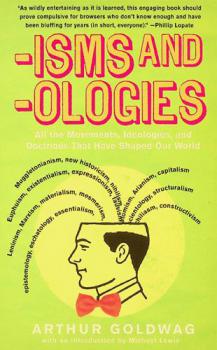
'Isms & 'ologies : all the movements, ideologies, & doctrines that have shaped our world
'Isms and 'Ologies : A Comprehensive Guide to the Schisms, Schools, Movements, and Ideologies You Need to Know to Survive at College or a Cocktail Party.
Book

“She does have an accent but…”: Race and language ideology in students' evaluations of mathematics instructors on RateMyProfessors.com
Nonnative English speakers (NNESs) who teach at English-medium institutions in the United States (US) have frequently been the subject of student complaints. Research into language ideologies concerning NNESs in the US suggests that such complaints can be understood as manifestations of a broader project of social exclusion operating, in part, through the ideological construction of the NNES as incomprehensible Other. The present study explores the extent to which such ideological presuppositions and exaggerative performances are observable in students' evaluations of ‘Asian’ mathematics instructors on the website RateMyProfessors.com (RMP). A mixed methodological approach combining statistical analysis of numeric RMP ratings, quantitative corpus linguistic techniques, and critical discourse analysis was employed. Findings confirm the presence of disadvantages related to ‘Asian’ instructors' race and language. However, RMP users' discourse is shown to be less overtly discriminatory and instead to reproduce dominant language ideology in subtle, previously undescribed ways.(Student evaluations, higher education, university teaching, nonnative speakers, second language users, ethnicity, critical discourse analysis, corpus linguistics, formulaic language)*
Journal Article

Discourse, grammar and ideology : functional and cognitive perspectives
\"Researchers in Critical Discourse Analysis (CDA) have often pointed to grammar as a locus of ideology in discourse. This book illustrates the role that grammars as models of language (and image) can play in revealing ideological properties of texts and discourse in social and political contexts. The book takes the reader through three distinct grammatical frameworks - functional grammar, multimodal grammar and cognitive grammar. Using examples taken from a range of discourses relating to globalisation, including discourses of immigration, war, corporate practice and political protests, the book demonstrates the individual utility and the interconnectedness of these models inside CDA. A key argument advanced is that the cognitive processes necessarily involved in making sense of language are based in visual experience. This position offers new ways of understanding the ideological effects of grammatical choices in texts and suggests a reassessment of the relationship between linguistic and multimodal grammars in CDA. The book will appeal to students and researchers interested in CDA and the relationship between discourse, cognition and social action\"-- Provided by publisher.
Book
“This migrants’ babble is not a German dialect!”: The interaction of standard language ideology and ‘us’/‘them’ dichotomies in the public discourse on a multiethnolect
This article investigates a public debate in Germany that put a special spotlight on the interaction of standard language ideologies with social dichotomies, centering on the question of whether Kiezdeutsch, a new way of speaking in multilingual urban neighbourhoods, is a legitimate German dialect. Based on a corpus of emails and postings to media websites, I analyse central topoi in this debate and an underlying narrative on language and identity. Central elements of this narrative are claims of cultural elevation and cultural unity for an idealised standard language ‘High German’, a view of German dialects as part of a national folk culture, and the construction of an exclusive in-group of ‘German’ speakers who own this language and its dialects. The narrative provides a potent conceptual frame for the Othering of Kiezdeutsch and its speakers, and for the projection of social and sometimes racist deliminations onto the linguistic plane. (Standard language ideology, Kiezdeutsch, dialect, public discourse, Othering, racism by proxy)*
Journal Article