
Catalogue Search | MBRL


Are you sure you want to remove the book from the shelf?

{{itemTitle}}
20
result(s) for
"Language Use in Translation and Interpreting"
Sort by:
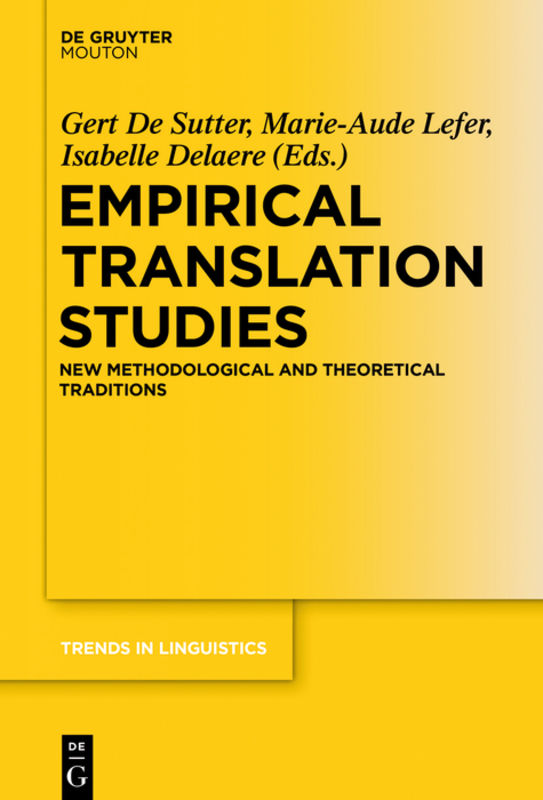
Empirical translation studies : new methodological and theoretical traditions
The present volume is devoted to the study of language use in translated texts as a function of various linguistic, contextual and cognitive factors. It contributes to the recent trend in empirical translation studies towards more methodological sophistication, including mixed methodology designs and multivariate statistical analyses, ultimately leading to a more accurate understanding of language use in translations.
eBook

A corpus-based analysis on the use of MAKE in sinologist Cyril Birch’s English version of Mistress and Maid (Jiaohongji)
While corpus-based translation studies have extensively analyzed lexical patterns, they exhibit critical theoretical limitations in integrating translation theories with empirical analysis, particularly in dramatic translation contexts where cultural mediation and audience reception intersect. Existing high-frequency verb research lacks systematic analysis of how individual lexical choices serve multiple simultaneous function—linguistic, cultural, and theatrical—in cross-cultural dramatic translation. This study addresses these gaps through integrated corpus-translation theory analysis of MAKE deployment in Cyril Birch’s English translation of Mistress and Maid (Jiaohongji) , a classical Chinese chuanqi play. Using AntConc 4.1.1 for corpus analysis (158 MAKE instances from 86,047-word corpus) combined with systematic cultural context examination, the research investigates how high-frequency verbs function as cultural bridging mechanisms. Methodological limitations include single-translator focus and potential genre-specific constraints. Analysis reveals five systematic functional categories: delexical verb constructions facilitating cultural concept transfer, causative verb patterns in bridging metaphorical traditions, notional verb usage in supporting plot development, linking constructions creating thematic resonance, and phrasal verb constructions in emotional expression. These patterns demonstrate that high-frequency verb deployment serves strategic cultural mediation functions beyond simple linguistic substitution. Theoretical Contributions: the study validates and refines the application translation universals in dramatic contexts, demonstrating how simplification and explicitation operate through systematic high-frequency verb deployment. It integrates descriptive translation studies with cultural mediation theory, revealing how micro-level lexical choices serve macro-level intercultural communication goals while challenging corpus linguistics’ purely quantitative approaches to translation analysis. Findings offer evidence-based guidance for dramatic translators regarding strategic use of high-frequency verbs to balance source-text fidelity with target-audience accessibility, particularly in contexts requiring cultural sensitivity and dramatic authenticity.
Journal Article

Nation, Language, and the Ethics of Translation
In recent years, scholarship on translation has moved well beyond the technicalities of converting one language into another and beyond conventional translation theory. With new technologies blurring distinctions between \"the original\" and its reproductions, and with globalization redefining national and cultural boundaries, \"translation\" is now emerging as a reformulated subject of lively, interdisciplinary debate. Nation, Language, and the Ethics of Translation enters the heart of this debate. It covers an exceptional range of topics, from simultaneous translation to legal theory, from the language of exile to the language of new nations, from the press to the cinema; and cultures and languages from contemporary Bengal to ancient Japan, from translations of Homer to the work of Don DeLillo.
All twenty-two essays, by leading voices including Gayatri Spivak and the late Edward Said, are provocative and persuasive. The book's four sections--\"Translation as Medium and across Media,\" \"The Ethics of Translation,\" \"Translation and Difference,\" and \"Beyond the Nation\"--together provide a comprehensive view of current thinking on nationality and translation, one that will be widely consulted for years to come.
The contributors are Jonathan E. Abel, Emily Apter, Sandra Bermann, Vilashini Cooppan, Stanley Corngold, David Damrosch, Robert Eaglestone, Stathis Gourgouris, Pierre Legrand, Jacques Lezra, Françoise Lionnet, Sylvia Molloy, Yopie Prins, Edward Said, Azade Seyhan, Gayatri Chakravorty Spivak, Henry Staten, Lawrence Venuti, Lynn Visson, Gauri Viswanathan, Samuel Weber, and Michael Wood.
eBook

The UPF learner translation corpus as a resource for translator training
The learner translation corpus developed at the School of Translation and Interpreting of Pompeu Fabra University in Barcelona is a web-searchable resource created for pedagogical and research purposes. It comprises a multiple translation corpus (English–Catalan) featuring automatic linguistic annotation and manual error annotation, complemented with an interface for monolingual or bilingual querying of the data. The corpus can be used to identify common errors in the students' work and to analyse their patterns of language use. It provides easy access to error samples and to multiple versions of the same source text sequence to be used as learning materials in various courses in the translator-training university curriculum.
Journal Article

Using electronic information resources to solve cultural translation problems
PurposeThe purpose of this paper is to investigate the use of electronic information resources to solve cultural translation problems at different stages of acquisition of the translator’s cultural competence.Design/methodology/approachA process and product-oriented, cross-sectional, quasi-experimental study was conducted with 38 students with German as a second foreign language from the four years of the Bachelor’s degree in Translation and Interpreting at Universitat Autònoma de Barcelona, and ten professional translators.FindingsTranslation students use a wider variety of resources, perform more queries and spend more time on queries than translators when solving cultural translation problems. The students’ information-seeking process is generally less efficient than that of the translators. Training has little impact on the students’ use of electronic information resources for this specific purpose, since all students use them similarly regardless of the year they are in.Research limitations/implicationsThe study has been conducted with a small sample and only one language pair from a single pedagogical context. The tendencies observed cannot be generalised to the whole population of translation students.Practical implicationsThis paper has implications for translator training, as it encourages the development of efficient information-seeking processes for the resolution of cultural translation problems.Originality/valueUnlike other studies, this paper focusses on a specific translation problem type. It provides information related to the students’ information-seeking strategies for the resolution of cultural translation problems, which can be useful for translation training.
Journal Article

On Status Quo, Problems, and Future Development of Translation and Interpreting MOOCs in China—A Mixed Methods Approach
The release of China MOOCs Action Declaration signifies the strategic role of Massive Open Online Courses (MOOCs) in China's national education. Compared with traditional face-to-face instruction, MOOCs have distinctive advantages, such as their large scale, openness, accessibility, flexibility and convenience, so they have shown great development momentum since the very beginning. However, translation and interpreting (TI) MOOCs in China have started relatively late, with limited numbers and types of courses offered and only sporadic studies, especially in-depth empirical research, on existing courses. By adopting a mixed-methods approach involving both desk research of TI MOOCs on 10 major MOOC platforms and in-depth interviews of two teachers and 10 students with TI MOOC teaching or learning experience, this study explores the status quo, problems, and future development of TI MOOCs in China. It is hoped that this paper will shed some light on the research and development (R&D), and application of TI MOOCs, as well as on reforms and innovations of TI education in China and other similar contexts.
Journal Article

Anxiety Inventory for Respiratory Disease: Cross-Cultural Adaptation and Semantic Validity of the Brazilian Version for Individuals with Chronic Obstructive Pulmonary Disease
Most instruments available to screen for anxiety in people with chronic obstructive pulmonary disease (COPD) are not disease specific. Therefore, the Anxiety Inventory for Respiratory Disease (AIR) was developed to measure anxiety for this patient group; however, it requires cross-cultural adaptation for use in non-English speaking countries.
To carry out cross-cultural adaptation of the AIR scale for Brazilian patients with COPD and to analyze its semantic validity.
This methodological study followed six stages: 1) Initial translation by two independent translators fluent in English; 2) Synthesis of translations; 3) Back translation by two English first language translators; 4) Expert committee review (eight healthcare professionals, a methodologist, the translators, and back-translators); 5) Pre-final version evaluation with 30 patients with COPD through a cognitive interview; and 6) Submission of documents. Semantic validity was analyzed by agreement rate and content validity index (CVI) for the committee equivalence assessments.
1) Initial translation: the two translated versions presented eight divergences; 2) Synthesis of translations: the differences were discussed to reach consensus; 3) Back-translation: there were no important inconsistencies; 4) Expert Committee: the experts proposed eight and the instrument developer proposed three changes, which were analyzed and voted on, resulting in the pre-final version; 5) Evaluation of the pre-final version: data collection allowed for other changes and the formulation of instructions by applying the adapted instrument in an interview format. Patients rated the questions as clear or very clear; 6) The expert committee and the developer approved the final documents. The agreement rate and CVI were ≥ 0.80 for all items of the scale final version.
The process of cross-cultural adaptation followed all necessary stages and the semantic validity results were adequate, providing the Brazilian version of the AIR to assess anxiety symptoms in patients with COPD.
Journal Article

Directionality and context effects in word translation tasks performed by conference interpreters
Professional interpreters employed by international institutions usually work into their L1 from their L2, while freelance interpreters tend to work both into and from their L1. A study was devised to see if the long-term interpreting unidirectional practice (in the L2–L1 direction only), in contrast to bidirectional practice (in the L2–L1 and L1–L2 direction), influences the speed of lexical retrieval manifested through shorter translation latencies. Forty-eight professional conference interpreters produced oral translations of nouns presented in isolation, in high context constraint sentences and in low context constraint sentences. Contrary to predictions, unidirectional interpreters did not manifest directionality asymmetry and their L2–L1 translation latencies were not shorter than L1–L2 translation latencies. Surprisingly, the L2–L1 direction advantage was found in the group of bidirectional interpreters. The data suggest that the dominant directionality in interpreting practice has little impact on the strength of interlingual lexical links in the interpreter’s mental lexicon or that other factors (such as language use, exposure and immersion) might offset any such impact. The study also revealed an expected context effect, which shows that interpreters use semantic constraint to anticipate sentence-final words.
Journal Article

German translation of the Alberta context tool and two measures of research use: methods, challenges and lessons learned
Background
Understanding the relationship between organizational context and research utilization is key to reducing the research-practice gap in health care. This is particularly true in the residential long term care (LTC) setting where relatively little work has examined the influence of context on research implementation. Reliable, valid measures and tools are a prerequisite for studying organizational context and research utilization. Few such tools exist in German. We thus translated three such tools (the Alberta Context Tool and two measures of research use) into German for use in German residential LTC. We point out challenges and strategies for their solution unique to German residential LTC, and demonstrate how resolving specific challenges in the translation of the health care aide instrument version streamlined the translation process of versions for registered nurses, allied health providers, practice specialists, and managers.
Methods
Our translation methods were based on best practices and included two independent forward translations, reconciliation of the forward translations, expert panel discussions, two independent back translations, reconciliation of the back translations, back translation review, and cognitive debriefing.
Results
We categorized the challenges in this translation process into seven categories: (1) differing professional education of Canadian and German care providers, (2) risk that German translations would become grammatically complex, (3) wordings at risk of being misunderstood, (4) phrases/idioms non-existent in German, (5) lack of corresponding German words, (6) limited comprehensibility of corresponding German words, and (7) target persons’ unfamiliarity with activities detailed in survey items. Examples of each challenge are described with strategies that we used to manage the challenge.
Conclusion
Translating an existing instrument is complex and time-consuming, but a rigorous approach is necessary to obtain instrument equivalence. Essential components were (1) involvement of and co-operation with the instrument developers and (2) expert panel discussions, including both target group and content experts. Equivalent translated instruments help researchers from different cultures to find a common language and undertake comparative research. As acceptable psychometric properties are a prerequisite for that, we are currently carrying out a study with that focus.
Journal Article

Conference interpreting as extreme language use
This issue of the International Journal of Bilingualism, which focuses on the interactions between cognitive and language processes in conference interpreters, is introduced. Adapted from the source document
Journal Article